

What the Supreme Court ruled on health care 'tax' - CNN International

Diablo

New member
120628025456-healthcare-coverage-jubilation-horizontal-gallery.jpg
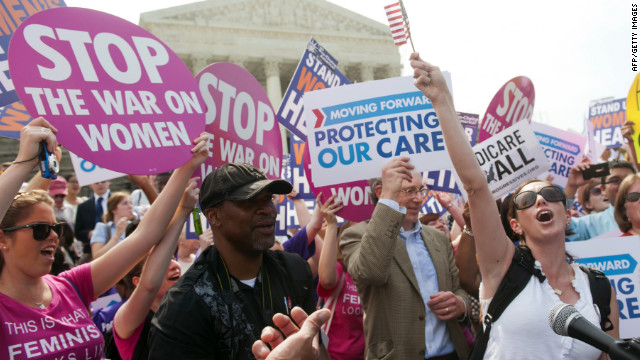
Supporters of the health care legislation celebrate after the Supreme Court upheld the constitutionality of the Patient Protection and Affordable Care Act in a 5-4 ruling Thursday, June 28.
120628031607-healthcare-coverage-supreme-court-scene-horizontal-gallery.jpg
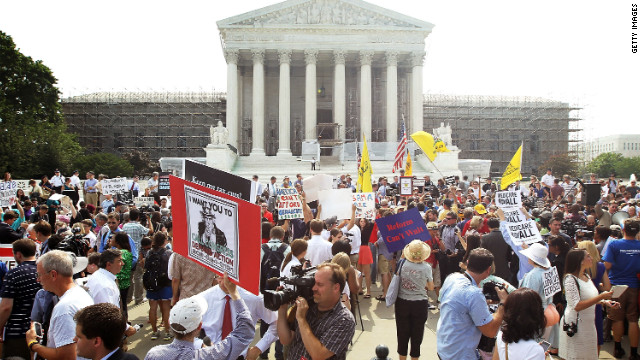
Journalists and supporters and protesters of the health care law gather outside the Supreme Court after the justices ruled in favor of its constitutionality in a narrow decision.
120628012208-healthcare-coverage-supreme-court-1-horizontal-gallery.jpg
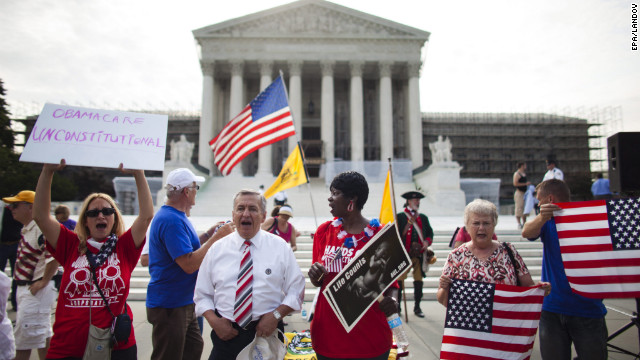
Protesters against the health care law rally outside the Supreme Court before the justices issue their ruling Thursday.
120628115631-healthcare-coverage-media-horizontal-gallery.jpg
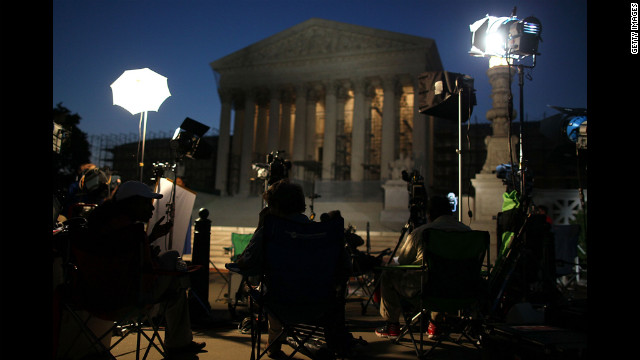
Reporters and camera crews begin waiting early Thursday outside the Supreme Court in anticipation of the court's health care ruling.
120626080528-healthcare-3a-horizontal-gallery.jpg
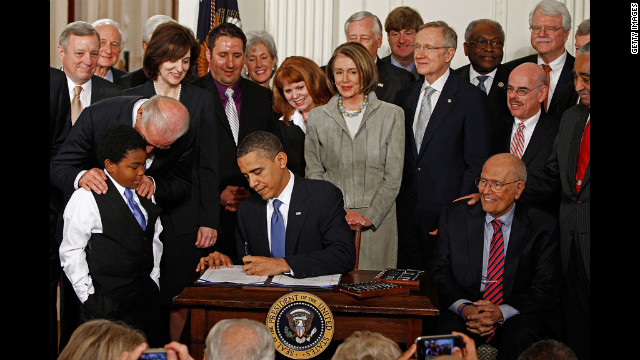
President Barack Obama signs the health care legislation in a March 23, 2010, ceremony with Democrats in the White House East Room. The law, which critics dubbed Obamacare, is Obama's signature legislation.
120626060118-healthcare-1-horizontal-gallery.jpg
The constitutionality of the 2,409-page act was challenged by 26 states. The most controversial aspect of the law -- the "individual mandate" -- would require individuals not covered by insurance via their employer or the government to purchase and maintain minimal health insurance or pay a penalty.
120626060058-healthcare-6-horizontal-gallery.jpg
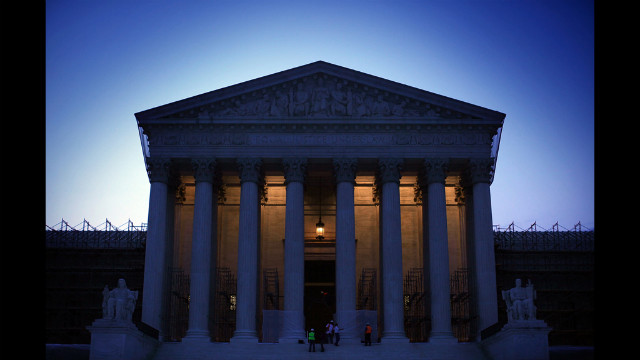
The Supreme Court held three days of politically charged hearings in March on the Affordable Care Act.
120626060110-healthcare-3-horizontal-gallery.jpg
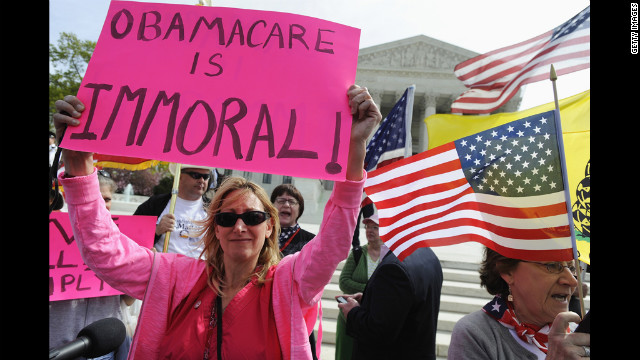
Opponents of Obama's health care legislation protest in front of the Supreme Court on March 28. Critics argued the law's requirement that most Americans have health insurance or pay a fine was an unconstitutional intrusion on individual freedom.
120626074016-healthcare-2a-horizontal-gallery.jpg
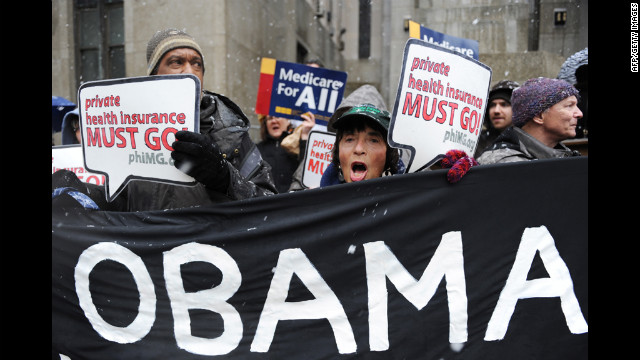
Advocates for universal, government-financed health care carry signs one month before the health care overhaul was signed into law.
120626060102-healthcare-5-horizontal-gallery.jpg
Two years after Obama signed the health care legislation, the Supreme Court took up the historic test of whether it's constitutional.
120626081532-healthcare-7a-horizontal-gallery.jpg
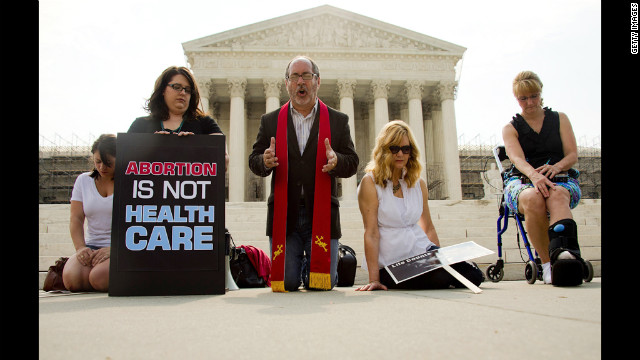
The Rev. Patrick Mahoney leads demonstrators in prayer outside the Supreme Court on Monday, June 25, as they await the court's ruling.
120626060053-healthcare-8-horizontal-gallery.jpg
The high court upheld the law's central provision -- a requirement that all people have health insurance. The decision will have an immediate and long-term impact on all Americans, both in how they get medicine and health care.


120628025456-healthcare-coverage-jubilation-topics.jpg

1
120628031607-healthcare-coverage-supreme-court-scene-topics.jpg

2
120628012208-healthcare-coverage-supreme-court-1-topics.jpg

3
120628115631-healthcare-coverage-media-topics.jpg

4
120626080528-healthcare-3a-topics.jpg

5
120626060118-healthcare-1-topics.jpg

6
120626060058-healthcare-6-topics.jpg

7
120626060110-healthcare-3-topics.jpg

8
120626074016-healthcare-2a-topics.jpg

9
120626060102-healthcare-5-topics.jpg

10
120626081532-healthcare-7a-topics.jpg

11
120626060053-healthcare-8-topics.jpg

12


  • The Supreme Court rejected arguments that the individual mandate involves a "penalty"
  • The mandate "looks like a tax in many respects," Chief Justice John Roberts wrote
  • The Obama administration argued that it's a penalty but also could be viewed as a tax
  • The court said the Anti-Injunction Act does not apply


(CNN) -- In its ruling last week on the national health care law, the Supreme Court found that penalties the law places on people who don't buy health insurance count as a tax protected by the Constitution.
The Obama administration had argued that the fees should be considered a penalty. But the government also argued that the individual mandate can be viewed as constitutional under Congress' powers of taxation.
The high court rejected the "penalty" argument.
"The payment is not so high that there is really no choice but to buy health insurance; the payment is not limited to willful violations, as penalties for unlawful acts often are; and the payment is collected solely by the (Internal Revenue Service) through the normal means of taxation," Chief Justice John Roberts wrote in the decision.
The court noted that the law calls for no other punishments for refusal to buy health insurance.
bttn_close.gif

120705024848-point-romney-tax-problem-00002607-story-body.jpg
Romney, Obama's tax vs. penalty problem
bttn_close.gif

120702102414-exp-tsr-wasserman-schultz-tax-00002001-story-body.jpg
Is health care mandate a tax... or not?
bttn_close.gif

120629032639-ac-kth-health-care-mandate-tax-00004223-story-body.jpg
Obama said mandate isn't tax in 2009
"Indeed, it is estimated that four million people each year will choose to pay the IRS rather than buy insurance," the decision said, citing figures from the Congressional Budget Office. "We would expect Congress to be troubled by that prospect if such conduct were unlawful."
But on the taxation argument, the court agreed. The Constitution allows Congress to tax and spend, giving the federal government "considerable influence even in areas where it cannot directly regulate," the decision said.
The mandate "looks like a tax in many respects," Roberts wrote. The money is to be paid by people when they file their tax returns and does not apply to those who pay no federal income taxes; the amount someone owes "is determined by such familiar factors as taxable income, number of dependents, and joint filing status," and the "requirement to pay is found in the Internal Revenue Code and enforced by the IRS."
The high court overturned a unanimous decision by the 11th U.S. Circuit Court of Appeals that the mandate did not impose a tax.
The Supreme Court also ruled that it could proceed with considering the constitutionality of the tax despite the Anti-Injunction Act, which dates back 145 years. The law said lawsuits can't be used to prevent taxing, only to get refunded for taxes already paid. The high court said whether something is a tax for the purposes of the Anti-Injunction Act is Congress' decision -- and since Congress designated the mandate as including a penalty rather than a tax, the law did not apply in this case.
"It is up to Congress whether to apply the Anti-Injunction Act to any particular statute, so it makes sense to be guided by Congress's choice of label on that question. That choice does not, however, control whether an exaction is within Congress's constitutional power to tax."
The court emphasized that it was not weighing in on whether the mandate is a good idea.
"Because the Constitution permits such a tax, it is not our role to forbid it, or to pass upon its wisdom or fairness," the decision said.

p-89EKCgBk8MZdE.gif
 
Back
Top