
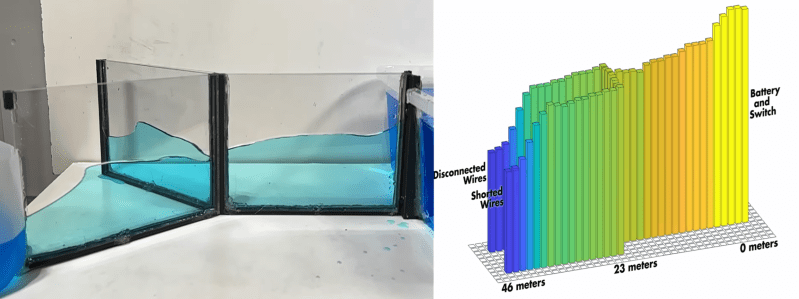
It’s one thing to learn about transmission lines in theory, and quite another to watch a voltage pulse bounce off an open connector. [Alpha Phoenix] bridges the gap between knowledge and understanding in the excellent videos after the break. With a simple circuit, he uses an oscilloscope to visualize the propagation of electricity, showing us exactly how signals travel, reflect, and interfere.
The experiment relies on a twisted-pair Y-harness, where one leg is left open and the other is terminated by a resistor. By stitching together oscilloscope traces captured at regular intervals along the wire, [Alpha Phoenix] constructs a visualization of the voltage pulse propagating. To make this intuitive, [Alpha Phoenix] built a water model of the same circuit with acrylic channels, and the visual result is almost identical to the electrical traces.
For those who dabble in the dark art of RF and radio, the real payoff is the demonstration of impedance matching in the second video. He swaps resistors on the terminated leg to show how energy “sloshes” back when the resistance is too high or too low. However, when the resistor matches the line’s characteristic impedance, the reflection vanishes entirely—the energy is perfectly dissipated. It really makes it click how a well-matched, low SWR antenna is crucial for performance and protecting your radio.
[Alpha Phoenix] is a genius at making physics visible. He even managed “film” a laser beam traveling at light speed.