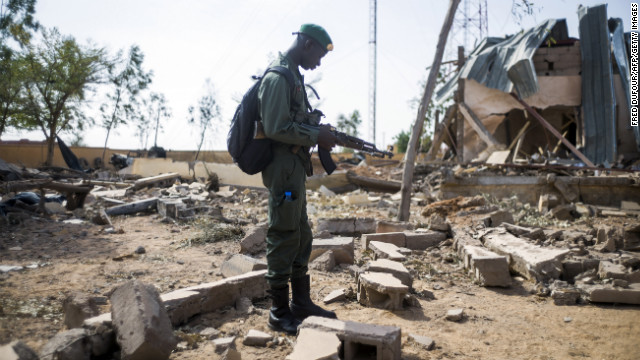
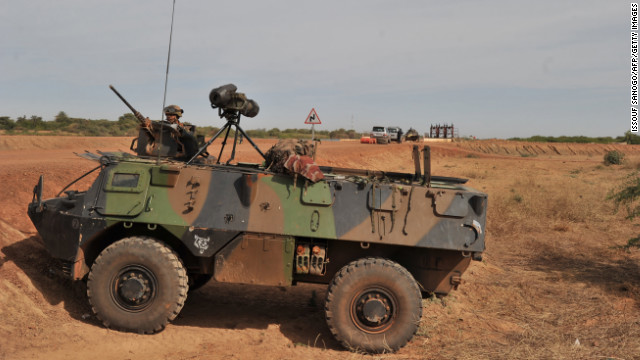
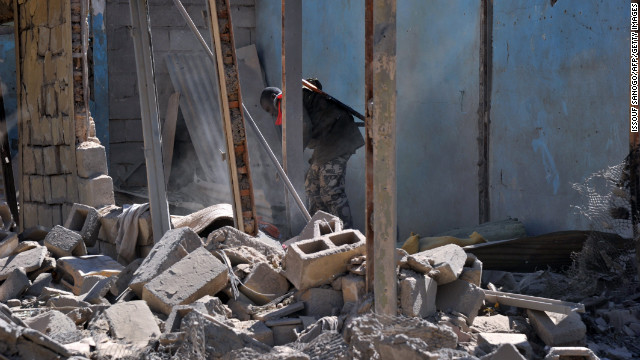
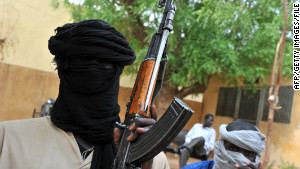
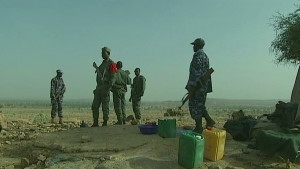
A Malian soldier stands amid debris Saturday, January 26, in the key central town of Konna, which has been under French and Malian army control since last week. It was taken on January 11 by Islamist groups.
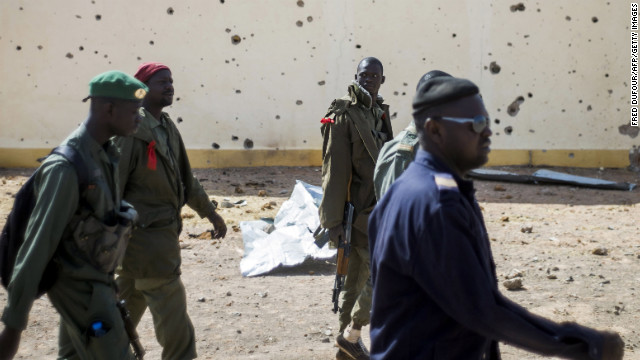
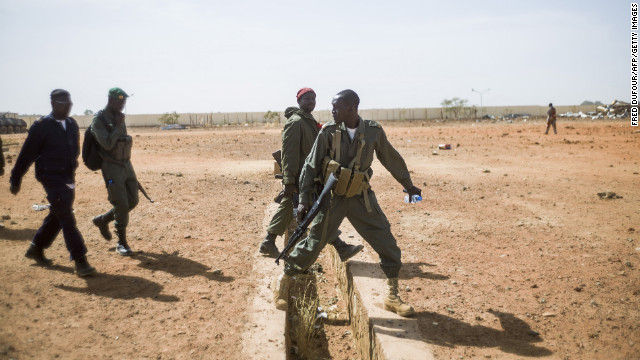
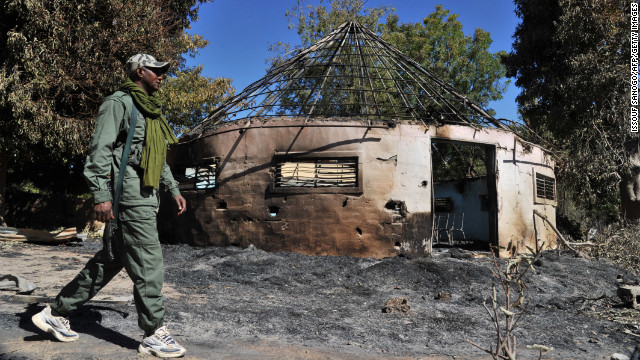
Malian soldiers walk past the bullet-riddled wall of a house in Konna on Saturday, January 26.
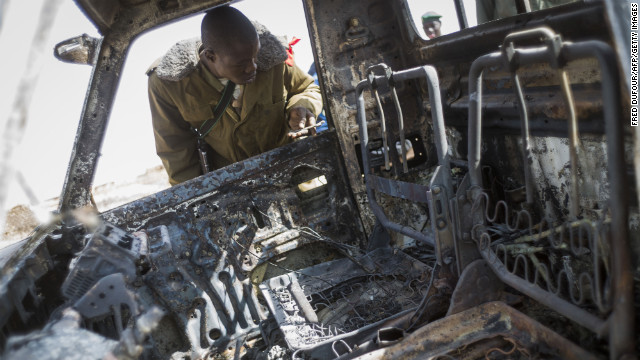
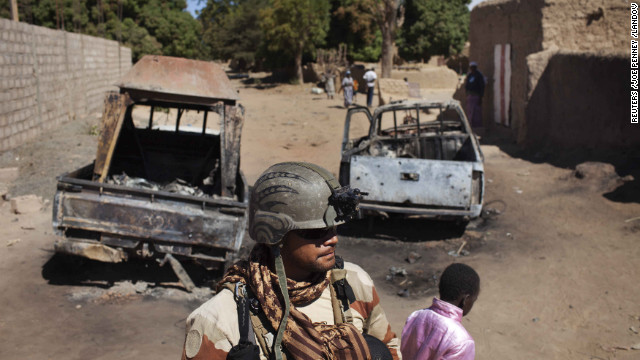
A Malian soldier looks at the wreckage of an Islamist rebel's armed pickup truck in Konna.
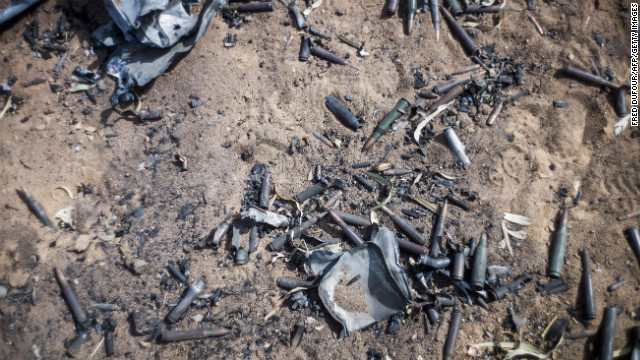
Ammunition lies on the ground in Konna.
Malian soldiers escort journalists in Konna.
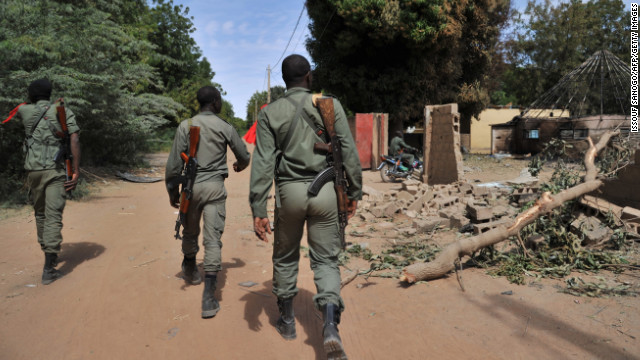
Malian soldiers patrol a street of Diabaly on January 26.
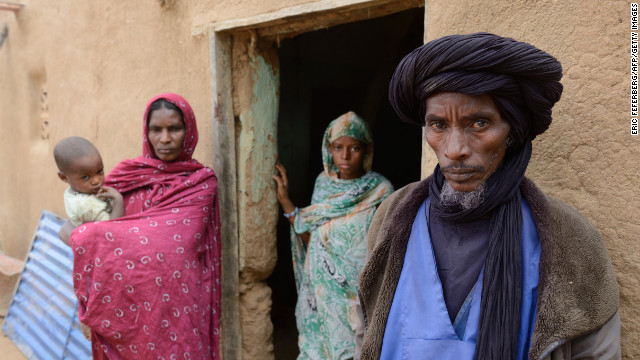
Ali Ag Noh, right, stands with his family in front of his house on Friday, Janurary 25, in the village of Seribala, Mali, after his cousin and brother-in-law, Aboubakrim Ag Mohamed, and a cattle rancher, Samba Dicko, were shot dead on January 24, allegedly by the Malian Army. According to Noh, Mohamed, a Tuareg, and Dicko were shot in the head in Seribala after being accused by two Malian soldiers of being Islamists or aiding Islamists.
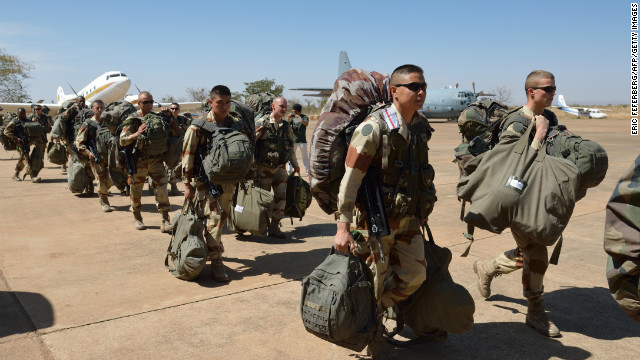
Members of the French army arrive at a base camp in Sevare, Mali, on January 25. French and Malian troops advanced on the key Islamist stronghold of Gao after recapturing the northern town of Hombori as the extremists bombed a strategic bridge to thwart a new front planned in the east.
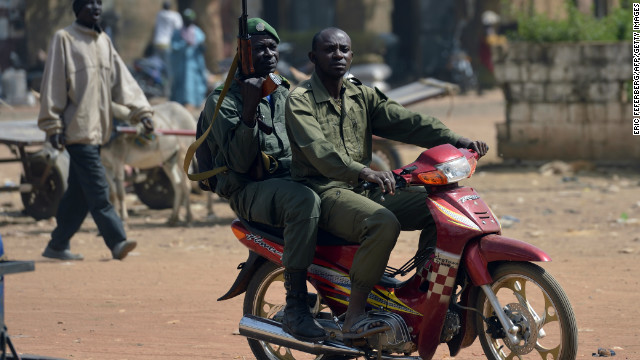
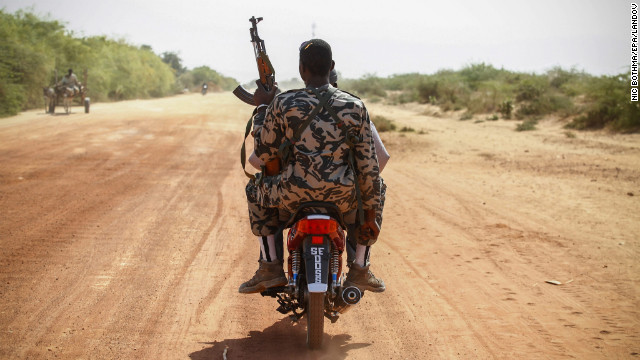
Malian soldiers ride a motorcycle in a street of Merkala, on Thursday, January 24, 2013 as the first of the 6,000 troops pledged by African nations to support France started heading north.
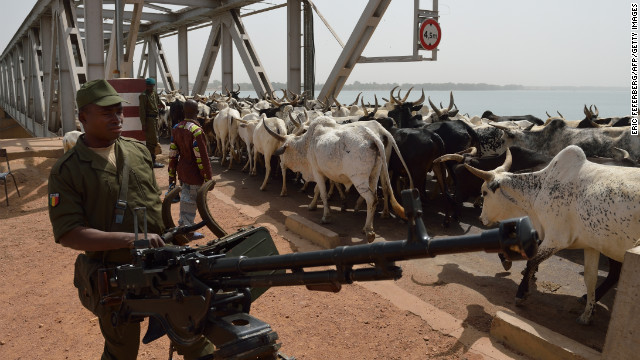
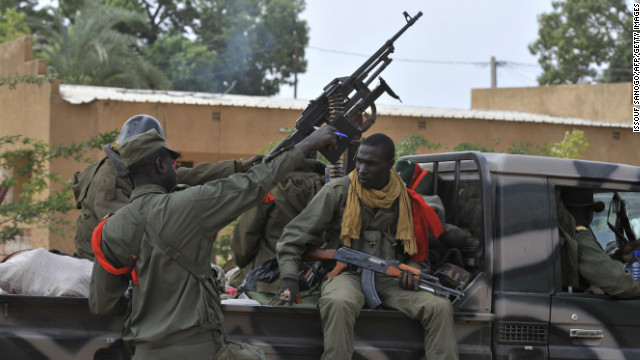
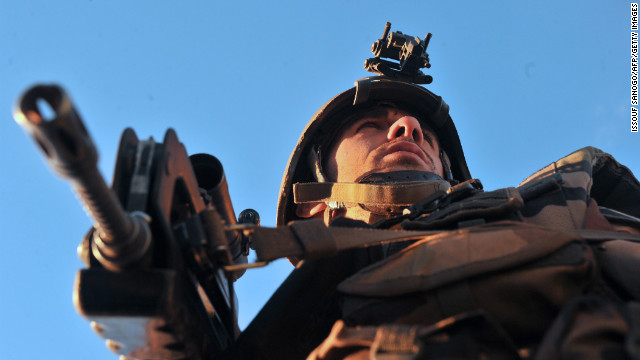
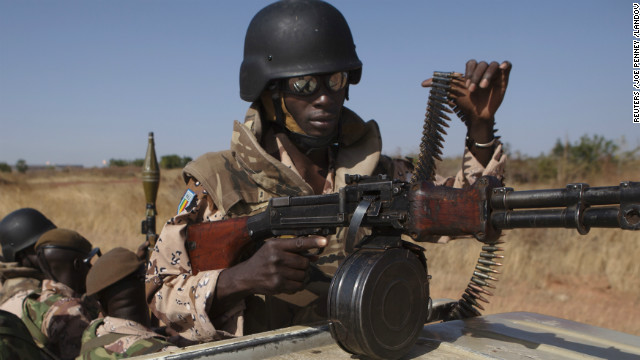
A Malian soldier armed with a machine gun watches a herd of cattle crossing a bridge over the Niger River on January 24. Mali's military offensive against militants controlling the northern half of the country has gathered pace in the past two weeks, with backing from France and other international allies.
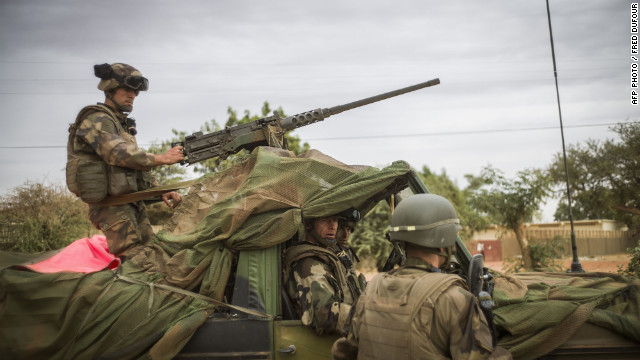
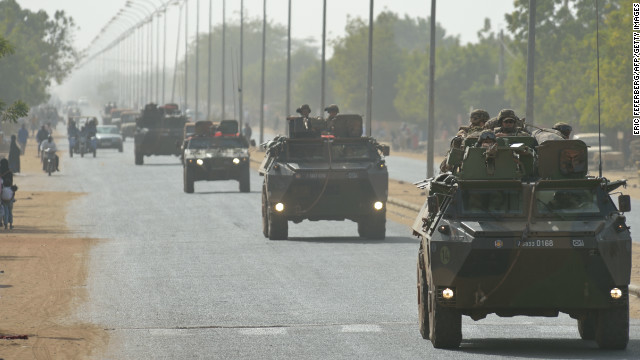
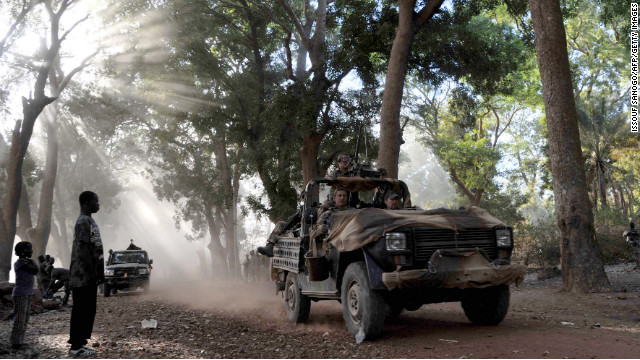
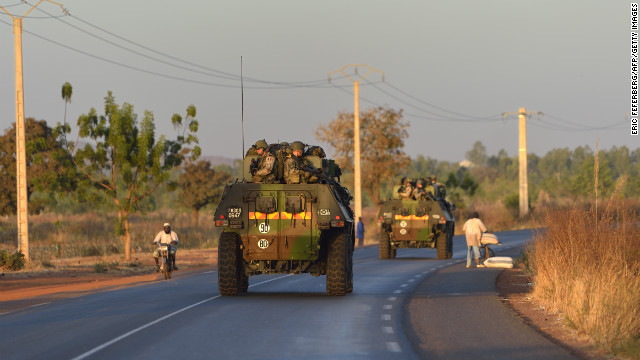
A French army convoy travels near Segou, in south-central Mali, is on its way to Diabaly on January 24.
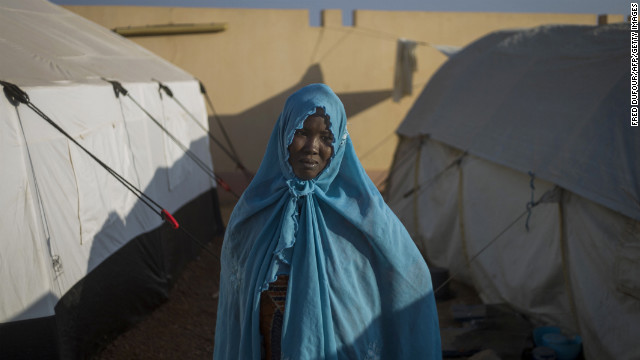
A woman who fled northern Mali sits at a camp for internally displaced persons in Sevare on Wednesday, January 23. The EU announced 20 million euros of extra humanitarian aid to help Malians fleeing fighting, its second such donation in as many months.
A soldier rides on the back of a scooter outside Diabaly on January 23.
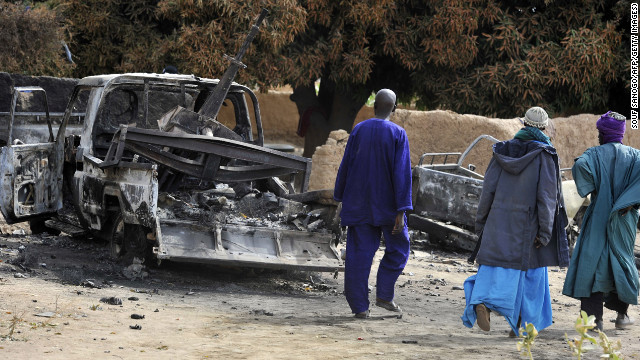
Malians walk past a destroyed truck mounted with a machine gun on Tuesday, January 22. The truck was used by militants and destroyed during airstrikes by the French air force.
Malian soldiers patrol Diabaly on January 22.
Malian soldiers walk past destroyed army barracks as they patrol in Diabaly on January 22, 2013.
A French soldier mans his post on January 22 near the city of Diabaly, Mali.
A French soldier stands guard in front of charred pickups used by Islamist rebels in Diabaly, Mali, on Monday, January 21. The Malian military says it has gained control of the town of Diabaly, a key advance in the battle against Islamist militants in the north.
A Malian soldier walks past a army building that was taken by the jihadists before being destroyed during aerial bombing in Diabaly on January 21.
A Malian soldier searches through debris after aerial bombing in the city of Diabaly on January 21.
A French soldier looks around after arriving in Diabaly on January 21.
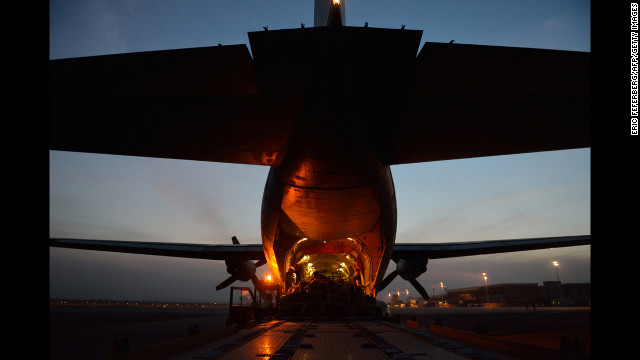
French soldiers unload military equipment from an aircraft on January 21.
Malian youths look on as French soldiers drive through Niono on Sunday, January 20.
The French Army conducts operations in Mali on January 20.
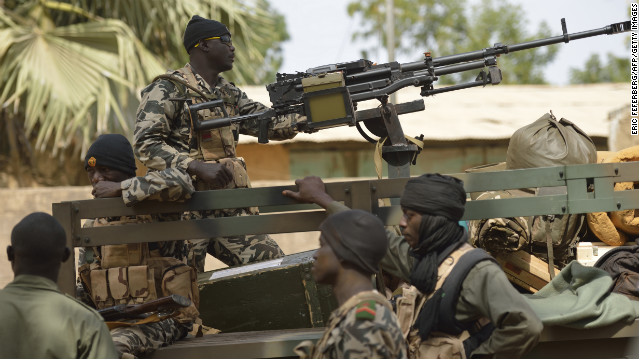
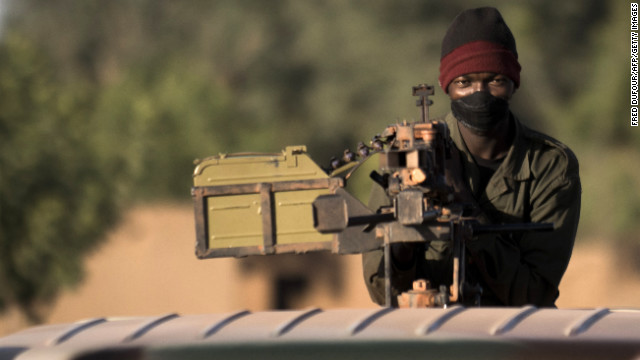
A Malian soldier holds a machine gun on top of a jeep on the road back from the town of Mopti, Mali, on Saturday, January 19.
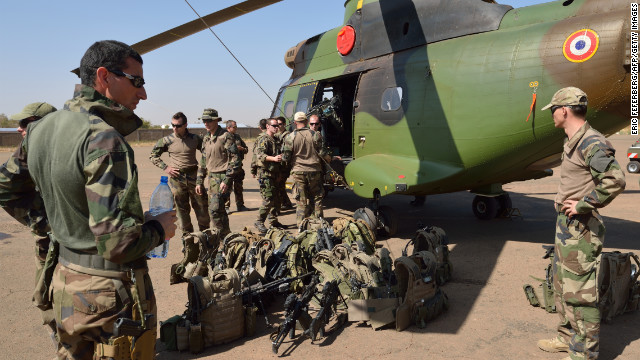
French soldiers of the 5th Combat Helicopter Regiment stand with their equipment in front of a helicopter on January 19 at an airbase near Bamako, Mali. French Defense Minister Jean-Yves Le Drian said on January 19 that France now had 2,000 troops on the ground in Mali as part of a drive against Islamist militants holding the north of the country.
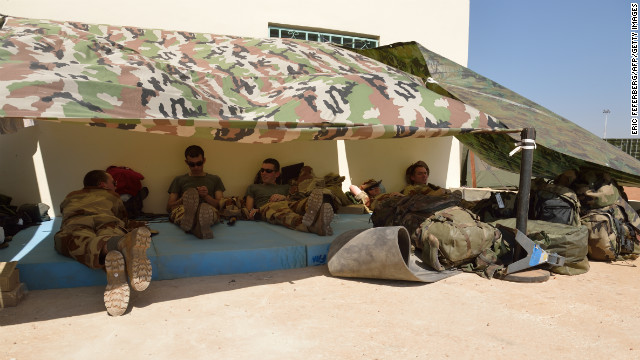
French soldiers of the 5th Combat Helicopter Regiment relax on January 19 at the airbase near Bamako.
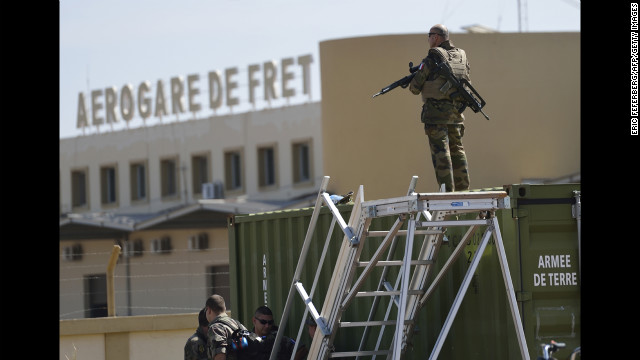
A French soldier from the helicopter regiment stands guard at the airbase on January 19.
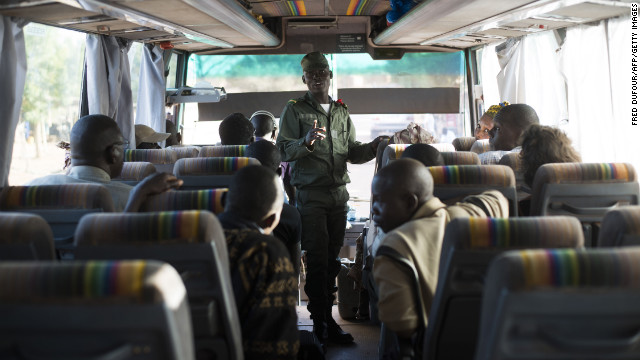
Malian soldiers check the identity of passengers in a bus coming from Mopti on January 19.
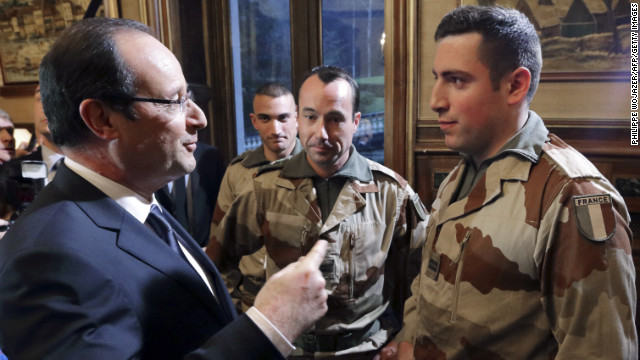
French President Francois Hollande, left, speaks with soldiers who are due to leave for Mali, during a meeting in Tulle, France, on January 19.
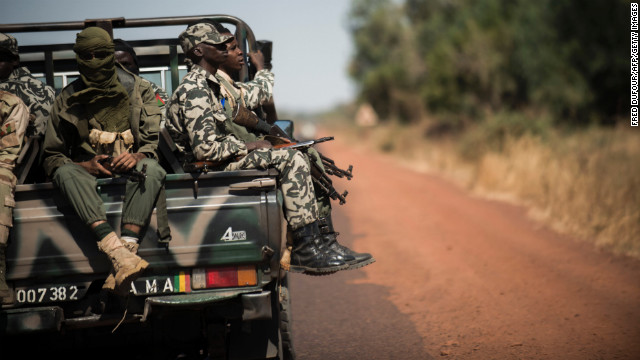
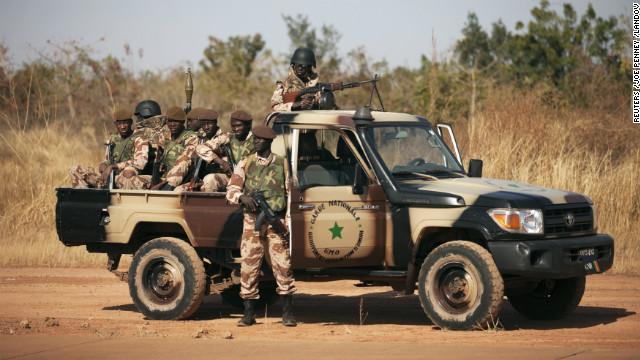
Malian soldiers sit in a truck on their way to Niono, Mali, on Friday, January 18.
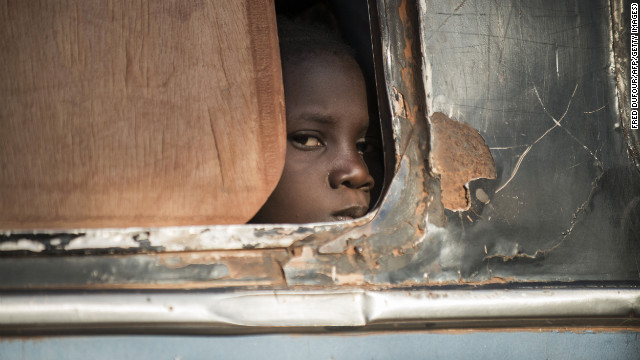
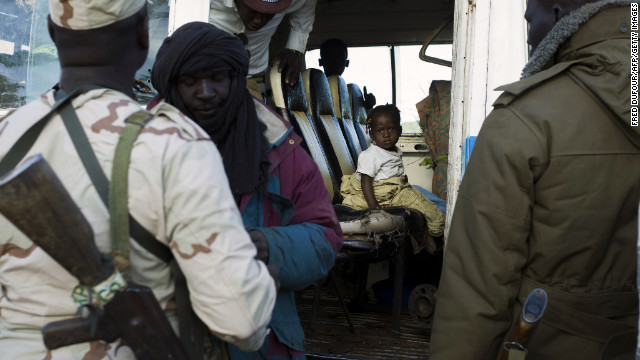
A Malian child looks out from a bus as Malian army soldiers check vehicles and passengers in the city of Niono on Friday, January 18. Malian troops, with help from France and a U.N.-mandated African force, are fighting al Qaeda-linked Islamist militants.
Malian soldiers man a checkpoint in Niono on January 18.
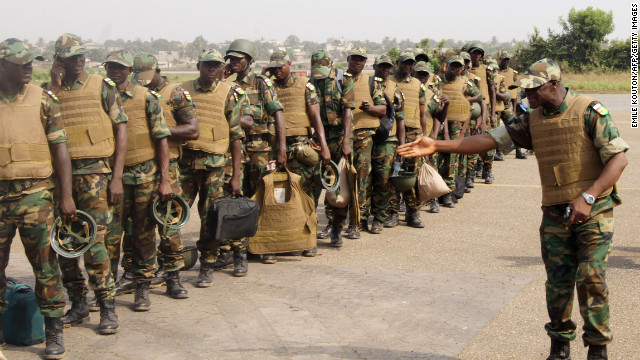
Togolese troops board a plane to Bamako, Mali, on Thursday, January 17, at the Lome airport in Togo. Troops from West African countries are heading to Mali as part of a U.N.-mandated African force to fight the insurgents.
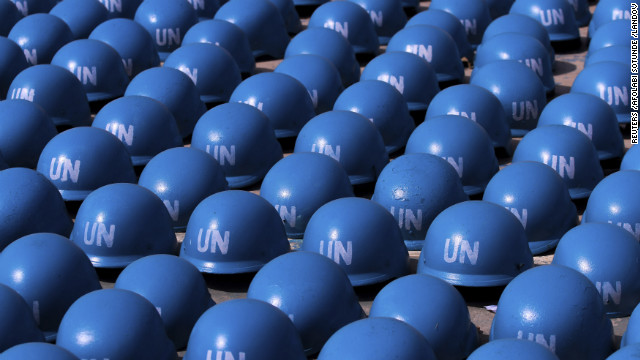
Helmets belonging to soldiers of the Nigerian army are prepared to be sent to Mali at the Nigerian army peacekeeping center near Kaduna, Nigeria, on January 17.
Malian soldiers stand guard as Mali's President Dioncounda Traore speaks to French troops at an air base in Bamako, Mali, on Wednesday, January 16.
A Malian soldier adjusts his weapon as President Traore speaks to French troops at an air base in Bamako on January 16.
French army soldiers stand on armoured vehicles as they leave Bamako and start their deployment to the north of Mali as part of the Serval operation on Tuesday, January 15.
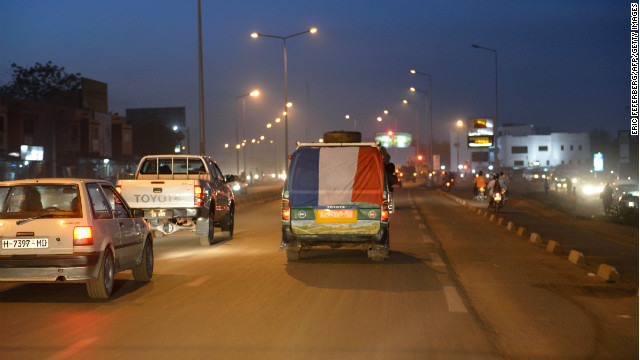
A French flag is hung on a van in Bamako as French troops start a deployment in the north of Mali on Wednesday.
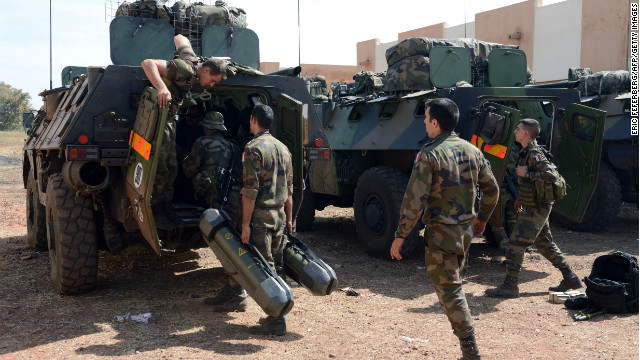
French troops prepare their Sagaie armoured all terrain vehicles from the Licorne operation based in Abidjan, Ivory Coast, at the 101st military airbase near Bamako on Wednesday.
French troops from the Licorne operation based in Abidjan, Ivory Coast, arrive at the 101st military airbase near Bamako on Wednesday to reinforce the Serval operations, before their deployment in the north of Mali.
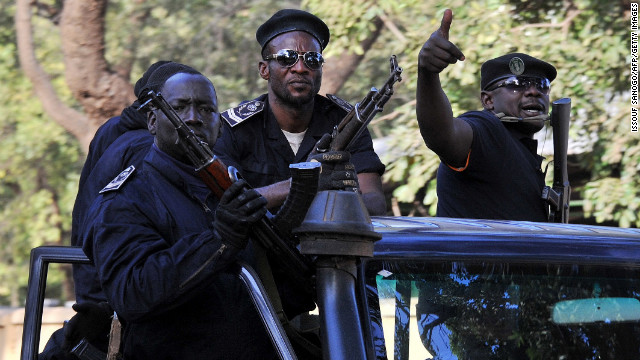
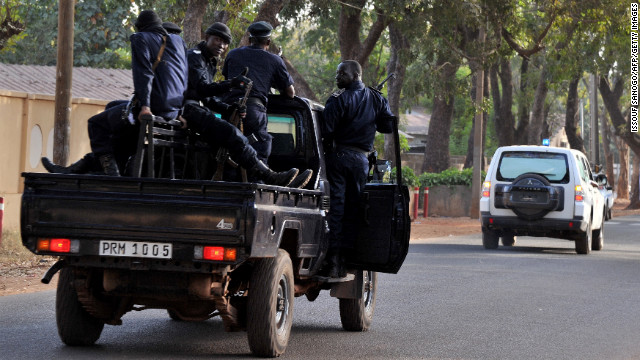
Malian police patrol in the capital of Bamako on Sunday, January 13.
Malian police patrol Bamako on Sunday.
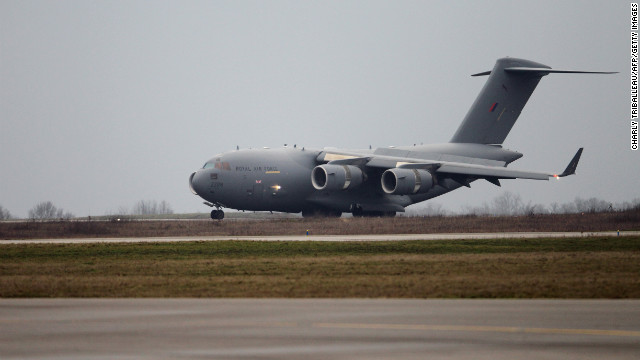
A British army Boeing C-17 cargo plane from British Brize Norton base lands Sunday at the Evreux military base in France to take supplies to Bamako.
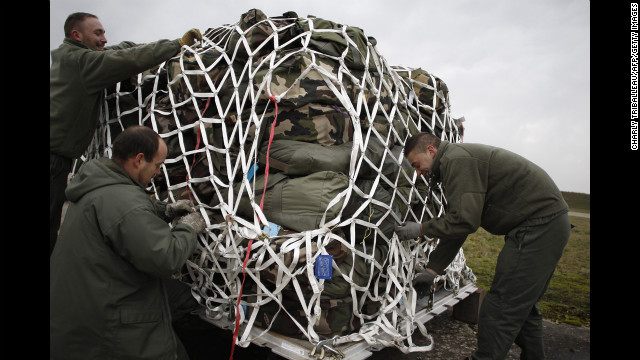
French soldiers prepare cargo for a British plane en route to Bamako on Sunday at the Evreux military base.
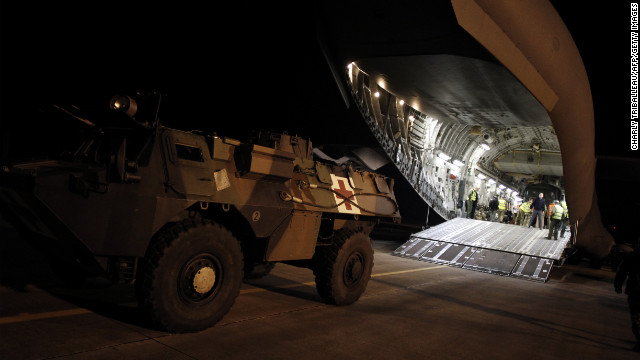
A French armored vehicle rolls onto a British army aircraft to be taken to Bamako on Sunday in Evreux.
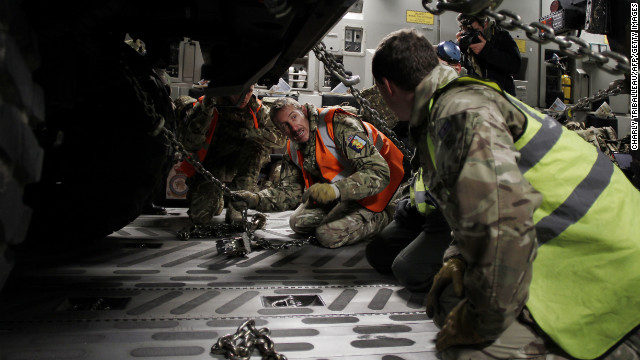
Workers adjust chains on a vehicle load in the C-17 in Evreux on Sunday.
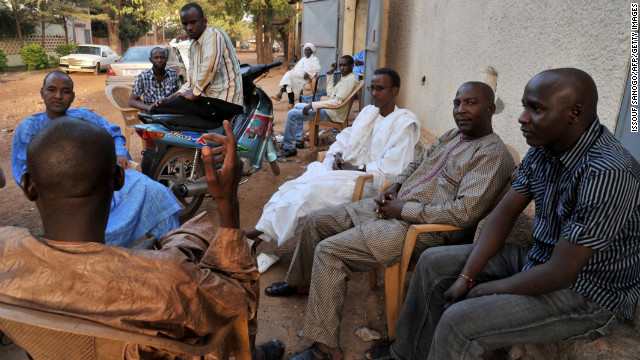
Internally displaced Malians from Timbuktu chat at a makeshift cafe in Bamako on Sunday.
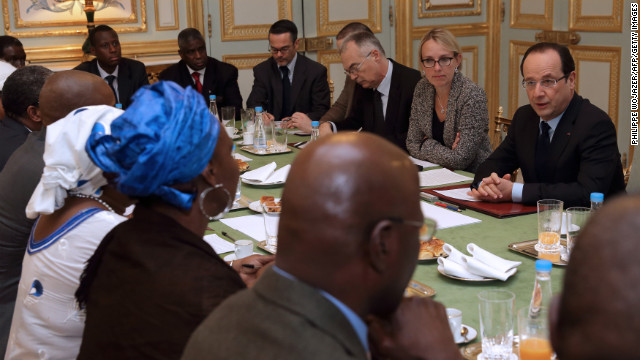
French President Francois Hollande, right, speaks with members of Malian associations in France during a meeting at the Elysee Palace in Paris on Sunday.
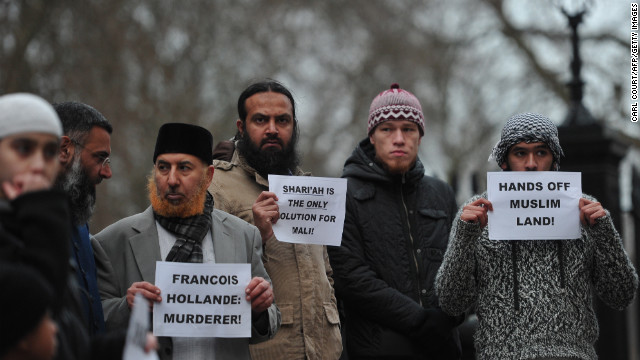
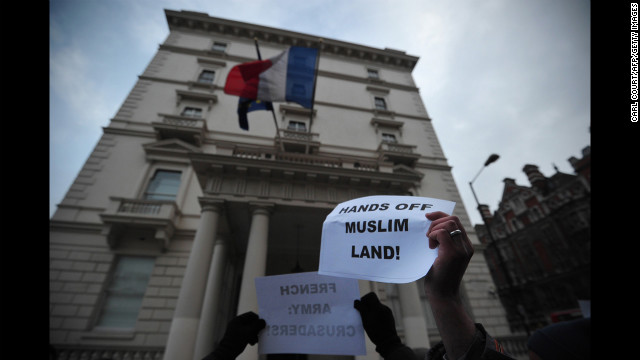
Muslim men protest French military action in Mali outside the French Embassy in central London on Saturday, January 12. About 50 Muslim protesters gathered outside the embassy.
Protesters wave signs outside the French Embassy on Saturday in London.
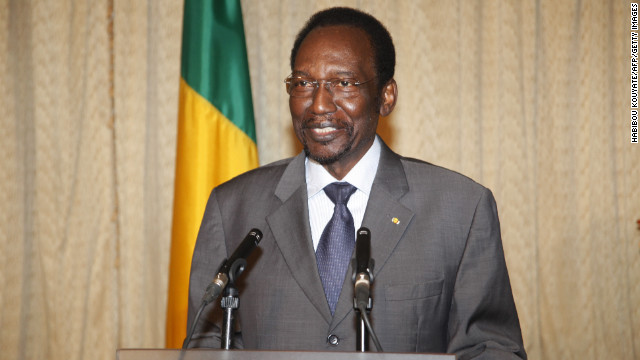
The interim president of Mali, Dioncounda Traore, speaks after a ministerial Cabinet meeting in Bamako on Friday, January 11. Malian authorities declared a state of emergency throughout the country on Friday as the army launched a counteroffensive against Islamists who were pushing south.
1
2
3
4
5
6
7
8
9
10
11
12
13
14
15
16
17
18
19
20
21
22
23
24
25
26
27
28
29
30
31
32
33
34
35
36
37
38
39
40
41
42
43
44
45
46
47
48
49
50
51
52
- NEW: United States agrees to conduct aerial refueling missions, to transport troops
- Malian and French forces recapture the city of Gao, a stronghold of the Islamic militants
- The Malian offensive is backed by French forces
(CNN) -- The United States is intensifying its involvement in Mali, where local and French forces are battling Islamic militants.
It will support the French military by conducting aerial refueling missions, according to the Pentagon, which released a short statement Saturday following a call between Defense Secretary Leon Panetta and French Defense Minister Jean-Yves Le Drian.
"The leaders also discussed plans for the United States to transport troops from African nations, including Chad and Togo, to support the international effort in Mali. Secretary Panetta and Minister Le Drian resolved to remain in close contact as aggressive operations against terrorist networks in Mali are ongoing," it read.
U.S. policy prohibits direct military aid to Mali because the fledgling government is the result of a coup. No support can go to the Malian military directly until leaders are chosen through an election.
Al Qaeda in Mali behind Algeria attack
The Mali terror connection
Mali conflict takes toll on civilians
But the United States is supporting the effort with intelligence and airlift support.
So far, the U.S. Air Force has flown at least seven C-17 cargo missions into Mali, carrying 200 passengers, mainly French troops, and 168 tons of equipment, according to Maj. Robert Firman, a Pentagon spokesman.
The uptick in U.S. involvement comes as Malian forces loosened the grip that Islamist militants' hold in the country's north with the retaking of the city of Gao.
With the support of French forces, the Malians entered and took control of Gao, which for months had been a militant stronghold, the French defense ministry said.
The advance was made in stages, with forces taking Gao's airport and the main bridge leading to town before entering the rest of the city.
"Jihadist terrorists, who have fought Malian and French armies, have seen their mobile and logistical capabilities reduced," the ministry said in a news release.
The quickening advance of the government forces has brought them to the heart of the territory held by the militants.
Broken limbs, torn lives in northern Mali
The Islamic extremists carved out a large haven in northern Mali last year, taking advantage of a chaotic situation after a military coup by the separatist party MNLA. The militants banned music, smoking, drinking and watching sports on television. They also destroyed historic tombs and shrines.
The takeover stoked fear among global security experts that Mali could become a new hub for terrorism.
Refugees tell harrowing stories of life under the Islamist militants.
But the French-based International Federation for Human Rights said it is "very alarmed" by reports that Malian soldiers are themselves carrying out extrajudicial killings and abuses as they counterstrike.
The United Nations' refugee agency, UNHCR, has called for an increase in international aid for the hundreds of thousands of people who have been displaced by the fighting in the country.
More signs al Qaeda in Mali orchestrated Algeria attack
More than 150,000 refugees have fled Mali into neighboring countries, and another 230,000 are displaced inside Mali, the agency said.
The military's advance into Gao may shed more light on the conditions that residents there have faced. According to the U.N. agency, one former resident told of a hospital stripped of medicine by the armed militants and filling with bodies.
As the Malian troops advance, some other countries in the region are joining the French force aiding them. Between 700 and 800 African troops from Benin, Nigeria, Togo and Burkina Faso have arrived, U.S. State Department spokeswoman Victoria Nuland said Friday, and a number of Senegalese troops and up to 2,000 from Chad are on the way.
France has 2,150 soldiers on Malian soil, with 1,000 more troops supporting the operation from elsewhere.
French involvement in the conflict began on January 11, the day after militants said they had seized the city of Konna, east of Diabaly in central Mali, and were poised to advance south toward Bamako, the capital.
Until 1960, Mali had been under French control.
The MNLA, made up of ethnic Tuareg rebels, staged their coup against Mali's central government after returning to Mali well-armed from fighting for
late Libyan leader Moammar Gadhafi.
Mali's famed Timbuktu without water, other services
CNN's Pierre Meilhan and Barbara Starr contributed to this report.