

When it comes to seaborne propulsion, one simple layout has largely dominated over all others. You pair some kind of engine with some kind of basic propeller at the back of the ship, and then you throw on a rudder to handle the steering. This lets you push the ship forward, left, and right, and stopping is just a matter of turning the engine off and waiting… or reversing thrust if you’re really eager to slow down.
This basic system works for a grand majority of vessels out on the water. However, there is a more advanced design that offers not only forward propulsion, but also steering, all in the one package. It may look strange, but the Voith Schneider propeller offers some interesting benefits to watercraft looking for an edge in maneuverability.
Spinning Underwater Wings
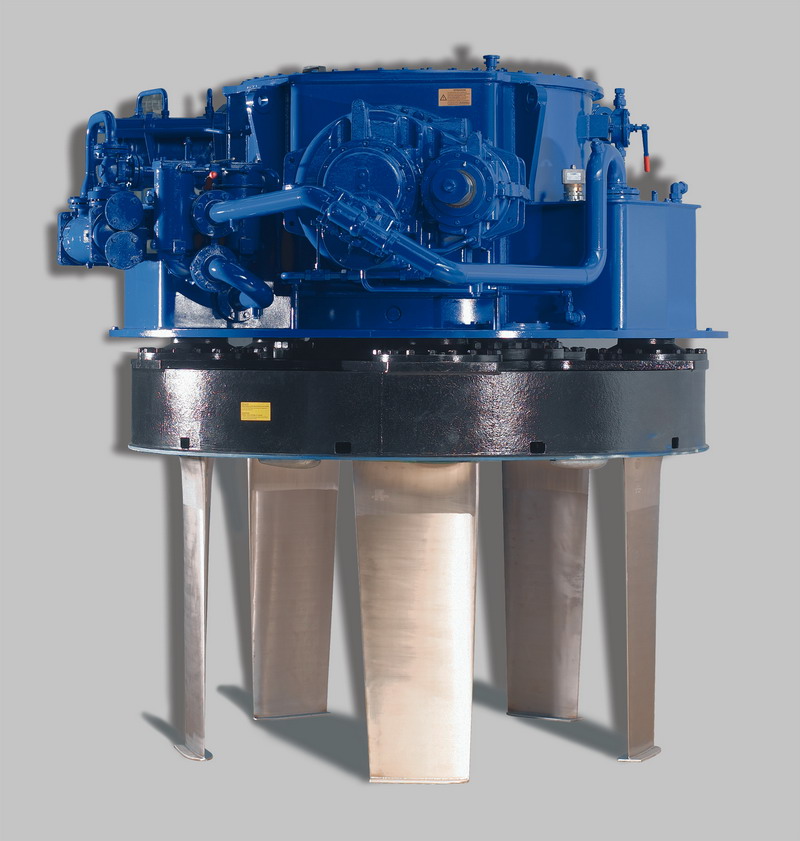
A modern Voith-Schneider propeller. Credit: Voith AG, Heidenheim
The Voith Schneider propeller design looks rather unlike any propeller you might have seen before. Perhaps the most obvious reason is because of its axis of operation. Traditional propellers tend to operate in an axis parallel with the waterline, or at least within a few degrees or so. However, the Voith Schneider design spins about the vertical axis instead. This is because it uses vertically-oriented blades mounted on a rotating plate. Each blade has a hydrofoil profile, which enables it to generate thrust when moving through the water. By spinning these blades at speed and varying their angle of attack, it’s possible to create a thrust vector in any direction on the horizontal plane. A special gear system is used to vary the angle of each blade as the plate rotates, such that the overall net thrust generated by all the blades is in the desired direction of travel.
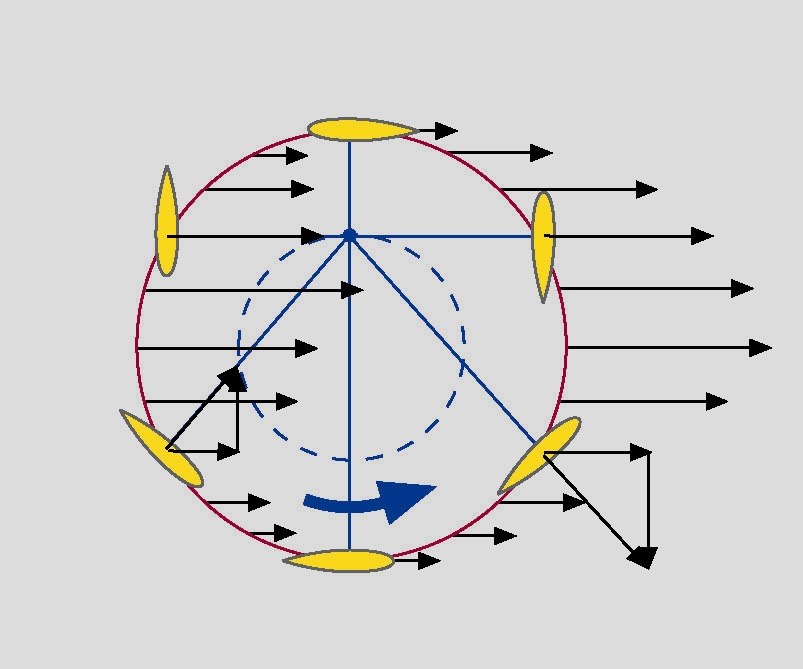
The angle of attack of each blade changes as the disc rotates, providing thrust in the desired direction. Controlling the angle of attack of all the blades in this way allows the thrust vector to be pointed in any direction in a full 360 degrees of rotation. It thus provides a great deal of flexibility when controlling a vessel on the water. Credit: Voith AG, Heidenheim
This design has certain key advantages over a traditional maritime propulsion setup. Namely, by fitting a vessel with Voith-Schneider propellers, it’s possible to add a great deal of maneuverability, to the point where a traditional rudder becomes entirely unnecessary. Instead of having to thrust the ship forwards and then turn, it’s possible to directly push the vessel with each individual thruster in the direction that is desired. This can be particularly useful for low-speed operations like docking, and provides a much more instantaneous change of direction than is possible with a regular propeller and rudder setup.
Voith Schneider thrusters are particularly useful for ships like tugs where precision maneuverability is a huge aid to operations. Numerous thrusters are often to a given vessel, providing greater total thrust and additional control. It’s also typical to fit Voith Schneider propellers with a guard underneath, which prevents grounding damage and can act as a sort of nozzle that improves low-speed performance. These propellers are perhaps not the ideal choice for watercraft aiming for outright speed, but for lower-speed work, they can offer great benefits in control.
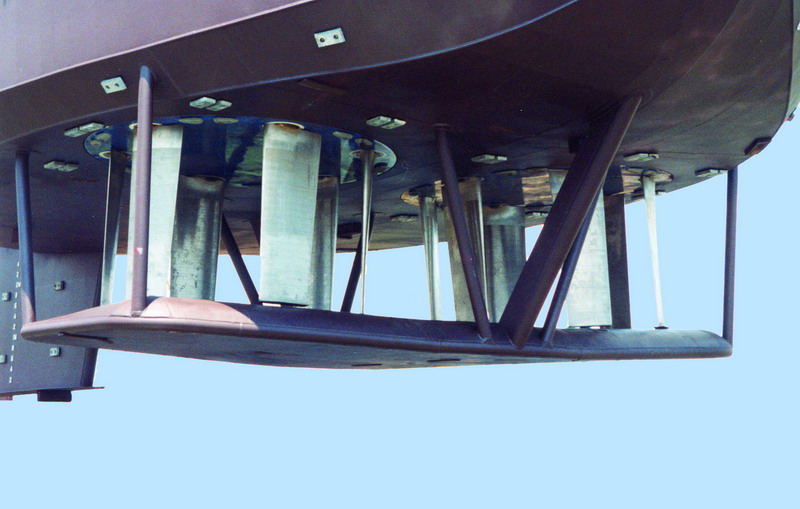
A pair of Voith Schneider propellers fitted to a tug. Note the protective plate underneath the thrusters which protects against damage. Credit: Voith AG, Heidenheim
The design looks somewhat unintuitive and even futuristic, but it actually goes back a long way. The first prototype was actually designed as a water turbine for generating electricity. However, it proved unexceptional in this role. It was only when the device was tested as a pump that engineers realized it could be repurposed as a combined thruster to replace a traditional propeller and rudder. A patent was issued in Germany in 1972, and the first prototype was tested on the water all the way back in 1928, on a small 60-horsepower vessel known as the Torqueo. The design soon found use on a number of German vessels in the interwar period, including minesweepers. The Voith Schneider design can be operated quite slowly while still providing thrust, minimizing cavitation and thus sound signature, which is considered advantageous for this role. In some German designs, such as the failed Graf Zeppelin aircraft carrier, the thrusters were even installed alongside regular propulsion systems, and made retractable so they wouldn’t present additional drag when not in use. Some decades later, the US Navy itself would later field similarly-equipped minesweepers in the 1990s, though all examples were dismantled and sold off by the early 2000s. Beyond military uses, the thruster has found application in a number of ferries and tugs around the world, and remain in production today.
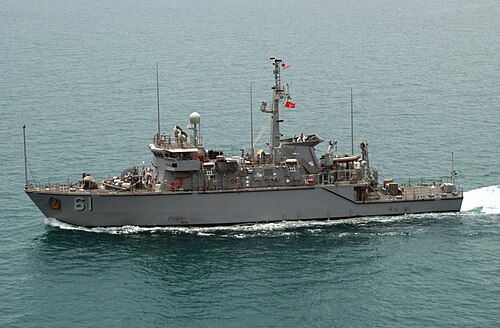
The US Navy’s Osprey class minehunters used twin Voith Schneider propellers, including the USS Raven pictured here in the North Arabian Gulf. Top speed of the class stands at 12 knots, a hair slower than the Italian Lerici class the type is based on, which uses conventional propulsion and rudders. Credit: public domain, DOD
Despite their unique abilities, Voith Schneider propellers remain a curio rather than a fixture in the shipping world. In the past century of their existence, just 4,500 examples have been built, near exclusively by Voith AG, and thus they are equipping a relatively small amount of the global maritime fleet. They compete with more familiar designs, such as azimuth thrusters, which are widely popular and more intuitive to understand. Given their oddball nature, and moderate level of mechanical complexity, they’re perhaps never going to supplant the tried-and-true prop and rudder that propels most conventional vessels. Still, if you’re looking to build a ship that can elegantly strafe in any direction you want to go, it’s hard to go past the Voith Schneider concept for all the benefits it brings.