
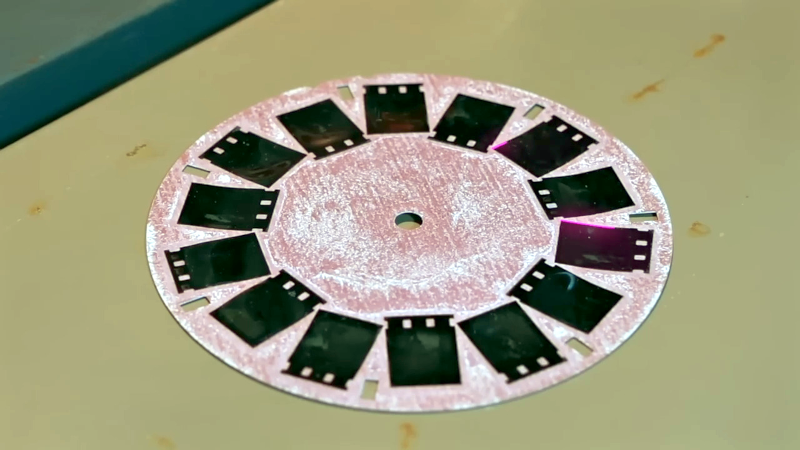
We are going to bet that as a kid, you had a View-Master. This toy has been around for decades and is, more or less, a handheld stereoscope. We never thought much about the device’s invention until we saw a recent video from [View Master Travels and Peter Dibble]. It turns out that the principle of the whole thing was created by the well-known [Charles Wheatstone]. However, it was piano repairman [William Gruber] who invented what we think of as the View-Master.
[Gruber] didn’t just work on normal pianos, but complex player pianos and, in particular, the pianos used to record player piano rolls. He was also, as you might expect, a stereo photography enthusiast. Many of the ideas used in automating pianos would show up in the View-Master and the machines that made the reels, too. In the 1930s, stereoscopes were not particularly popular and were cumbersome to use. Color film was also a new technology.
[Gruber] realized that a disk-like format would be easy to use and, more importantly, easy to mass produce. The reels had a few features to simplify their use. For example, if you show each image in sequence, you’d eventually see pictures upside down. [Gruber’s] solution? Use an odd number of pairs and advance the reel two positions for each jump forward. That way, you never show an image to the wrong eye.
The model “A” didn’t look much like the View-Master you probably remember. By 1940, the toy was a hit. But initially, it wasn’t really a toy so much as a way for adults to view distant sites. Of course, World War II could have stopped the enterprise dead, but instead, they shifted to producing training aids for the military. The War Department would buy 100,000 viewers and about 6 million reels to help train soldiers to identify aircraft and ships, as well as to estimate range.
Training was always a key use of the View-Master technology, but the company eventually bought a competitor with rights to Disney films and exploded into a must-have toy. When the company was bought by GAF, the focus on the toy market grew. Despite some efforts to keep the company relevant in an era with virtual reality and other 3D technologies, View-Master is, sadly, a bit of nostalgia now, even though you can still buy them. But it is impressive that despite many changes to the viewer and the production methods, the View-Master reel remained virtually unchanged despite the production of about 1.5 billion of them. Sure, there were fancy viewers that had audio tracks, too, but the basic idea of an odd number of film frames mounted in a circle in a notched disk remained the same.
These days, a phone can be your View-Master, at least, if you can cross your eyes. Want to preserve your View-Master reels for posterity? So did [W. Jason Altice].