
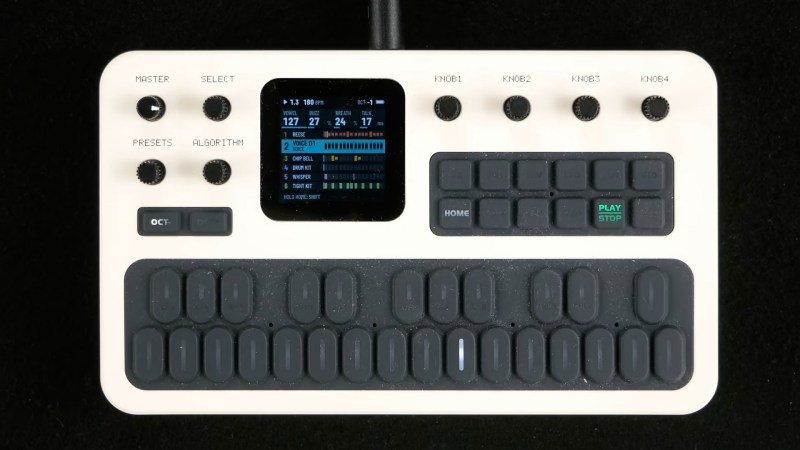
The M-Vave FM-1 was a pretty unremarkable little synthesizer “toy” until the open-source synth hackers took it over. Now, it’s a sweet platform for exploration, the incredible work done by the community has encouraged the manufacturer to release an open SDK, and it has recently taken the global synth nerd community by storm. (It has sadly also gotten about a 50% markup in the last month due to this popularity.)
It’s the perfect storm of inexpensive hardware, vibe-coded software, and easy-to-use tooling that enables synthesizer firmware-hacking for the mainstream. It is also the fashionable box of the moment in a nerdy niche of the synthesizer world at the moment and it’s something that we’re going to see in non-synthesizer contexts as well, so buckle up.
Opening Already Open Software
The funny thing about the FM-1 is that most of the good stuff inside it was open-source all along. As it is sold, it is a Yamaha DX7 emulator, and it appears to be running the same sound engine as Dexed, which is an open-source DX7 clone based on the even older music synthesizer for android (msfa).
Dexed, and its smaller brother MiniDexed, has given birth to many sweet synthesizer hacks that we’ve seen here, including a personal favorite: a Yamaha TX816 clone based on a Raspberry Pi. So it certainly looked to everyone at the time as if M-vave wrapped a not-entirely-inspiring user interface around this sound engine and shipped it.
And that would have been the end of it too, if it weren’t for
The Robots Take Off
A quick note on the LLM / agentic coding elephant in the room here. From reading through [AL-255]’s work, it was most almost certainly worked on and documented by the robots, and we have no idea of the relative contribution of man and machine. Publishing a reverse engineering effort like this enables others in the community to point their robots at the repo, and gives them a tremendous leg up in the next steps along the path. We have just as little clue about how much of any of the subsequent synthesizer and sequencer routines were written with LLM assistance, but at the rate they’re popping up, we’d guess a lot.
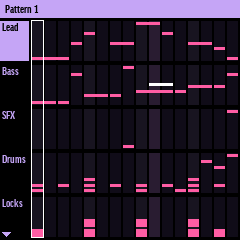
[Baud Girl]’s sequencer looks great!
About two months after [AL-255]’s work, [Madeline] wrote one of the first reworks of the firmware for the FM-1, working as “Baud Girl”. It added some virtual analog to the cold DX7 tones, but notably wrapped it up in a much nicer UI than the original. It has so far been kept closed-source, but as a proof of what’s possible, it certainly inspired many others.
And then along came [Leo Kuroshita]’s open-source Felucca. This program added a yet fancier sequencer, multiple instruments, drums, and even sound effects. It turned the single-instrument FM-1 into a miniature music-production workshop – what the kids from the 1990’s would call a “groovebox”. [isod89]’s Sloop would refine on Felucca, and is probably the standout application running on the FM-1 platform at the moment.
The Firmware Hub started collecting a list of applications written by the community, and there are 250 of them in about six weeks’ time. Suffice it to say that we can’t even begin to scratch the surface, but they range from serious musical interface explorations, to rainbow-colored kids toys, to fart machines, and then to recreations of iconic synthesizers of the past. Something for everyone? Certainly more interesting than Dexed-in-a-box!
There is no guarantee of quality or of suitability for purpose. On some of them, pitch bend won’t work because the bot or person doing the coding just didn’t get around to it. On others, there will be USB problems. Some have audio glitches, which is a serious issue for a sound-making machine. It’s hard to judge the signal-to-noise ratio of the software output for this device (pun intended); it’s the wild west. And at the rate that applications are piling in, you can only hope to review a snapshot anyway.
If you want a guided tour of some of the best applications as of last week, we love [AudioPilz]’s Tier List, embedded below, that also comes with a heavy dose of synth-nerd inside jokes. [Floyd Steinberg]’s video is full of thoughtful commentary on the state of the art.
Plot Twist: Open Source!
Then the story takes a cool turn. M-vave, the company that makes the FM-1, decided to open-source its firmware and its entire SDK. Well, kinda. The strangest turn of events is that they opened up everything except the sound engine itself, which they release as a binary blob. Why? Nobody knows. Some have speculated that it’s because it is based on the GPL-licensed Dexed and are covering their tracks, which is possible. But if M-vave went further back than that, and based it exclusively on the Apache 2.0-licensed msfa, then they’re in the clear.
Either way, there is now official open-firmware support for this little gadget, and a growing community of folks writing new software for it. Because of this official support, musicians who have never flashed an Arduino are overwriting their stock bootloaders. For their part, M-vave is selling a lot more FM-1s than it would otherwise. It’s a win all around.
Apocalypse? Now? In this Economy?
If you watch a number of video reviews of the FM-1, they range from “Game Changer: The Industry is Doomed!” to “The Only Synth You’ll Ever Need” to “Robot Slop”. We think that’s all a little bit overblown. There have always been awesome open-source projects in the synthesizer space. Mutable Instrument’s [Émilie Gillet] gave us countless amazing open examples, many of which are implemented for the FM-1. Major synth manufacturer Korg flirted around with encouraging users to code their own synthesizers in the Minilogue series. None of the FM-1’s capabilities are new, and not all of it is even musical. As a pure synth, it sounds fine, but it’s nothing to write home about.
But what is interesting about the FM-1 story is the sheer velocity at which things are progressing, the positive manufacturer response to being “hacked”, and the empowerment of a community to write its own oddball sound machines. There is more new firmware coming out for the FM-1 than any one person can hope to keep up with, even though the tooling to do so has never been easier. It’s a microcosm of the creation-overflow that we live in. Will this be seen as the beginning of a new era of custom firmware for commercial devices? Fun times!