
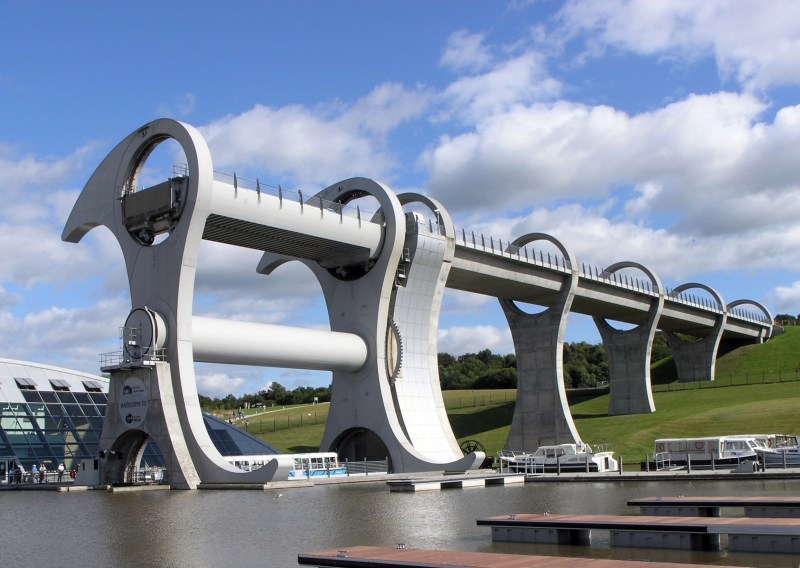
We live in an age where engineering marvels are commonplace: airplanes crisscross the sky, skyscrapers grow like weeds, and spacecraft reach for the stars. But every so often, we see something unusual that makes us take a second look. The Falkirk Wheel is a great example, and, even better, it is functional art, as well.
The Wheel links two canals in Scotland. Before you click away, here’s the kicker: One canal is 35 meters higher than the other. Before 1933, the canals were connected with 11 locks. It took nearly a day to operate the locks to get a boat from one canal to the other. In the 1930s, there wasn’t enough traffic to maintain the locks, and they tore them out.
Fast Forward
In the 1990s, a team of architects led by [Tony Kettle] proposed building a wheel to transfer boats between the two canals. The original model was made from [Tony’s] daughter’s Lego bricks.
The idea is simple. Build a 35-meter wheel with two cassions, 180 degrees apart. Each cassion can hold 250,000 liters of water. To move a boat, you fill the caissons with 500 tonnes of water. Then you let a boat into one of them with its weight displacing an equal amount of water, so the caissons stay at the same weight.
Once you have a balanced system, you just spin the wheel to make a half turn. There are 10 motors that require 22.5 kilowatts, and each half turn consumes about 1.5 kilowatt-hours.
Not Lockless
The wheel actually raises boats up 24 m, so the remaining 11 m still requires two locks. But this is a far cry from the eleven locks the system replaces. The structure has a foundation with 30 concrete piles down on the bedrock. The wheel itself uses 14,000 bolts to avoid welds that might fatigue under stress.
As you’d expect, the caissons have to turn with the wheel in order to stay level, somewhat like a Ferris Wheel. This works using three 8-meter gears. It takes about four minutes for the wheel to make a half turn. You can watch it work in the video below.
Why?
We were a bit disappointed that there doesn’t seem to be any reason to connect the two canals except as a tourist attraction. On the other hand, about half a million visitors go every year, so it does have an economic impact. As far as we know, this is the world’s only rotating boat lift. It certainly is artistic compared to, say, the historic Anderton Lift.
We love big engineering. Even the ones that seem commonplace.
Featured image: “FalkirkWheelSide” by Sean Mack.