
In the 1970s, the USSR had an undersea cable connecting a major naval base at Petropavlovsk to the Pacific Fleet headquarters at Vladivostok. The cable traversed the Sea of Okhotsk, which, at the time, the USSR claimed. It was off limits to foreign vessels, heavily patrolled, and laced with detection devices. How much more secure could it be? Against the US Navy, apparently not very secure at all. For about a decade starting in 1972, the Navy delivered tapes of all the traffic on the cable to the NSA.
Top Secret
You need a few things to make this a success. First, you need a stealthy submarine. The Navy had the USS Halibut, which has a strange history. You also need some sort of undetectable listening device that can operate on the ocean floor. You also need a crew that is sworn to secrecy.
That last part was hard to manage. It takes a lot of people to mount a secret operation to the other side of the globe, so they came up with a cover story: officially, the Halibut was in Okhotsk to recover parts of a Soviet weapon for analysis. Only a few people knew the real mission. The whole operation was known as Operation Ivy Bell.
The Halibut
The Halibut is possibly the strangest submarine ever. It started life destined to be a diesel sub. However, before it launched in 1959, it had been converted to nuclear power. In fact, the sub was the first designed to launch guided missiles and was the first sub to successfully launch a guided missile, although it had to surface to launch.
Oddly enough, the sub carried nuclear cruise missiles and its specific target, should the world go to a nuclear war, was the Soviet naval base at Petropavolvsk.
By 1965, the sub had been replaced for missile duty by newer submarines. It was tapped to be converted for “special operations.” Under the guise of being a deep-sea recovery vehicle, the Halibut received skids to settle on the seabed, side thrusters, specialized anchors, and a host of electronic equipment, including “the Fish” a 12-foot-long array of cameras, sonar, and strobe lights weighing nearly two tons. The “rescue vehicle” on its stern didn’t actually detach. It was a compartment for deploying saturation divers.
An early mission was Operation Sand Dollar. Halibut found the wreck of the Soviet K-129, which the US would go on to recover in another top secret mission, looking for secrets and Soviet technology.
When it came time to deploy the listening device on an underwater cable, Halibut was perfect. It could park a safe distance away, deploy saturation divers, and recover them. If you want to see more about the Halibut, check out the [Defence Central] video below.
The Listening Device
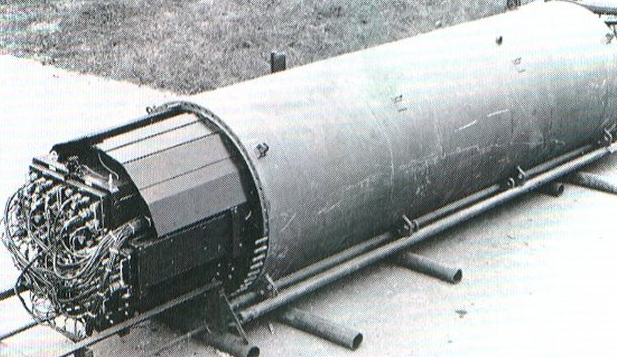
A later undersea wire tap device (Soviet photograph)
This wasn’t a hidden microphone in a briefcase. It was a 20-foot, six-ton pressure vessel parked on the ocean floor. Details are murky, but there was another part, probably smaller, that clamped around the cable. Working inductively, it didn’t pierce the cable for fear the Soviets would notice that. In addition, if they raised the cable for maintenance, the device was made to break away and sink to the bottom.
Needless to say, tapping a cable on the ocean floor isn’t easy. First, they had to locate the cable. Luckily, there were signs at either end telling fishing vessels to avoid the area. That helped, but they still had to search for the 5-inch wide cables. They found them at least 400 feet below the surface, some 120 miles offshore.
Saturation diving was a relatively new idea at the time, and the Navy’s SeaLab experiments had given them several years of experience with the technology. While commercial saturation dives started in 1965, it was still exotic technology in 1971. The first mission simply recorded a bit of data on the submarine and returned it. Once it was proven, the sub returned with the giant tap device and installed it.
It took four divers to position the big tap. Even then, you couldn’t just leave it there. The device used tapes and required service once a month. So Halibut or another sub had to visit each month to swap tapes out. We couldn’t find out what the power source for the bug was, so they probably had to change the batteries, too.
The Soviets didn’t consider the cable to be at risk for eavesdropping, so much of the traffic on the cable was in the clear. It was a gold mine of intelligence information, and many credit the information gained as crucial to closing the SALT II treaty talks.
Secondary Mission
Most of the crews participating in Operation Ivy Bell didn’t have clearance to know what was going on. Instead, they thought they were on a different secret mission to retrieve debris from Soviet anti-ship missiles.
To keep the story believable, the crew actually did recover a large number of parts from the subject Soviet missiles. Turns out, analysis of the debris did reveal some useful information, so two spy missions for the price of one.
Presumably, the assumption would be that if the Soviets heard a sub was scavenging missile parts, it might qualify as a secret, but it would hardly be a surprise. They couldn’t have imagined the real purpose of the submarine.
Future Taps
Later undersea taps were created that used radioisotope batteries and could store a year’s data between visits that tapped other Soviet phone lines. Submarines Parche, Richard B. Russel, and Seawolf saw duty with some of these other taps as well as taking over for Halibut when it retired four years after the start of Operation Ivy Bell.
The original Okhotsk tap would have operated for many more years if it were not for [Ronald Pelton]. A former NSA employee, he found himself bankrupt over $65,000 of debt. In 1980, he showed up at the Soviet embassy in Washington and offered to sell what he knew.
He knew a number of things, including what was going on with Operation Ivy Bells. That data netted him $5,000 and, overall, he got about $35,000 or so. Oh, he also got life in prison when, in 1985, a Soviet defector revealed he had been the initial contact for [Pelton].
The Soviets didn’t immediately act on [Pelton’s] intel, but by 1981, the Americans knew something was up. A small fleet of ships was parked right over the device. The USS Parche was sent to retrieve it, but they couldn’t find it. Today, it (or, perhaps, a replica) is in the Great Patriotic War Museum in Moscow.
A surprising amount of the Cold War was waged under the sea. Not to mention in the air.