
- NEW: The meteor released a 500-kiloton blast, NASA officials say
- About 1,000 people were hurt, most by flying glass, state media report
- Some buildings in Chelyabinsk lost some or all of their windows in the explosion
- Five Russian regions, one of them Chelyabinsk, were affected, Itar-Tass says
Chelyabinsk, Russia (CNN) -- A day after a spectacular meteor blast shook Russia's Urals region, the clean-up operation got under way Saturday in the hard-hit Russian city of Chelyabinsk.
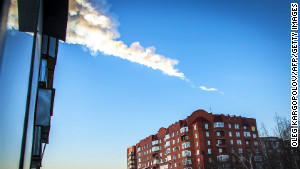
Although some buildings were unscathed when the sonic waves from the Friday morning explosion reverberated through the city, others lost some or most windows.
About 1,000 people were hurt, many by the flying glass, according to the state-run RIA Novosti news agency.
The injured included more than 200 children. Most of those hurt are in the Chelyabinsk region, though the vast majority of injuries are not thought to be serious.
The city of Chelyabinsk was functioning normally Saturday as the repair work began.
Many believe it had a lucky escape as fragments of the meteor came raining down.

West of the city, authorities have sealed off a section of a frozen lake where it's believed a sizable meteorite crashed through the ice.
Opinion: Don't count 'doomsday asteroid' out yet
The meteor was a once-in-a-century event, NASA officials said, describing it as a "tiny asteroid."
The space agency revised its estimate of the meteor's size upward late Friday from 49 feet (15 meters) to 55 feet (17 meters), and its estimated mass from 7,000 to 10,000 tons.
The space agency also increased the estimated amount of energy released in the meteor's explosion from about 300 to nearly 500 kilotons. By comparison, the nuclear bomb the United States dropped on Hiroshima in 1945 released an estimated 15 kilotons of energy.
The whole event, from the meteor's atmospheric entry to its disintegration in the air above central Russia, took 32.5 seconds, NASA said.
About 20,000 emergency response workers were mobilized Friday, RIA Novosti reported.
Russian Emergencies Minister Vladimir Puchkov arrived in the city of Chelyabinsk on Friday evening to take stock of the situation, the official Itar-Tass news agency reported.
About 3,000 buildings were damaged -- mostly with broken glass -- as a result of the shock waves caused by the blast, RIA Novosti said.
Hospitals, kindergartens and schools were among those affected, said Vladimir Stepanov, of the National Center for Emergency Situations at the Russian Interior Ministry
Read more: Saving Earth from asteroids
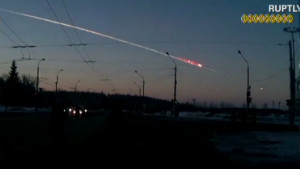
Amateur video footage showed a bright white streak moving rapidly across the sky, before exploding with an even brighter flash and a deafening bang.
The explosion occurred about 9:20 a.m. local time, as many people were out and about.
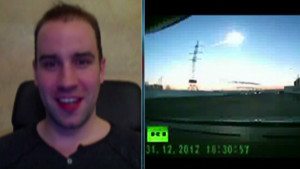
Russians captured vivid images, many using dash cameras inside their vehicles.
Dash cameras are popular in Russia for several reasons, including possible disputes over traffic accidents and the corrupt reputations of police in many areas. Drivers install the cameras for their own protection and to document incidents they could be caught in; on Friday, they were able to document a spectacular natural phenomenon.
CNN iReporter and Instagram user Max Chuykov saw the meteor trail from the city of Yekaterinburg. He shared on Instagram that it was "close to the ground."
Witness Ekaterina Shlygina posted to CNN iReport and wrote on Instagram: "Upon Chelyabinsk a huge fireball has exploded. It wasn't an aircraft."
The national space agency, Roscosmos, said scientists believed one meteoroid had entered the atmosphere, where it burned and disintegrated into fragments.
Read more: When the Quadrantid meteor shower hit its peak
Five regions of Russia, one of them Chelyabinsk, are thought to have been affected, as well as neighboring Kazakhstan, Itar-Tass said.
NASA said on its website that the meteor was the largest reported since 1908, when the famous Tunguska event took place in remote Siberia.
In that incident, an asteroid entered the atmosphere and exploded, leveling about 80 million trees over an area of 820 square miles -- about two-thirds the size of Rhode Island -- but leaving no crater.
"We would expect an event of this magnitude to occur once every 100 years on average," said Paul Chodas, of NASA's Near-Earth Object Program Office at the Jet Propulsion Laboratory in California. He was referring to the latest meteor.
"When you have a fireball of this size we would expect a large number of meteorites to reach the surface and in this case there were probably some large ones."
NASA estimates 4,700 'potentially hazardous' asteroids
In what astronomers said was an unrelated coincidence, a larger asteroid, called 2012 DA14, passed relatively close to Earth around 2:24 p.m. ET Friday.
Stargazers in Australia, Asia and Eastern Europe could see the asteroid with the aid of a telescope or binoculars, but it never got closer than 17,100 miles to our planet's surface.
The Russian meteor was about one-third the size of the asteroid. The two bodies were on very different trajectories, scientists said.
CNN's Phil Black reported from Chelyabinsk and Laura Smith-Spark wrote in London.
