

An auspicious anniversary passed for me this week, as it’s a decade since I started writing for Hackaday. In that time this job has taken me all over Europe, it’s shown me the very best and most awesome things our community has to offer, and I hope that you have enjoyed my attempts to share all of that with you. It’s worth a moment to reflect on the last ten years in terms of what has made our world during that time.
What Sticks In My Mind?

The gift that keeps on giving: the inept reactions of the British police to a drone report.
With quite a few thousand articles under my belt I’ve sadly reached the point at which I can’t remember them all, indeed a hazard when thinking of new ones is that any idea might be something I’ve written before. But there are some of mine and from others which remain in the mind, such as our April Fool pieces, or my coverage of the needless panic about drone flights. Who can forget Brian Benchoff’s Apple Device, a spoof Apple take on a Raspberry Pi for which he even made real(fake) hardware.
Perhaps the only time I have ever found myself with what you might call a real scoop that has importance beyond Hackaday came at the end of 2018. London’s Gatwick airport was closed for several days due to drone sighting, soon followed by London Heathrow, and we were the first publication to pose the question as to whether the drone had existed at all.
The public were treated to a years-long saga of deceit from the authorities as they attempted to cover up the fact that they’d shut down two airports over nothing, with the eventual grudging admission made after years of Freedom of Information requests from activists, that there had never been any evidence of drone involvement at all. The craziest story in all of this was the time they chased a drone which turned out to be their own helicopter, which along with the rest of the sorry saga is related in a talk I did at a hacker camp in 2019. Given that in the week I write this there’s been an airspace closure over El Paso in Texas because of a mix-up over a US government test of an anti-drone weapon, it seems that drone panic is a story which will run and run.
Hardware Hacking As A Series of Epochs
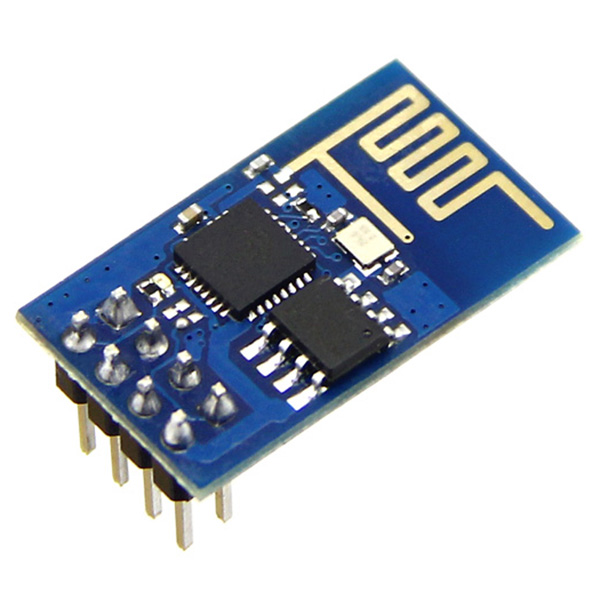
The ESP8266 might seem an odd choice for part of the decade, but it ushered in a new era of affordable connected devices.
It’s been my observation since long before Hackaday, that the hardware hacking world gains momentum following the appearance of new parts or technologies. I’ve referred to them in terms of epochs in the past. In the last decade we were fortunate that a happy confluence of several such events came within a short time; in the period from about 2005 to 2015 we received accessible and cheap single board computers, 3D printing affordable by mere mortals, cheap PCBs from China, and the explosion of parts and modules from AliExpress sellers. These have arguably been the backbone of Hackaday’s success, because you in our community have taken them and used them to craft such amazing projects. If I had to name a single part which embodies this it would be Espressif’s ESP8266, while it’s largely obsolete in 2026 its appearance in 2014 as a Wi-Fi enabled microcontroller for around a dollar was nothing short of revolutionary. Before the 8266 an Internet connected project was expensive and complex, afterwards it’s done as a matter of course, and ubiquitous.
The Future
If I have a perennial concern about where our community is going, it’s in wondering where the next of those epochs will come from. Sadly, we haven’t yet gotten our crystal ball working, but maybe it’s time to look ahead for a minute anyway.
Perhaps the most likely direction will come not from new parts or technologies, but from a reaction to the world around us. As trust in monolithic online services plummets I’m sure our community will respond, and I hope that in the next few years I can have a truly open-source smartphone devoid of links to large corporates, that I’d want to use. Projects that help disconnect from cloud services are going to be popular in the coming years.
I don’t join the general hype around AI, but I think that locally-hosted LLMs will increasingly find their way into projects featured here as the hardware to run them becomes commoditised. A semblance of a personality in our home automation for example is surely going to tempt some hackers, but maybe it won’t be the epoch I’m looking for. For that I see custom semiconductors as one promising future, and I hope that for example Tiny Tapeoput will be only the start. I know nothing about IC design, but I look forward to the time I first sit down to learn the ropes and order the Jenny Chip. It’s next-level now, but in 2036 it’s likely to be as normal as ordering a PCB is for us today.
How has the hackerspace community fared?

I miss you, Oxford Hackspace, but I don’t miss the drama.
I have spent a large proportion of my time in the world of hackerspaces over the last decade and before, ever since I saw my city had a group of people who’d started one. In them I have found my people, and found access to knowledge and experience well beyond my own. I’ve sat in spaces all across the UK and Europe and drunk caffeinated beverages with all manner of like-minded crazies, and it’s been a blast.
A good thing in that world over the years has been the extinguishing of the consensus model under which many early hackerspaces were run. I was a director of such a space whose drama level exceeded 1000 MilliNoiseBridges and it has marked me ever since, so it’s nice to see a much more sensible committee-based model take its place.
Every space has its own flavour, but the more recent ones I have been a member of in my peripatetic existence over the last few years have been blissfully stable and a joy to be part of. In Europe most established spaces are now in their second decade, and if I see a danger for them it’s in failing to keep attracting hackers in their 20s and fading into irrelevance. Maybe I’ll come back in another decade and tell you how that went.
How It All Began
A decade ago I was building a not-ultimately-successful electronic kit business when I saw one of Mike Szczys’ “We’re Hiring!” posts on my go-to hardware news website, and thought it looked like a fun thing to do. I didn’t realise that being the only electronic engineer who’d worked for the Oxford Dictionary put me uniquely in line for this, so from that happy accident onwards the last decade has been a blast. I’d like to thank you the Hackaday readers, my awesome Hackaday colleagues, and the wider community of crazy, weird, and talented people I have met along the way. The next decade of hardware hacking is now on.