
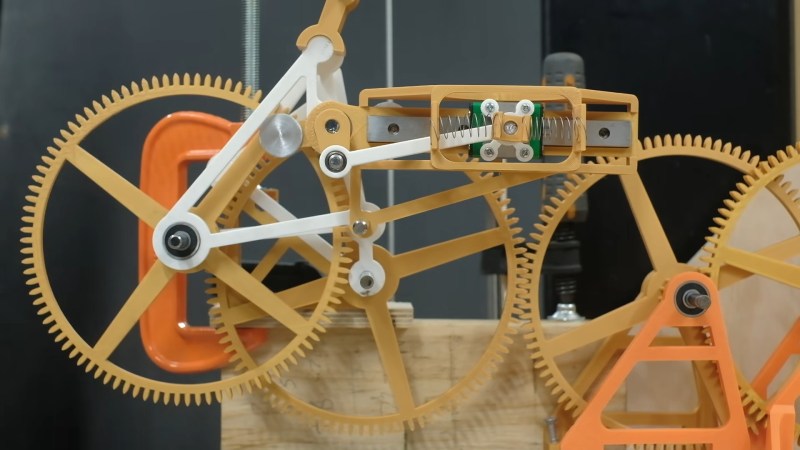
When it comes to clockwork, there is a spectrum — some people love the ticking, and some people hate it, while most fall into the broad middle of indifference. Once upon a time, Pope Alexander VII fell into the “hate it” category, and commissioned a silent timepiece from [Fratelli Campani] in 1656. Three hundred seventy years later, [Many Vices] sought out to re-create the mechanism in extruded plastic thanks to the efforts of watchmaker [Carlo G. Croce], who documented his brass recreation in this PDF file and his own videos.
While the archaeology of recreating the mechanism from old photos is interesting, the mechanism itself is the real showpiece. The secret, as you might be able to tell from the photographs, is an eccentric crank escapement that provides continuous movement rather than the traditional anchor escapement whose periodic movements creates the distinctive ‘tick’ and ‘tock’. [Many] tests both in his video so you can hear the difference and see how much power is wasted with the crank escapement, which doesn’t keep going very long.
We wonder if carefully tuning the flywheel he’s using to match the frequency of the swinging pendulum would help a little there. Likewise, his linear-rail-based spring pendulum modification — though it does look awesome and we’d love a train-themed clock using it — doesn’t come close to providing the runtime of traditional clockwork. That’s probably why the anchor escapement persisted for centuries, even if some people and Popes couldn’t stand the tick-tock.
We’ve featured a lot of different 3D printed clocks, from wholly mechanical to electromechanical digital units to even ones based on D20s , so it’s hard to believe that not much more than a decade back, printing a mechanical clock was considered a challenge. Time marches on whether we can hear it or not.