
If you know about Peltier modules, a solid-state fridge seems like an easy project. Pump 12V into the module, include a heat sink and a fan. Then you are done, right? According to [Peltier Power], this is not the way to design things, but it is common enough to give these units a reputation for failing quickly.
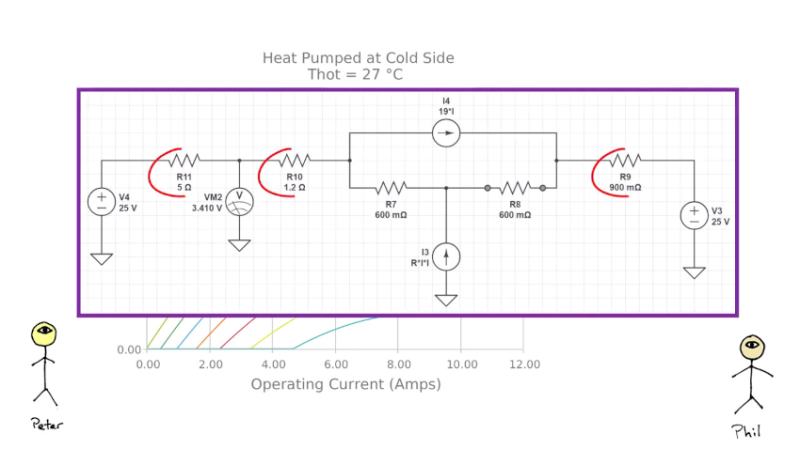
The problem is that while it makes sense that an inefficient Peltier module needs more power to get more cooling. But the reality is in practical applications, many designs push the current up when it should be moving it down. The curve describes a parabola, and you can be on the high side or low side and still get the same result. But obviously, you don’t want to put in more current and get the same cooling that you could get with lower currents.
According to the video, the mistake people make is pushing to a stable point to reach a cool point, then increasing the current until the chamber cools further. However, maintaining the cool doesn’t have to require a higher current. Once cold, you can reduce the current to maintain temperature, so to get colder, you can just lower the current less instead of increasing it. Of course, that’s somewhat of a simplification. You have to account for other thermal design factors, but that’s the general idea.
He has noted this behavior in commercial units, but did find one brand that had the correct logic. He also has some tips on using these types of coolers.
Our favorite use for these modules has to be a cloud chamber. Naturally, we’ve seen a fair number of homebrew fridges.