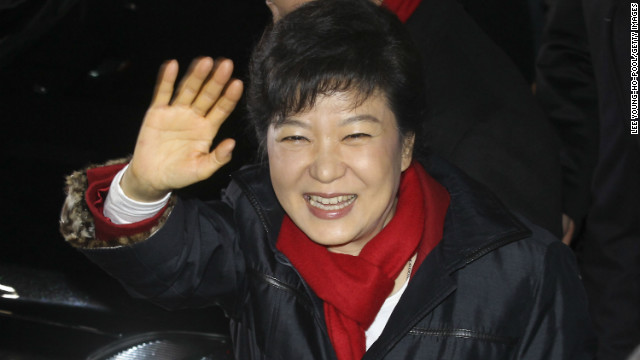
President-elect Park Geun-Hye, South Korea's first female president, waves to supporters after being declared the winner on December 19, 2012 in Seoul. She will become one of several female leaders in Asia, as well as the world.
" border="0" height="360" id="articleGalleryPhoto002" width="640"/>Julia Gillard, the first woman in Australia to hold the position as prime minister, assumed office in 2010. She made a fiery speech about sexism that drew global attention in October.
Yingluck Shinawatra became Thailand's first female prime minister in 2011 after her party won a majority of parliamentary seats. She is the younger sister of one of Thailand's most polarizing political figures, former Prime Minister Thaksin Shinawatra.
Sheikh Hasina is the prime Minister of Bangladesh. She is the daughter of Sheikh Mujibur Rahman, who led efforts for autonomy from Pakistan and was killed in a coup.
Dilma Rousseff assumed office in January 2011, becoming the first woman to become Brazil's president. Other female leaders in Latin America are Laura Chinchilla and Cristina Fernández de Kirchner, presidents of Costa Rica and Argentina, respectively.
Trinidad and Tobago's Prime Minister Kamla Persad-Bissessa has held the office since 2010.
Ellen Johnson Sirleaf has been Liberia's president since 2006. In 2011, she won the Nobel Peace Prize along with two others for their women's rights advocacy. Another female president in sub-Saharan Africa is President Joyce Banda in Malawi, who took office in 2012.
Lithuanian President Dalia Grybauskait