
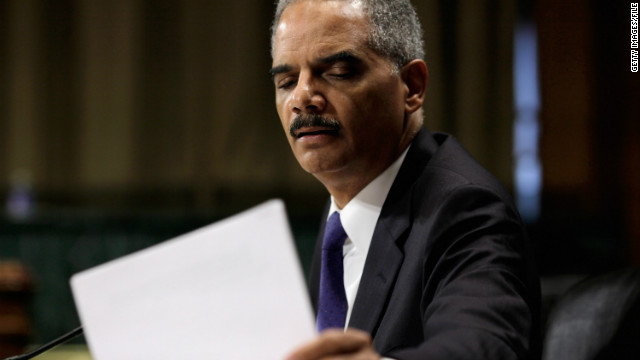
Republicans say Attorney General Eric Holder and the Justice Department are concealing details on Fast and Furious.
- The dispute involves documents in the "Fast and Furious" failed weapons crackdown
- The U.S. House cited Attorney General Eric Holder for contempt of Congress
- The White House claimed executive privilege
- Democrats protested the contempt citation as a political move
Washington (CNN) -- The House Oversight Committee plans to file a civil contempt suit against Attorney General Eric Holder Monday after a contempt of Congress citation passed the House of Representatives last month.
"We are filing charges against Attorney General Eric Holder tomorrow," said a post on committee chairman Rep. Darrell Issa's official Twitter account late Sunday, which included the hash tag "fastandfurious."
The lawsuit was not unexpected after the White House and Justice Department said in early July that Holder will not face criminal prosecution under the congressional citation.
Legal experts said previously that President Barack Obama's assertion of executive privilege in the case would prevent a criminal prosecution under a practice dating to the Reagan administration.
Hedging their bets, the House also cited Holder for civil contempt to give it the option of filing a lawsuit compelling Holder to turn over documents sought by Oversight Committee investigators linked to the failed Operation Fast and Furious weapons crackdown. Such a case was expected to take years to complete.
A July 6 letter from the Justice Department to Issa, who led the investigation that brought the contempt charge against Holder, explained that "across administrations of both political parties, the longstanding position of the Department of Justice has been and remains that we will not prosecute" in such a circumstance.

"The department will not bring the congressional contempt citation before a grand jury or take any other action to prosecute the Attorney General," concluded the letter from Deputy Attorney General James Cole.
White House spokesman Jay Carney said the same thing, also on July 6, saying "it is an established principle, dating back to the administration of President Ronald Reagan, that the Justice Department does not pursue prosecution in a contempt case when the president has asserted executive privilege."
Fast and Furious investigation started with agent's death
A spokesman for Issa's committee and another top congressional Republican, veteran Sen. Charles Grassley of Iowa, complained at the time that the refusal to prosecute showed a lack of independence by the U.S. attorney who would handle the case.
"It is regrettable that the political leadership of the Justice Department is trying to intervene in an effort to prevent the U.S. attorney for the District of Columbia from making an independent decision about whether to prosecute this case," said Frederick Hill, the panel's director of communications.
Obama asserted executive privilege on some documents sought by Issa's committee in its investigation of Operation Fast and Furious. The executive privilege assertion prevented the documents from being turned over on the grounds that they include internal deliberations traditionally protected from outside eyes.
AME Church likens Congress's Holder vote to 'evil strategies' following Reconstruction
The Bureau of Alcohol, Tobacco, Firearms and Explosives launched Operation Fast and Furious out of Arizona to track weapons purchases by Mexican drug cartels. It followed similar programs started in the Bush administration.
However, Fast and Furious lost track of more than 1,000 firearms it had been monitoring, and two of the lost weapons turned up at the scene of the 2010 killing of U.S. Border Patrol agent Brian Terry.
Issa, R-California, and Republicans contend that Holder and the Justice Department are concealing details of how Fast and Furious was approved and managed.
Democrats argue that Issa and his GOP colleagues are using the issue to try to score political points by discrediting Holder and, by extension, the president in an election year.
The showdown between Issa and Holder over the program dates to subpoenas issued last year by the House committee seeking a wide range of documents and other materials. Eventually, the committee reduced its demand to focus on documents involving decision-making after the Fast and Furious program was shut down.
Executive privilege: A rocky legal and political road in U.S. history
In particular, the committee wanted internal documents relating to the period after February 2011, when the Justice Department sent Congress an erroneous letter -- later withdrawn -- that said top officials knew nothing about Fast and Furious until early that year.
In July, Issa conceded that investigators lack any evidence that Holder knew of the failed weapons-tracking tactics of Fast and Furious. The contempt citation, he said, was for Holder's failure to comply with subpoenas seeking specific documents.
"It's not for what the attorney general knew about Fast and Furious," Issa said. "It's about the attorney general's refusal to provide the documents."
Carney said last month that Issa's comment showed the contempt citation was about politics.
The truth about the Fast and Furious scandal
CNN's Tom Cohen, Carol Cratty, Terry Frieden and Alan Silverleib contributed to this report.
