
Published August 24, 2013 FoxNews.com
Defense Secretary Chuck Hagel suggested Friday that the Pentagon was moving naval forces closer to Syria in preparation for a possible decision by President Obama to order military strikes.
Hagel declined to describe any specific movements of U.S. forces. He said Obama asked that the Pentagon prepare military options for Syria and that some of those options "requires positioning our forces."
The president's senior national security advisers are expected to meet at the White House this weekend to discuss possible military options for responding to the alleged use of chemical weapons by the Syrian government, a U.S. official told Fox News Friday.
U.S. defense officials told The Associated Press that the Navy had sent a fourth warship armed with ballistic missiles into the eastern Mediterranean Sea but without immediate orders for any missile launch into Syria.
U.S. Navy ships are capable of a variety of military action, including launching Tomahawk cruise missiles, as they did against Libya in 2011 as part of an international action that led to the overthrow of the Libyan government.
"The Defense Department has a responsibility to provide the president with options for contingencies, and that requires positioning our forces, positioning our assets, to be able to carry out different options -- whatever options the president might choose," Hagel said.
He said the U.S. is coordinating with the international community to determine "what exactly did happen" in the reported use by the Syrian government of chemical weapons against civilians earlier this week.
"We're still assessing that," he said.
Hagel said a determination on the chemical attack should be made swiftly because "there may be another attack coming," although he added that "we don't know" whether that will happen.
Meanwhile, Syrian state media accused rebels of using chemical arms against government troops in clashes Saturday near Damacus, while Doctors Without Borders said it has tallied 355 deaths from the purported chemical weapons attack on Wednesday.
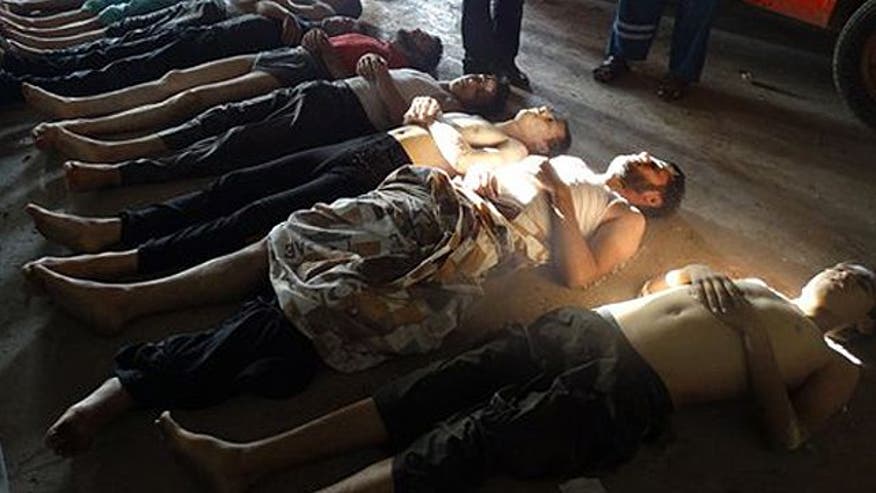
The international aid group said three hospitals it supports in the eastern Damascus region reported receiving roughly 3,600 patients with "neurotoxic symptoms" over less than three hours on Wednesday morning when the attack in the eastern Ghouta area took place. Of those, 355 died.
Syrian state media said Saturday the army offensive in Jobar, near Damascus, had forced the rebels to resort to chemical weapons "as their last card." State TV broadcast images of plastic jugs, gas masks, vials of an unspecified medication, explosives and other items that it said were seized from rebel hideouts. It did not, however, show any video of soldiers reportedly affected by toxic gas in the fighting.
The claims could muddy the debate about who was responsible for Wednesday's alleged gas attack, which spurred demands for an independent investigation and renewed talk of potential international military action if chemical weapons were indeed used.
Just hours before the state media reports, the U.N. disarmament chief arrived in Damascus to press Assad's regime to allow U.N. experts to investigate the attacked attack. The regime has denied allegations that it was behind that attack, calling them "absolutely baseless" and suggesting they are an attempt to discredit the government.
The state news agency said several government troops who took part in the Jobar offensive experienced severe trouble breaking or even "suffocation" after "armed terrorist groups used chemical weapons." It was not clear what was meant by "suffocation" and the report mentioned no fatalities among the troops.
"The Syrian Army achieves major progress in the past days and for that reason, the terrorist groups used chemical weapons as their last card," state TV said.
The report was followed by an unusual string of breaking alerts on the TV's news scroll Saturday, with a series of claims related to the alleged use of chemical arms by rebels in Jobar.
One message cited a Syrian TV journalist who is embedded with the troops in the district who said the army confiscated an arms cache that included gas masks and several barrels with "made in Saudi Arabia" stamped on them. It did not say what was in the barrels, but appeared to suggest that some sort of chemical agent was inside and supplied by Saudi Arabia, the region's Sunni Muslim power and a staunch supporter of Syria's Sunni-led revolt.
Another news scroll said that troops, after overrunning rebel positions, discovered antidotes following exposure to chemical agents. The TV said the medicines were produced by a Qatari-German medical supplies company. Qatar is another strong supporter of the Syrian rebels. The report could not be immediately verified.
State TV also broadcast images of a Syrian army officer, wearing a surgical mask, telling reporters wearing similar masks that soldiers were subjected to poisonous attack in Jobar. He spoke inside the depot where the alleged confiscated products were placed.
"Our troops did not suffer body wounds," said the officer said. "I believe terrorist groups used special substances that are poisonous in an attempt to affect this advance."
The reported attack Wednesday would amount to the most heinous use of chemical weapons since Saddam Hussein gassed thousands of Kurds in the town of Halabja two-and-half decades ago.
Hagel said that although he is scheduled to spend the next week traveling in Southeast Asia, he will remain in contact with the White House about developments in Syria and planning for potential U.S. action.
Obama conceded in an interview on CNN's "New Day" program that the episode is a "big event of grave concern" that requires American attention. He said any large-scale chemical weapons usage would affect "core national interests" of the United States and its allies. But nothing he said signaled a shift toward U.S. action.
The president made no mention of the "red line" of chemical weapons use that he marked out for Syrian President Bashar Assad a year ago and that U.S. intelligence says has been breached at least on a small scale several times since.
U.S. confirmation took more than four months after rebels similarly reported chemical attacks in February, though in this instance a U.N. chemical weapons team is already on the ground in Syria. Assad's government, then as now, has denied the claims as baseless.
Obama also cited the need for the U.S. to be part of a coalition in dealing with Syria. America's ability by itself to solve the Arab country's sectarian fighting is "overstated," he said.
The Associated Press contributed to this report.

Defense Secretary Chuck Hagel suggested Friday that the Pentagon was moving naval forces closer to Syria in preparation for a possible decision by President Obama to order military strikes.
Hagel declined to describe any specific movements of U.S. forces. He said Obama asked that the Pentagon prepare military options for Syria and that some of those options "requires positioning our forces."
The president's senior national security advisers are expected to meet at the White House this weekend to discuss possible military options for responding to the alleged use of chemical weapons by the Syrian government, a U.S. official told Fox News Friday.
U.S. defense officials told The Associated Press that the Navy had sent a fourth warship armed with ballistic missiles into the eastern Mediterranean Sea but without immediate orders for any missile launch into Syria.
U.S. Navy ships are capable of a variety of military action, including launching Tomahawk cruise missiles, as they did against Libya in 2011 as part of an international action that led to the overthrow of the Libyan government.
"The Defense Department has a responsibility to provide the president with options for contingencies, and that requires positioning our forces, positioning our assets, to be able to carry out different options -- whatever options the president might choose," Hagel said.
He said the U.S. is coordinating with the international community to determine "what exactly did happen" in the reported use by the Syrian government of chemical weapons against civilians earlier this week.
"We're still assessing that," he said.
Hagel said a determination on the chemical attack should be made swiftly because "there may be another attack coming," although he added that "we don't know" whether that will happen.
Meanwhile, Syrian state media accused rebels of using chemical arms against government troops in clashes Saturday near Damacus, while Doctors Without Borders said it has tallied 355 deaths from the purported chemical weapons attack on Wednesday.
The international aid group said three hospitals it supports in the eastern Damascus region reported receiving roughly 3,600 patients with "neurotoxic symptoms" over less than three hours on Wednesday morning when the attack in the eastern Ghouta area took place. Of those, 355 died.
Syrian state media said Saturday the army offensive in Jobar, near Damascus, had forced the rebels to resort to chemical weapons "as their last card." State TV broadcast images of plastic jugs, gas masks, vials of an unspecified medication, explosives and other items that it said were seized from rebel hideouts. It did not, however, show any video of soldiers reportedly affected by toxic gas in the fighting.
The claims could muddy the debate about who was responsible for Wednesday's alleged gas attack, which spurred demands for an independent investigation and renewed talk of potential international military action if chemical weapons were indeed used.
Just hours before the state media reports, the U.N. disarmament chief arrived in Damascus to press Assad's regime to allow U.N. experts to investigate the attacked attack. The regime has denied allegations that it was behind that attack, calling them "absolutely baseless" and suggesting they are an attempt to discredit the government.
The state news agency said several government troops who took part in the Jobar offensive experienced severe trouble breaking or even "suffocation" after "armed terrorist groups used chemical weapons." It was not clear what was meant by "suffocation" and the report mentioned no fatalities among the troops.
"The Syrian Army achieves major progress in the past days and for that reason, the terrorist groups used chemical weapons as their last card," state TV said.
The report was followed by an unusual string of breaking alerts on the TV's news scroll Saturday, with a series of claims related to the alleged use of chemical arms by rebels in Jobar.
One message cited a Syrian TV journalist who is embedded with the troops in the district who said the army confiscated an arms cache that included gas masks and several barrels with "made in Saudi Arabia" stamped on them. It did not say what was in the barrels, but appeared to suggest that some sort of chemical agent was inside and supplied by Saudi Arabia, the region's Sunni Muslim power and a staunch supporter of Syria's Sunni-led revolt.
Another news scroll said that troops, after overrunning rebel positions, discovered antidotes following exposure to chemical agents. The TV said the medicines were produced by a Qatari-German medical supplies company. Qatar is another strong supporter of the Syrian rebels. The report could not be immediately verified.
State TV also broadcast images of a Syrian army officer, wearing a surgical mask, telling reporters wearing similar masks that soldiers were subjected to poisonous attack in Jobar. He spoke inside the depot where the alleged confiscated products were placed.
"Our troops did not suffer body wounds," said the officer said. "I believe terrorist groups used special substances that are poisonous in an attempt to affect this advance."
The reported attack Wednesday would amount to the most heinous use of chemical weapons since Saddam Hussein gassed thousands of Kurds in the town of Halabja two-and-half decades ago.
Hagel said that although he is scheduled to spend the next week traveling in Southeast Asia, he will remain in contact with the White House about developments in Syria and planning for potential U.S. action.
Obama conceded in an interview on CNN's "New Day" program that the episode is a "big event of grave concern" that requires American attention. He said any large-scale chemical weapons usage would affect "core national interests" of the United States and its allies. But nothing he said signaled a shift toward U.S. action.
The president made no mention of the "red line" of chemical weapons use that he marked out for Syrian President Bashar Assad a year ago and that U.S. intelligence says has been breached at least on a small scale several times since.
U.S. confirmation took more than four months after rebels similarly reported chemical attacks in February, though in this instance a U.N. chemical weapons team is already on the ground in Syria. Assad's government, then as now, has denied the claims as baseless.
Obama also cited the need for the U.S. to be part of a coalition in dealing with Syria. America's ability by itself to solve the Arab country's sectarian fighting is "overstated," he said.
The Associated Press contributed to this report.