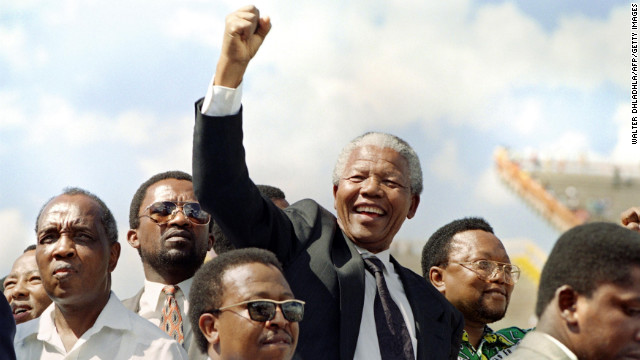
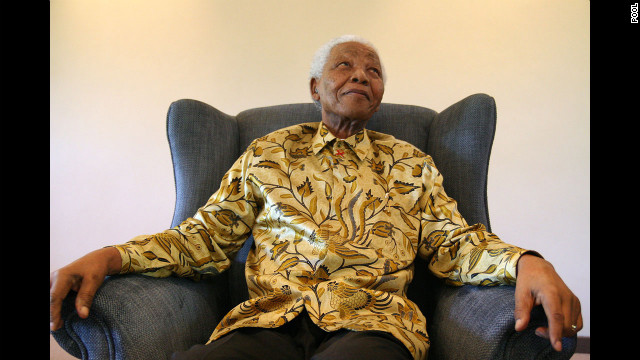
Nelson Mandela, now 94, endured 27 years in prison before becoming South Africa's first president from 1994 to 1999. Pictured, Mandela in Mmabatho for an election rally on March 15, 1994.
Mandela married his second wife, social worker Winnie Madikizela, in 1958. At the time, he was an active member of the African National Congress and had begun his lifelong commitment to ending segregation in South Africa.
In 1964, Mandela was sentenced to life imprisonment for plotting to overthrow South Africa's apartheid regime. Here, his wife, Winnie, leaves the courtroom after the verdict.
Winnie Mandela addresses a crowd of supporters in Johannesburg in 1988, standing in front of a pile of cards addressed to her husband at an event marking his 70th birthday. She led an international campaign calling for his release.
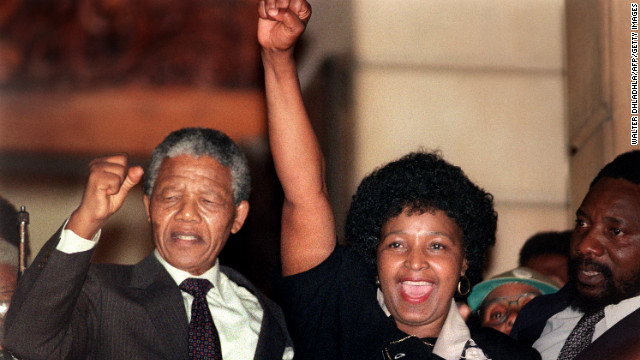
Nelson and Winnie Mandela raise their fists to salute a cheering crowd upon his 1990 release from Victor Verster Prison. He was still as upright and proud, he would say, as the day he walked into prison 27 years before.
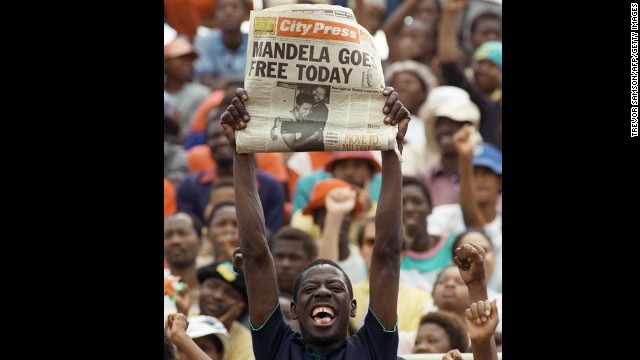
A jubilant South African holds up a newspaper announcing Mandela's release from prison at an ANC rally in Soweto on February 11, 1990.
Mandela attends a rally celebrating his release from jail at Soweto Soccer City stadium on February 13, 1990. More than 100,000 people attended the event.
Mandela and Zambian President Kenneth Kaunda arrive at an ANC rally on March 3, 1990, in Lusaka, Zambia. Mandela was elected president of the ANC the next year.
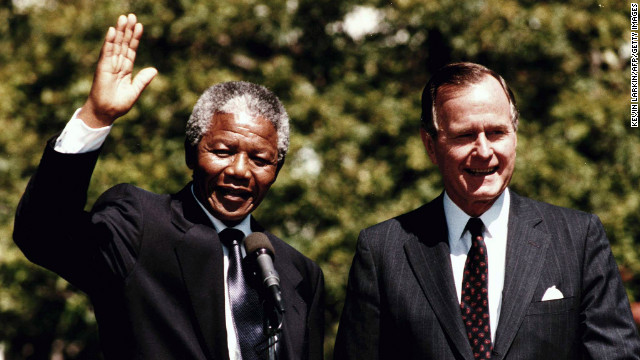
After his release in 1990, Mandela embarked on a world tour, meeting U.S. President George Bush at the White House in June.
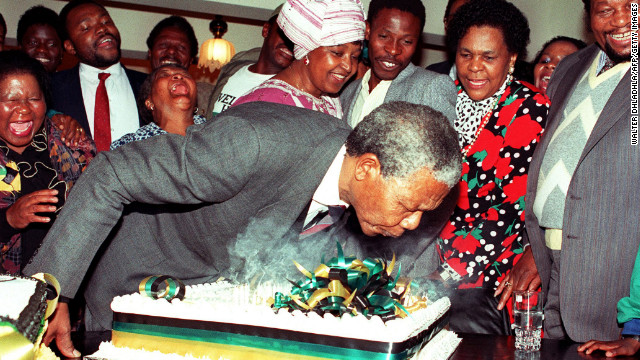
At his Soweto home on July 18, 1990, Mandela blows out the candles on his 72nd birthday cake. It was the first birthday he celebrated as a free man since the 1960s.
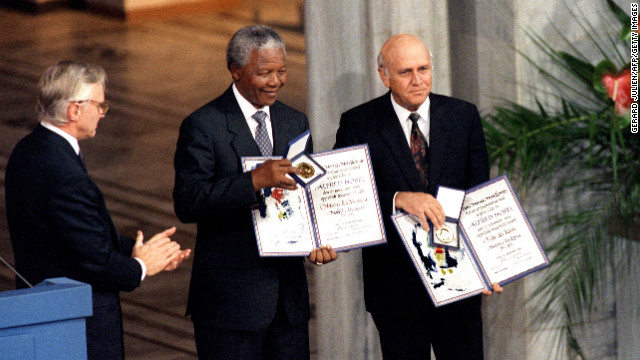
South African President Frederik de Klerk, right, and Mandela shared a Nobel Peace Prize in 1993 for their work to secure a peaceful transition from apartheid rule.
An estimated 40,000 ANC supporters listen to Mandela's address during a 1994 rally ahead of South Africa's general election.
Mandela was elected president in the first open election in South African history on April 29, 1994. He's pictured here taking the oath at his inauguration in May, becoming the nation's first black president.
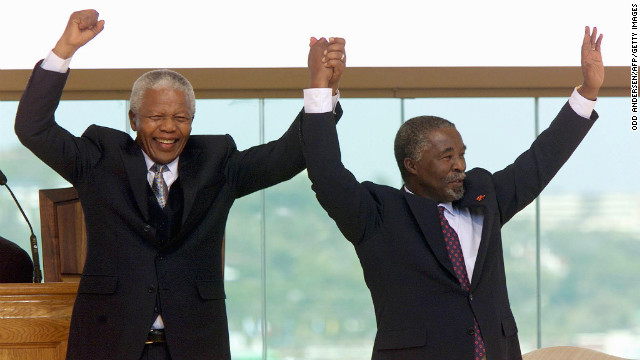
After one term as president, Mandela stepped down. Thabo Mvuyelwa Mbeki, at right, was sworn in as his replacement in June 1999.
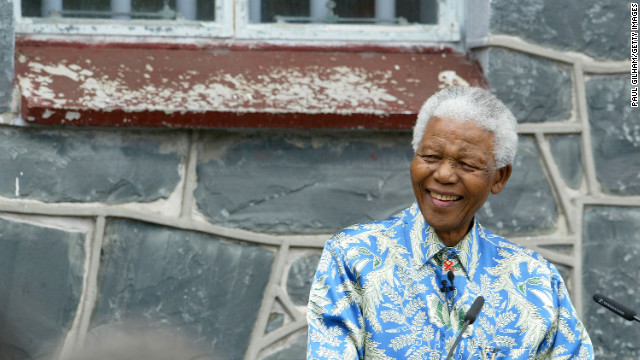
Mandela was sent to the infamous Robben Island, a prison five miles off the coast of South Africa, where he would spend 18 of his 27 years behind bars. His cell is shown here in 2003.
Mandela sits outside his former prison cell on Robben Island on November 28, 2003 ahead of his AIDS benefit concert at Green Point Stadium in Cape Town.
The "46664 - Give One Minute of Your Life to AIDS" concert was held on November 29, 2003. 46664 was Mandela's identification number in prison.
Mandela shows something to a group of international journalists visiting the Nelson Mandela Foundation in Johannesburg, May 2004.
Mandela welcomes a group of international journalists visiting the Nelson Mandela Foundation in Johannesburg in May 2004.
Mandela throws a rose on the grave of his son Makgatho in Qunu on January 15, 2005. He disclosed that his son had died of AIDS and said the disease should be given publicity so people would stop viewing it as extraordinary.
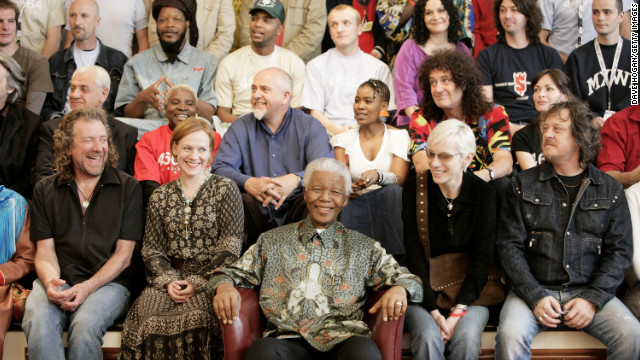
The "46664 Arctic" benefit concert was held in Tromso, Norway, on June 11, 2005. Mandela is pictured here surrounded by artists who performed at the event.
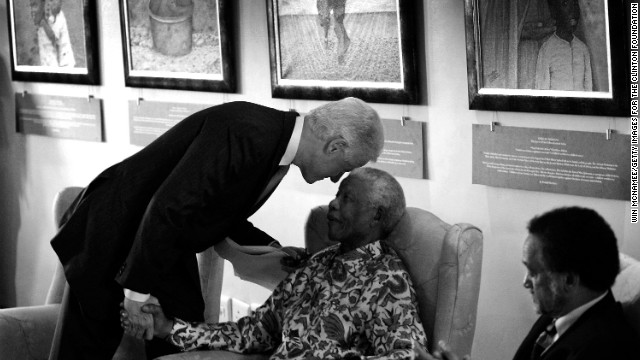
Former U.S. President Bill Clinton leans down to whisper to former South African President Nelson Mandela during a visit to the Nelson Mandela Foundation on July 19, 2007 in Johannesburg.
A bronze statue of Mandela was unveiled in Parliament Square in London on August 29, 2007. The 9-foot statue faces the Houses of Parliament.
Mandela poses with the Webb Ellis Cup during the Springboks rugby team's visit to his Johannesburg home on October 27, 2007. South Africa became the holders of the cup after defeating England in the 2007 Rugby World Cup Final.
Mandela leaves the InterContinental Hotel after a photoshoot with celebrity photographer Terry O'Neil on June 26, 2008 in London, England.
Mandela celebrates his 90th birthday at a celebration in July 2008 in his rural village.
Mandela meets in 2009 with international children as part of his 46664 Foundation, named after the number he wore while imprisoned for 27 years.
Mandela votes April 2009 in South Africa's fourth democratic election.
South African defender Aaron Mokoena presents a jersey for the national team to Mandela when meeting before a semifinal match against Brazil, June 2009.
An inmate at the Groot Drakenstein Prison in February 2010 cleans the base of a bronze statue depicting Mandela walking to freedom in 1990. Mandela spent his final months of imprisonment in a private house at Groot Drakenstein.
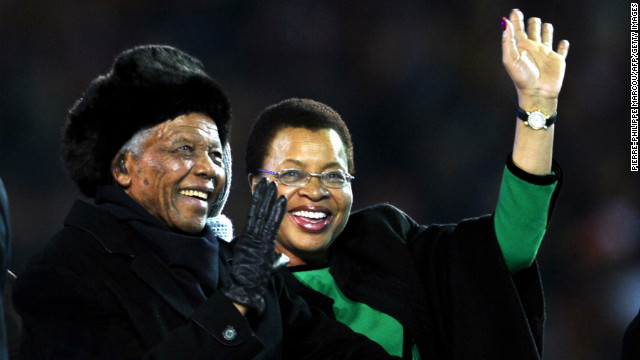
Nelson Mandela and his third wife, Graca Machel, arrive at the 2010 World Cup before the final match between Netherlands and Spain on July 11, 2010, at Soccer City Stadium in Soweto.
Surrounded by family members, Mandela celebrates his 92nd birthday at his home in Johannesburg on July 18, 2010.
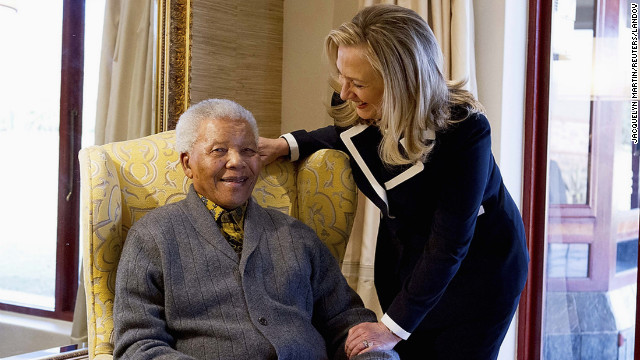
U.S. Secretary of State Hillary Clinton meets with Mandela, 94, at his home in Qunu, South Africa, on August 6, 2012.
1
2
3
4
5
6
7
8
9
10
11
12
13
14
15
16
17
18
19
20
21
22
23
24
25
26
27
28
29
30
31
32
33
- Crowds of supporters and news crews stand outside the hospital
- Nelson Mandela's family visits his bedside
- Officials say Mandela's condition worsened over the weekend
Pretoria, South Africa (CNN) -- Former South African President Nelson Mandela remained hospitalized in critical condition Tuesday, a government spokesman said.
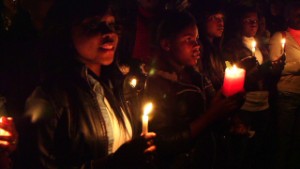
As night fell, well-wishers outside the Pretoria hospital where Mandela lay chanted his name, hung signs of support on bulletin boards and left flowers.
"We wish him well. We are calling on the world to unite and pray for Madiba," said 24-year-old Innocentia Moselane, using Mandela's traditional clan name. "He is our icon, and we love him."
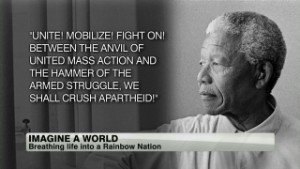
During his 27 years behind bars for fighting apartheid, Mandela became a rallying symbol for those fighting South Africa's white-minority rule at home and abroad. His release in 1990 was the beginning of the end of apartheid, the system of legalized racial segregation the South African government enforced for more than 45 years.
Dozens gather to pray for Nelson Mandela
Daughter: He is at peace
Mandela relatives lay claim
The whole world prays for one man
"He is our hero. He is my mentor, my father. He is everything to me," 36-year-old Kuda Nyahumzvi told CNN outside the hospital. "But when it is his time, we wish his soul could just rest. He spent so long in jail and struggling."
Among the balloons, posters and cards outside the hospital Tuesday were dozens of news crews and broadcast vans.
More than 40 vehicles crowded the parking spaces outside the Medi-Clinic Heart Hospital in Pretoria, the South African Press Association reported. Generators hummed and the area was brightly lit for the news organizations doing regular live broadcasts.
Government officials and several of Mandela's family members visited him in the hospital on Tuesday, the South African Press Association reported.
Mandela's wife, Graca Machel, spends every night at the hospital, where theformer president has been since June 8 for a recurring lung infection. Previously, authorities had described his condition as serious but stable.
But over the weekend, his health took a turn for the worse, with the South African president's office saying he was in critical condition.
"The doctors are doing everything possible to ensure his well-being and comfort," President Jacob Zuma told the nation Monday.
When the country held its first multiracial elections in 1994, Mandela became the South Africa's first black president. He stepped down in 1999 after serving a single term.
Though he continued to be a voice on the world stage for developing nations, human rights and the fight against AIDS after leaving office, Mandela, 94, has been sidelined by advancing age and bouts of illness in recent years.
He last appeared in public in 2010.
Journalist Hamilton Wende and CNN's Matt Smith contributed to this report.