
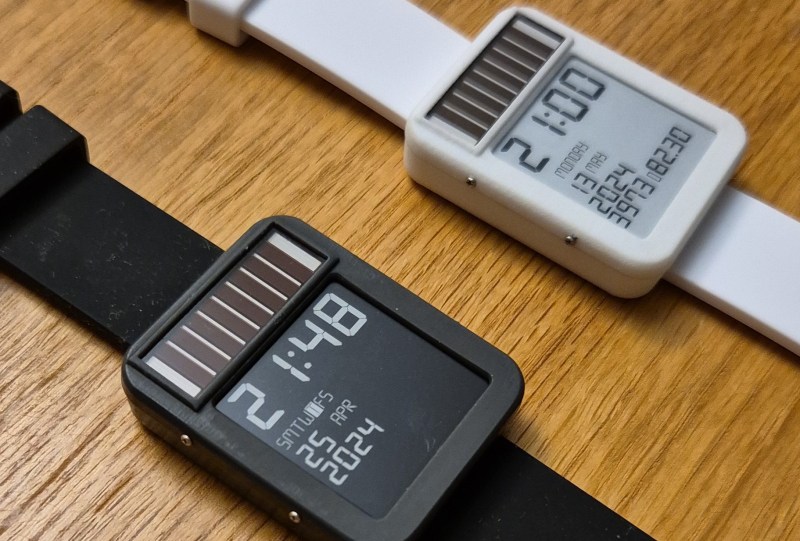
There’s something about the ESP32 family of microcontrollers and timekeeping. We probably see it in clocks as often as we do anything else; we also probably see more clocks with one as the beating heart than any of the many other possible timekeeping options.
[Daniel Ansorregui]’s LightInk watch is no different in that regard — but it is very different in one important detail, because like any other smartwatch, you won’t have to worry about battery life. Outside of gloomiest Gotham, its built-in solar panel should be able to keep it charged.
That’s for a few reasons. The obvious one is the e-ink display, which only takes a sip of power during updates. That’s hardly unique to [Daniel]’s projec t– he quite explicitly calls out the Watchy project, which we featured previously, as where he got the idea of putting e-ink and an ESP32-PICO together on his wrist. What is unique is the delightful hack [Daniel] is using to minimize power usage, which is our favorite part.
Obviously while the display isn’t updating and there’s no input from the touchscreen, the microcontroller should be in deep sleep. So, [Daniel] sets wake-up timers and an interrupt for the touch input and it’s all good, right? Well, yes, but when the ESP32 ran through a normal startup, [Daniel] clocked 28 mS to boot — and a whole milli-amp-second of juice out of the battery. That was pretty much down to the need to write the code from flash into RAM, and good luck power-optimizing that. Instead [Daniel] found a way to skip it, using the RTC.
The RTC has its own memory, which the ESP32 can start from in a microsecond or so. It turned out large enough to squeeze everything needed for these fast updates, including the SPI display driver. Since around two thirds of the watch’s power consumption was just booting up, slicing that doubled the energy efficiency, making solar power possible. Well, as long as you don’t get too excited using the fancier “smart” features like GPS and LoRA too often. Relatively speaking, those are power hogs. There are actually a lot of features, but we’ll let you check them out in the demo video below if you’re really interested.