
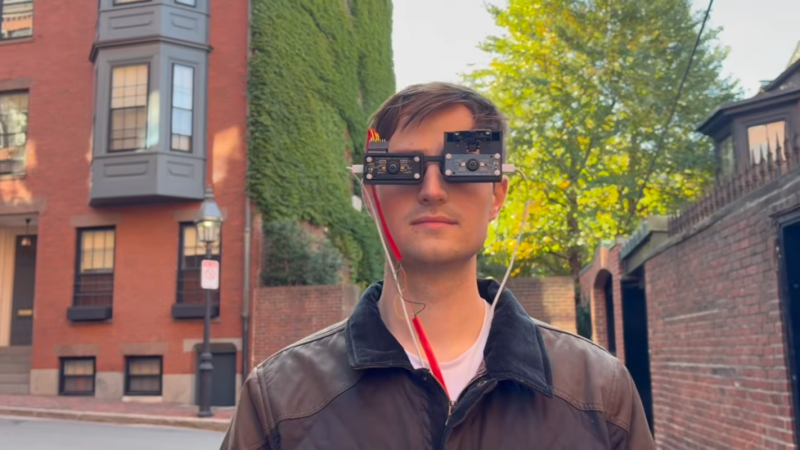
The human brain has a fairly remarkable ability to take any sensory input and convert it into another type. Most notably, those with vision impairments can use systems that produce sound from what they see in the environment, with the brain learning to process this information visually after some time. Touch is another sense that can be remapped to vision, and [DebackTech] has come up with this system which uses a series of vibration motors to assist the visually impaired.
The brain’s ability to transfer information from one system to another is known as cross-modal plasticity. This system specifically uses a pair of glasses that have LiDAR built in. The sensors continually scan the environment, providing a computer with distance and direction information. The computer processes this and outputs its findings immediately to a shirt with an array of vibration motors sewn into it. With practice, a user can learn to identify obstacles based on the vibration of these motors.
As far as actually usability goes, [DebackTech] was able to use them to walk around, ride an electric scooter, and play catch with a large, slow-moving ball. The prototype system is a little bit bulky for now but in a place like Boston with so many universities this presumably wouldn’t draw that much attention, and it could also be streamlined in future versions.
There are some other interesting methods that can be used to help those with visual disabilities, sometimes without using any technology at all.