
Oren Dorell, USA TODAY 1:19 p.m. EST November 8, 2013
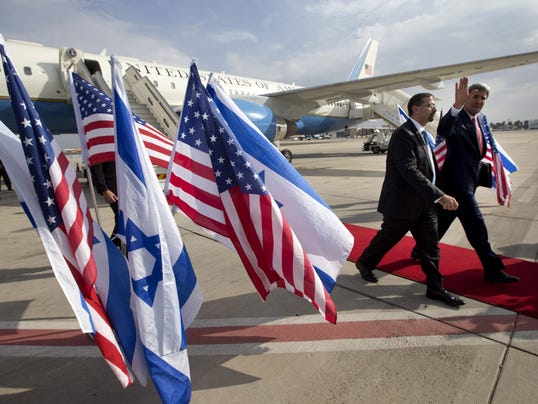
Secretary of State John Kerry walks alongside U.S. Ambassador to Israel Dan Shapiro, as the former arrives in Israel for a private meeting with Prime Minister Benjamin Netanyahu on Nov. 8, 2013.(Photo: Jason Reed, AFP/Getty Images)
[h=3]Story Highlights[/h]
SHARE 317 CONNECT EMAILMORE
Secretary of State John Kerry traveled to Geneva on Friday to try and "narrow the differences" with Iran on an interim agreement over its nuclear program, a proposal Israel says would be a "very bad deal" that allows Iran to keep heading toward a possible atomic bomb.
There has been no confirmation that a deal is close or details of possible elements of such a pact. But Israeli Prime Minister Benjamin Netanyahu spoke as if he knew what kind of offer was being discussed in Geneva by negotiators for the United States and other Western nations.
Speaking before a meeting with Kerry in Jerusalem on Friday, Netanyahu said it appears that the Iranians "got everything and paid nothing."
"They wanted relief of sanctions after years of grueling sanctions, they got that. They paid nothing because they are not reducing in any way their nuclear enrichment capability. So Iran got the deal of the century and the international community got a bad deal," Netanyahu said.
Netanyahu said that since Israel is not obligated by the agreement it reserves the right to do what it feels is necessary to defend itself, an apparent reference to a possible military strike against Iranian nuclear facilities.
John Earnest, a deputy press secretary for the White House, told reporters "there is no deal," and that "any critique of the deal is premature."
Israel and the USA suspect the facilities are being used to develop a nuclear bomb. Iran insists its nuclear program is for peaceful means.
Israel says the United States should seek nothing less than a total shutdown of uranium enrichment and other nuclear programs in Iran in return for the easing of economic sanctions.
Kerry said when he arrived Friday in Geneva at the invitation of European Union representative Catherine Ashton, that there are still "some important gaps that have to be closed" with Iran if an agreement is to be reached. Netanyahu said he reminded Kerry of Iran's true nature, a foe of America and supporter of Islamic terror attacks worldwide.
Bernadette Meehan, a spokeswoman for President Obama's National Security Council, said Friday the so-called "first step" offer, "would address Iran's most advanced nuclear activities, increase transparency so Iran will not be able to use the cover of talks to advance its program, and create time and space as we negotiate a comprehensive agreement."
If Iran does not live up to its commitments, "the temporary, modest relief would be terminated, and we would be in a position to ratchet up the pressure even further by adding new sanctions," Meehan said.
Mark Dubowitz, executive director of the Foundation for Defense of Democracies, says the parts of the offer he was briefed on by the White House undercut sanctions meant to block Iran from acquiring equipment it could use to develop its nuclear program or for weapons, and to convince Iran to negotiate a solution with world powers. The plan would give Iran a cash infusion from frozen accounts it can use to expand nuclear facilities or to fund terrorism, Dubowitz said.
"It totally eviscerates the sanctions regime if you allow Iran to spend money at its discretion to fund the very nuclear program it's funding, the very nuclear program you're trying to stop, or to fund terrorist activities against American citizens," said Dubowitz, who had proposed a different plan to allow Iran to buy non-sanctioned goods in Europe while negotiations continue.
Iran has $80 billion in foreign accounts, with unrestricted access to only $20 billion, Dubowitz said. He said he was not told the amounts under consideration in the plan.
"They told me, don't worry, it's reversible. If they cheat it won't happen again. But that's not reversible, unless you only give them 1% up front and more later."
Israel considers a nuclear-armed Iran to be an existential threat, citing hostile Iranian rhetoric toward the Jewish state, Iran's missile capabilities and its support for violent Middle Eastern militant groups.
Netanyahu says pressure must be maintained until Iran halts all enrichment of uranium, a key step in producing a nuclear weapon; removes its stockpile of enriched uranium from the country; closes suspicious enrichment facilities and shutters a facility that could produce plutonium, another potential gateway to nuclear arms.
Contributing: The Associated Press
SHARE 317 CONNECT EMAILMORE

Secretary of State John Kerry walks alongside U.S. Ambassador to Israel Dan Shapiro, as the former arrives in Israel for a private meeting with Prime Minister Benjamin Netanyahu on Nov. 8, 2013.(Photo: Jason Reed, AFP/Getty Images)
[h=3]Story Highlights[/h]
- Israel PM calls emerging nuclear deal 'bad'
- Secretary of State Kerry heads to Geneva for talks
- Israel has vowed to not let Iran get nuclear weapons
SHARE 317 CONNECT EMAILMORE
Secretary of State John Kerry traveled to Geneva on Friday to try and "narrow the differences" with Iran on an interim agreement over its nuclear program, a proposal Israel says would be a "very bad deal" that allows Iran to keep heading toward a possible atomic bomb.
There has been no confirmation that a deal is close or details of possible elements of such a pact. But Israeli Prime Minister Benjamin Netanyahu spoke as if he knew what kind of offer was being discussed in Geneva by negotiators for the United States and other Western nations.
Speaking before a meeting with Kerry in Jerusalem on Friday, Netanyahu said it appears that the Iranians "got everything and paid nothing."
"They wanted relief of sanctions after years of grueling sanctions, they got that. They paid nothing because they are not reducing in any way their nuclear enrichment capability. So Iran got the deal of the century and the international community got a bad deal," Netanyahu said.
Netanyahu said that since Israel is not obligated by the agreement it reserves the right to do what it feels is necessary to defend itself, an apparent reference to a possible military strike against Iranian nuclear facilities.
John Earnest, a deputy press secretary for the White House, told reporters "there is no deal," and that "any critique of the deal is premature."
Israel and the USA suspect the facilities are being used to develop a nuclear bomb. Iran insists its nuclear program is for peaceful means.
Israel says the United States should seek nothing less than a total shutdown of uranium enrichment and other nuclear programs in Iran in return for the easing of economic sanctions.
Kerry said when he arrived Friday in Geneva at the invitation of European Union representative Catherine Ashton, that there are still "some important gaps that have to be closed" with Iran if an agreement is to be reached. Netanyahu said he reminded Kerry of Iran's true nature, a foe of America and supporter of Islamic terror attacks worldwide.
Bernadette Meehan, a spokeswoman for President Obama's National Security Council, said Friday the so-called "first step" offer, "would address Iran's most advanced nuclear activities, increase transparency so Iran will not be able to use the cover of talks to advance its program, and create time and space as we negotiate a comprehensive agreement."
If Iran does not live up to its commitments, "the temporary, modest relief would be terminated, and we would be in a position to ratchet up the pressure even further by adding new sanctions," Meehan said.
Mark Dubowitz, executive director of the Foundation for Defense of Democracies, says the parts of the offer he was briefed on by the White House undercut sanctions meant to block Iran from acquiring equipment it could use to develop its nuclear program or for weapons, and to convince Iran to negotiate a solution with world powers. The plan would give Iran a cash infusion from frozen accounts it can use to expand nuclear facilities or to fund terrorism, Dubowitz said.
"It totally eviscerates the sanctions regime if you allow Iran to spend money at its discretion to fund the very nuclear program it's funding, the very nuclear program you're trying to stop, or to fund terrorist activities against American citizens," said Dubowitz, who had proposed a different plan to allow Iran to buy non-sanctioned goods in Europe while negotiations continue.
Iran has $80 billion in foreign accounts, with unrestricted access to only $20 billion, Dubowitz said. He said he was not told the amounts under consideration in the plan.
"They told me, don't worry, it's reversible. If they cheat it won't happen again. But that's not reversible, unless you only give them 1% up front and more later."
Israel considers a nuclear-armed Iran to be an existential threat, citing hostile Iranian rhetoric toward the Jewish state, Iran's missile capabilities and its support for violent Middle Eastern militant groups.
Netanyahu says pressure must be maintained until Iran halts all enrichment of uranium, a key step in producing a nuclear weapon; removes its stockpile of enriched uranium from the country; closes suspicious enrichment facilities and shutters a facility that could produce plutonium, another potential gateway to nuclear arms.
Contributing: The Associated Press
SHARE 317 CONNECT EMAILMORE