

Blood pressure is one of the so-called “vital signs” that medical practitioners use to determine the basic state of a patient in any given moment. It’s exactly what it sounds like—a measurement of the pressure of the blood flowing through the body, with some complications to account for the pulsatile nature of human blood flow.
You might think measuring blood pressure is a solved concern, and it mostly is. With that said, some blood pressure monitors out there aren’t quite doing their job properly, and [Milos Rasic] came to Hackaday Europe 2026 to spell out the problem.
Under Pressure
Before exploring the issue, it’s worth first understanding how blood pressure is actually measured. On a baseline level, it’s the same as pressure being measured in any other fluid. Specifically, though, when it comes to blood, it’s important to measure the pressure at two points. There is the peak, when the heart muscle is contracting, referred to as systolic pressure, and the low point, when the heart relaxes, referred to as diastolic pressure. Thus, blood pressure is referred to with two numbers, such as “140 over 90” or 140/90, referring to systolic and diastolic pressures respectively. It’s sometimes important to track the mean arterial pressure, too. Typically, nominal blood pressure would be considered around 120/80 mmHg. High blood pressure, or hypertension, starts at figures over 130/80 mmHg, while low blood pressure, or hypotension, would be considered relevant below 90/60 mmHg.
Blood pressure can be monitored in a number of ways. Most of the time, non-invasive methods are preferred, whether in the doctor’s office or at home. [Milos] notes that the classic hand-pumped blood pressure cuff device (sphygmomanometer) and a stethoscope is still a perfectly excellent way to measure blood pressure in a clinical scenario. This is referred to as the Korotkoff method, where the doctor listens for pulsations in the artery to begin as the pressure of the cuff slowly drops below the systolic pressure, and then later ease as it reduces below the diastolic pressure, monitoring pressure in the cuff on a gauge as they go. Then there are digital versions of arm cuff blood pressure monitors, which [Milos] notes can have some problems. Meanwhile, there are advanced technologies in development to do live measurement with things like mmWave radar devices or ultrasonic tricks, but they’re still emerging and less established in clinical contexts.
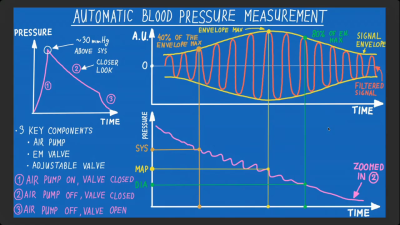
Many cheap electronic blood pressure monitors use the oscillometric method to measure blood pressure. Few manufacturers share the algorithms they use, but [Milos] has found many use something similar to the above, approximating systolic and diastolic pressures from measurements taken to find the mean arterial pressure. Credit: presentation slides
[Milos’s] talk focuses on the digital oscillometric analysis that is behind cheap electronic blood pressure monitors that commonly retail for $30-50. These devices start by pumping up an arm cuff to well above typical systolic pressures, before slowly letting it deflate. A sensor hooked up to the cuff is used to monitor the pressure during deflation. When the cuff is below systolic pressure but above diastolic pressure, the pressure in the cuff will oscillate with the pulsing of the blood flow. When isolated from the overall pressure loss from deflation, the amplitude of this oscillatory signal is maximum at the mean arterial pressure. According to [Milos], it’s common for electronic blood pressure monitors to then take some figure like 40% and 80% of the amplitude of the oscillation envelope, and grab the systolic and diastolic pressure values at those points. As far as accuracy goes, this method isn’t exactly perfect, being more of a useful approximation rather than something that’s rooted in a true direct measurement. Furthermore, [Milos] notes that, for example, Category A blood pressure monitors are only expected to land within a +/- 15 mmHg range, for 85% of their measurements. That’s not fantastic.
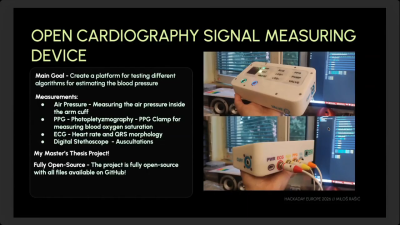
[Milos] has invested a great deal of time into the Open Cardiography Digital Measuring Device, hoping to better investigate alternative methods of measuring blood pressure in a non-invasive manner.
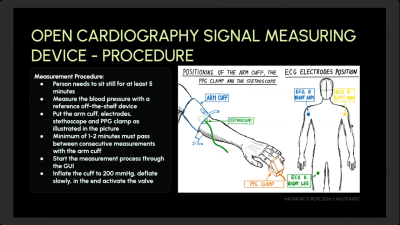
[Milos] notes that it’s important to allow the patient to sit still for five minutes before measurement if numbers are to be at all comparable between checks, as many factors can influence blood pressure in the moment.
The method used by these electronic devices tends to be a little inaccurate compared to the traditional clinical methods performed by trained professionals. For that reason, [Milos] developed the Open Cardiography Signal Measuring Device. It is specifically designed to test different algorithms for blood pressure measurement. It can measure pressure in an arm cuff, and also takes signals from a photopletyzmography (PPG) clamp for measuring blood oxygen saturation. There are also inputs for ECG and digital stethoscope signals, too. [Milos] has published the device’s design on Github for anyone to explore as desired. His talk explains how the device came together, and how he has been using it to evaluate the accuracy of off-the-shelf monitors and the use of alternative algorithms to those used in such units. He also discusses the challenges of measuring blood pressure accurately in this way when dealing with, for example, patients with less stable heart rates.
It’s an interesting exploration of a very specific part of vital sign measurement that few of us ever think about in detail. Sometimes it pays to know how the machines that you’re getting measurements from actually work, and whether you can trust what they’re saying. In the world of blood pressure measurement, [Milos] has done just that.