
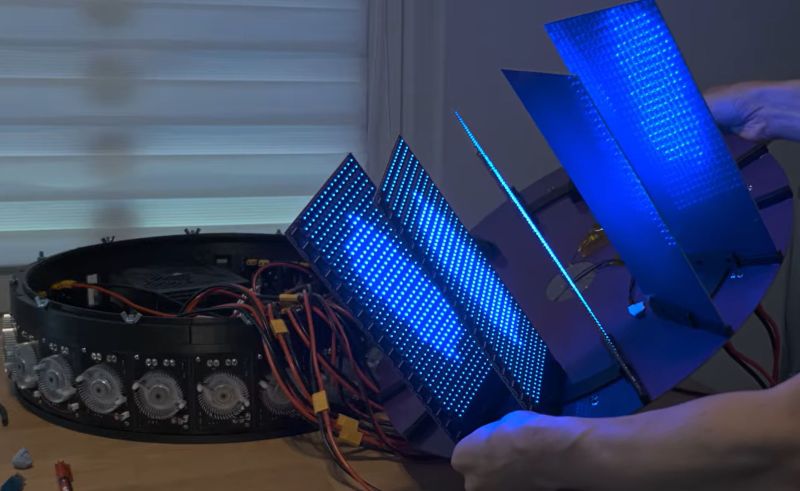
These cheap MCUs feature a QingKe 32-bit RISC-V core that’s clocked at a maximum of 100 MHz, with an RV32IMBC instruction set. This means that they support integers, integer multiplication and division, bit manipulation, and compressed instructions, but no atomic, vector, or floating-point instructions.
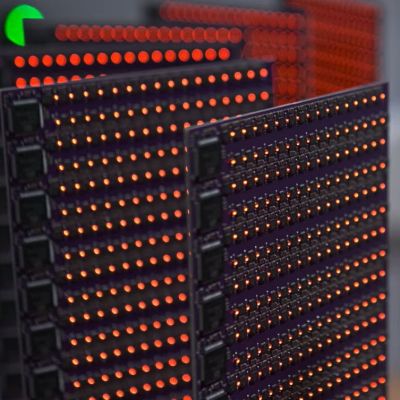
The basic concept was to use a single MCU per pixel, but once you start scaling up a measly 10 mA and ~$0.10 per MCU to literally tens of thousands of them, you’re suddenly talking about thousands of dollars in hardware as well as a cool 655.36A at 3.3V – or 2 kW – for something close to QVGA resolution at 320×200. Clearly this would be a rather crazy project to implement, which is why each MCU also got its own RGB LED to immediately create the pixel.
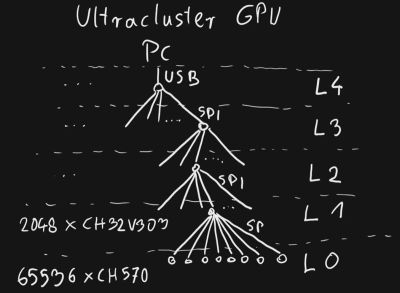
For the power supply, a 3 kW Corsair ATX PSU was used to supply power to the subsequent power stages. As a result, the first prototype looks like a pretty fancy addressable RGB LED matrix.
This is said to be only the first step, with this ‘Ultracluster GPU’ still getting a few more levels tacked onto it to make it into something that’s more GPU-shaped. Probably the biggest question here is whether the final version will be able to generate said QVGA output image without needing more power than what a typical 230 V, 16A European outlet can provide.
We think that [Jensen Huang] probably will be more scared of the ESP32-S3-based video card that [bitluni] made before, though at least [bitluni] seems to be having fun making more MCU-based clusters, such as this one from 2024 and this one from 2025.