
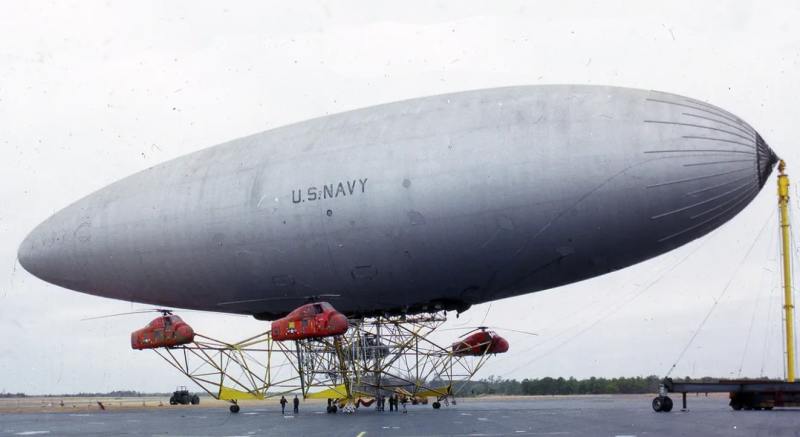
Over two decades after it was last deflated, detached from its gondola, and crated up at Lakehurst, the gas bag of an N-class ZPG-2W blimp was broken out and dusted off for what might have been the most bizarre afterlife in aviation history: as a key building block for the U.S. Forest Service’s Piasecki PA-97 Helistat.
Just look at it! It’s an antique blimp gas bag, four war-surplus helicopters pulled from the boneyard, and a whole maze of aluminum tubing. That the U.S. Forest Service, of all agencies, was the one building what amounts to the airship version of an X-plane is also weird enough to be called bizarre. Getting Frank Piasecki to design this thing, a man who did as much as almost anyone else to kill the airship, might be considered ironic, but to stay on theme, I’ll call it bizarre.
If you’re not already a quadrotor-blimp afficionado, we have some explaining to do.
How Frank Piasecki Killed the Blimp
Piasecki didn’t set out to do in the last airship program in the world, but that is, arguably, what he did. He was a pioneer in the world of helicopters. More specifically, he was a pioneer in heavy lift helicopters, the ones that could compete most directly with airships.
The small PV-2 was Piasecki’s first helicopter design, and took flight in 1943: the second ‘successful’ helicopter design flown in the USA, after Sikorski’s VS-300 of 1939. At the time, Sikorski and Bell were the big names in the helicopter business, but their helicopters were both small. Piasecki wasn’t positioned to compete with Sikorski and Bell in the small, lightweight helicopter market, so he went big.
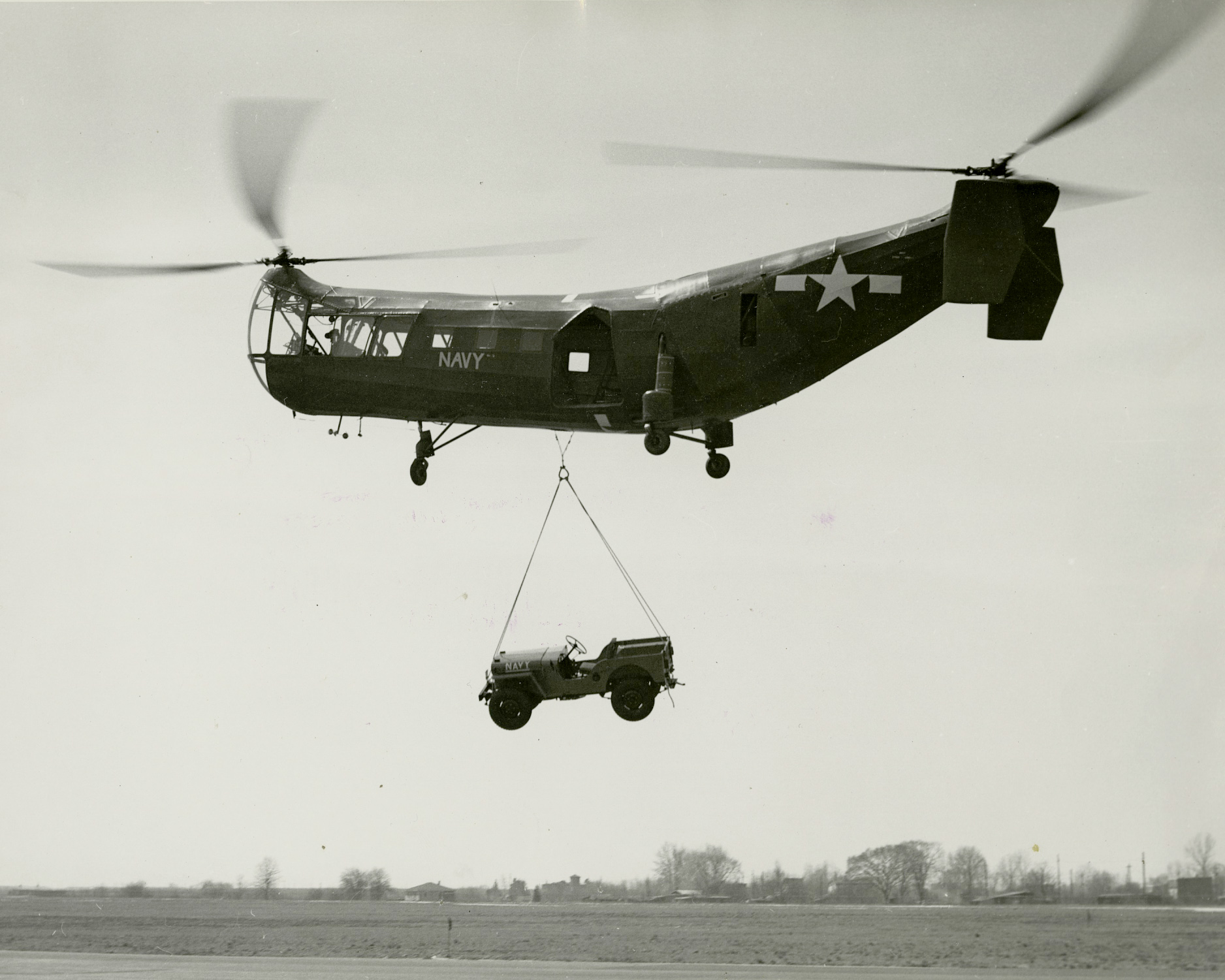
The prototype XHRP-1, demonstrating its lift capacity in 1947.
Image: Public Domain, via Vertical Flight Society
For his next design, Piasecki needed all the lift power he could get in order to outflank Bell and Sikorski. By using two counter-rotating rotors, Piasecki’s design got the maximum lift for its power output. Dual rotors also took up less space, an important consideration on the small aircraft carriers then active.
The prototype of the HRP-1 “flying banana” first flew in 1945, and so missed out on wartime service. The Navy ordered 20 and then handed them off to the Marines and Coast Guard in order to buy the improved HRP-2 version. It was still referred to as a flying banana, especially when painted high-vis yellow for search-and-rescue missions, but the official name was “Rescuer”.
The Bell 47 could lift one passenger, or two wounded men on litters mounted somewhat frighteningly outside of the aircraft. The Rescuer could hold six stretchers, or eight passengers– and double the cargo capacity of the Bell 47. It was a separate niche, and one that would prove successful for the Piasecki Helicopter Corporation.
The HRP-1 was the first in a line of two-rotor helicopters that lives on in the CH-47 Chinook, whose design was begun in 1956, the same year that Frank Piasecki was ousted from Piasecki Helicopters. For obvious reasons, the firm rebranded itself, taking the name Vertol until it was purchased by Boeing in 1960. By that point, the damage to the airship industry had been done.
Then It Got Bizarre
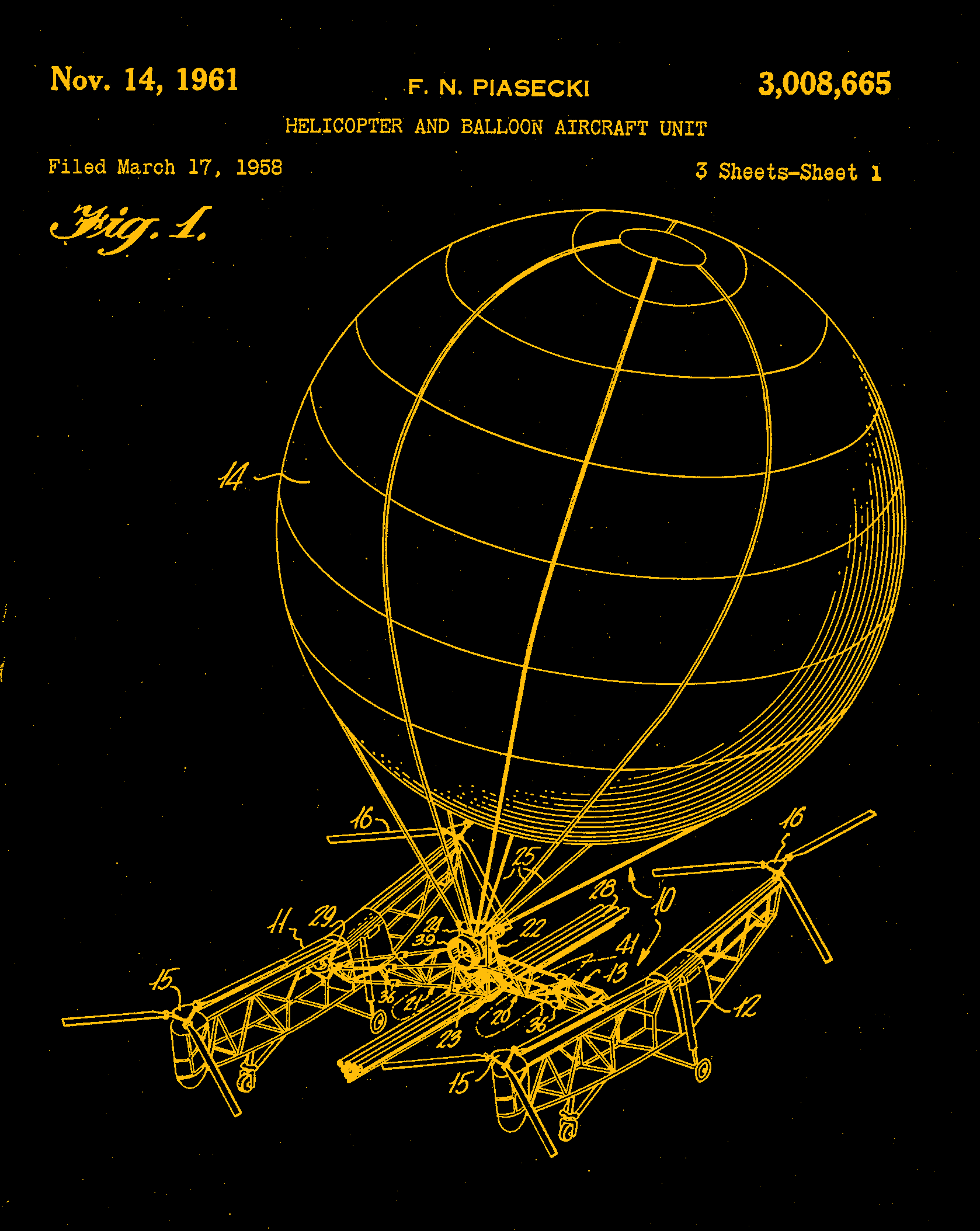
This looks even weirder than the one they built.
Image: Frank Piasecki, from US Patent 3008665A.
Even before the Navy wound up its lighter-than-air (LTA) program in 1962, Frank Piasecki was thinking of airships. In his quest for heavy-lift helicopters, he couldn’t help but notice the potential of LTA– after all, every pound carried by the static lift of a lighter-than-air gas bag is one less pound the helicopter’s rotors need to be concerned with.
What would eventually become the Piasecki Helistat was first described by U.S. Patent 3,008,655A “Helicopter and Balloon Aircraft Unit”. It differs from the craft that was eventually built mainly in using a spherical helium balloon rather than the aerodynamic gas bag of a blimp. The diagrams in the patents even include a load of logs, an inspired choice given the design was eventually taken up by the U.S. Forest Service. The patent was submitted in March 1958, granted in November 1961, and then absolutely nothing happened with it for over a decade.
In the text of the patent, we see that Piasecki was mostly concerned with increasing the lift capacity of his helicopters using the attached balloon, rather than thinking of this as a new type of airship. That would change with his next patent filing, in 1975, US4,591,112A “Vectored Thrust Airship”. Here the concept is no longer about increasing the lift capacity of helicopters, but explicitly recognizes itself as a sort of airship– and is recognizable as what would be built as the PA-97 starting just five years later.
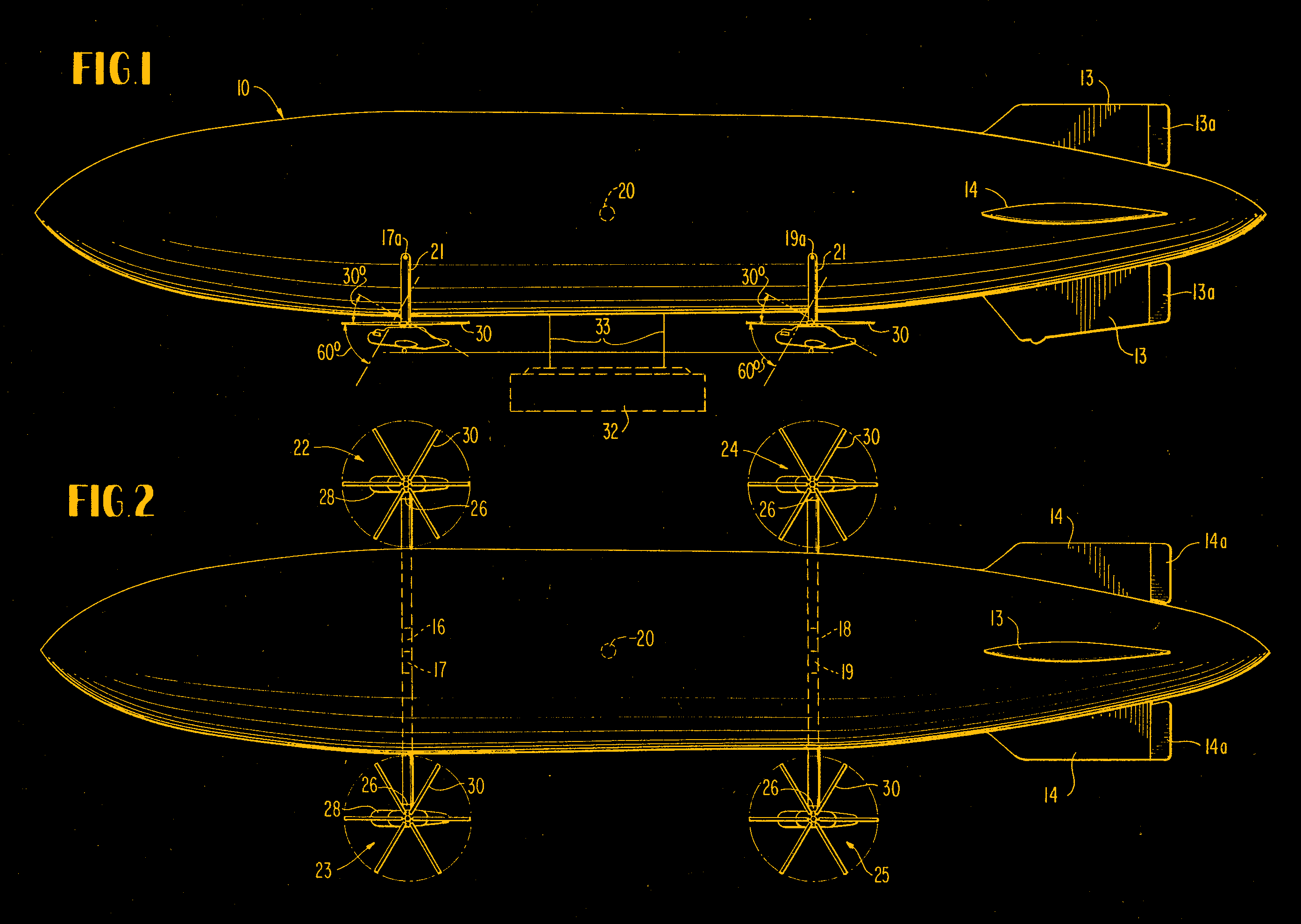
Now that’s an airship.
Image: Frank Piasecki, US Patent 4,591,112
The gas bag is elongated and aerodynamically suited for higher-speed flight. Gone are the twin ‘flying banana’ copters; instead we see a quartet of gondolas with helicopter-type rotors. Notably the patent specifies “two or more”– but it’s the quadcopter configuration that appears in the figures of the patent and was ultimately built. These rotors are to provide propulsion and direction to the craft, as much as lift– that was to be handled by the gas bag, though like the long-lost Navy blimps the intention was to “fly heavy” and let much of the load be taken up by the rotors.
The key reason to use helicopter rotors on an airship, as the patent describes, is for controllability: by altering the collective and cyclic pitch of multiple rotors, instant torque is available to control the pitch, yaw, and roll of the aircraft. It looks like a modern hobby quadrotor, but because the helistat has cyclic control, it can fly forwards without leaning the whole blimp forwards.
The Piasecki corporation proposed two variants of the concept in 1975: a smaller 75-ton version, designated project X-97-0004, and the X-97-0011 “Gargantua” which was actually pitched to NASA for the Shuttle Carrier Aircraft project. “Gargantua” would have used four CH-53E “Super Stallion” heavy-lift helicopters with a gas bag just slightly smaller than the USS Macon– indeed, internal documents have the caption “four CH-53 and Macon”. In spite of that caption, it was actually shorter than the Macon by a full hull section.
It is likely that this would have been a rigid design, though the only figure I was able to track down only shows two ring girders, fore and aft of the cargo bay that– I cannot emphasize enough–was meant to hold an actual Space Shuttle Orbiter. Well, most of it: the wings would have been flush with the bottom of the gas bag. The 140-ton capacity “Gargantua” was of course never built, which is both immensely disappointing and probably for the best. The design for the 75-ton version also sat on a shelf until it was scaled down far enough to interest the US Forest Service in 1979.
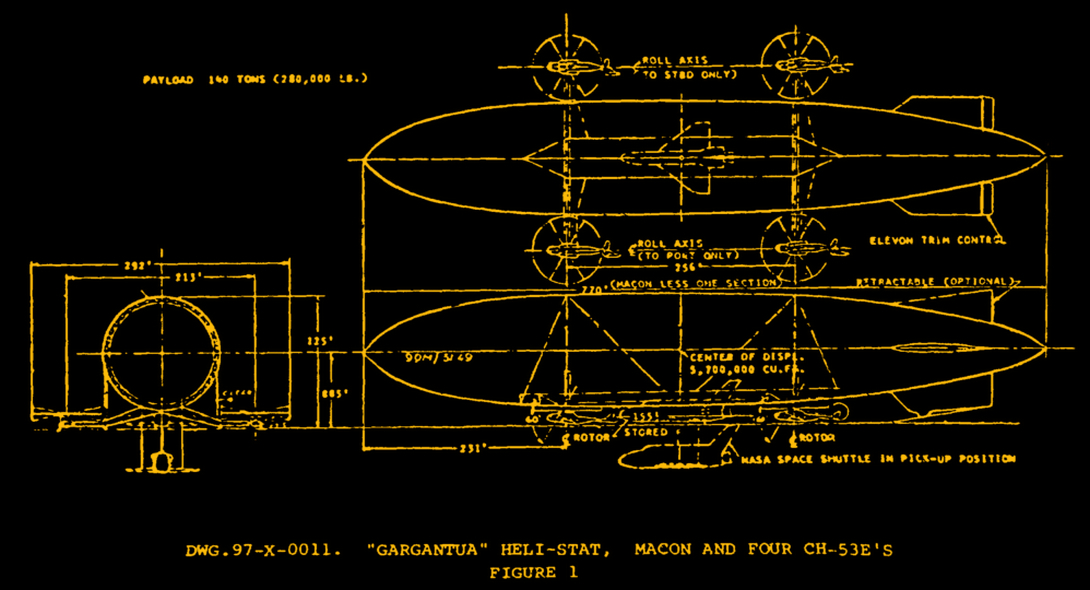
Note the Orbiter for scale, and allow your mind to boggle.
Image: Piasecki Aircraft Corporation
The Flying Forest Service

With concept art this good, what could go wrong?
Image: Piasecki Aircraft Corporation, via the Lyncean Group of San Diego
I did say everything about this aircraft was bizarre, including the agency that commissioned it. As near as I can tell, this is the first and only time the US Forest Service has gotten into the business of building aircraft. Teething problems were perhaps to be expected.
The idea isn’t crazy– by 1979, helicopter logging was a proven concept, limited largely by the lift capacity of existing helicopters. Most of the old-growth timber in the USA was, even by that point, located in the mountain west where building logging roads is prohibitively expensive or downright unsafe. Helicopters are, of course, thirsty beasts when lifting large loads. The hope was that the Helistat would be far more fuel-efficient and pay for itself thereby.
Indeed, the Forest Service optimistically anticipated making most of their money back off the development programme. It was believed that over a three-year test period, the 25-tonne lift Helistat would be able to harvest $19.7 million worth of timber, against a total programme cost of only $25 million.
Twenty five million, to develop a whole new class of aircraft. Even in 80s dollars, that seems absurdly optimistic, doesn’t it? Well, we did say the Forest Service really hadn’t done this before. Teething problems were bound to happen, and those teething problems drove the cost up to a hundred million by the end of the project in 1986.
It’s hard to see where the money went, though: it certainly wasn’t into the airframe. The gas-bag, as mentioned above, was essentially dumpster-dived from US Navy stores. The four piston-powered Sikorski H-34J helicpoters had been retired over a decade before, and it’s alleged that they were pulled from the boneyard specifically for this project. There are even allegations online that the rickety-looking aluminum framework holding the helicopters to the gas bag was made with scrap metal! Given that Frank Piasecki was apparently into his Red Green era, I would not at all be surprised to find out that holes in the ex-Navy gas bag had been patched with duct tape.
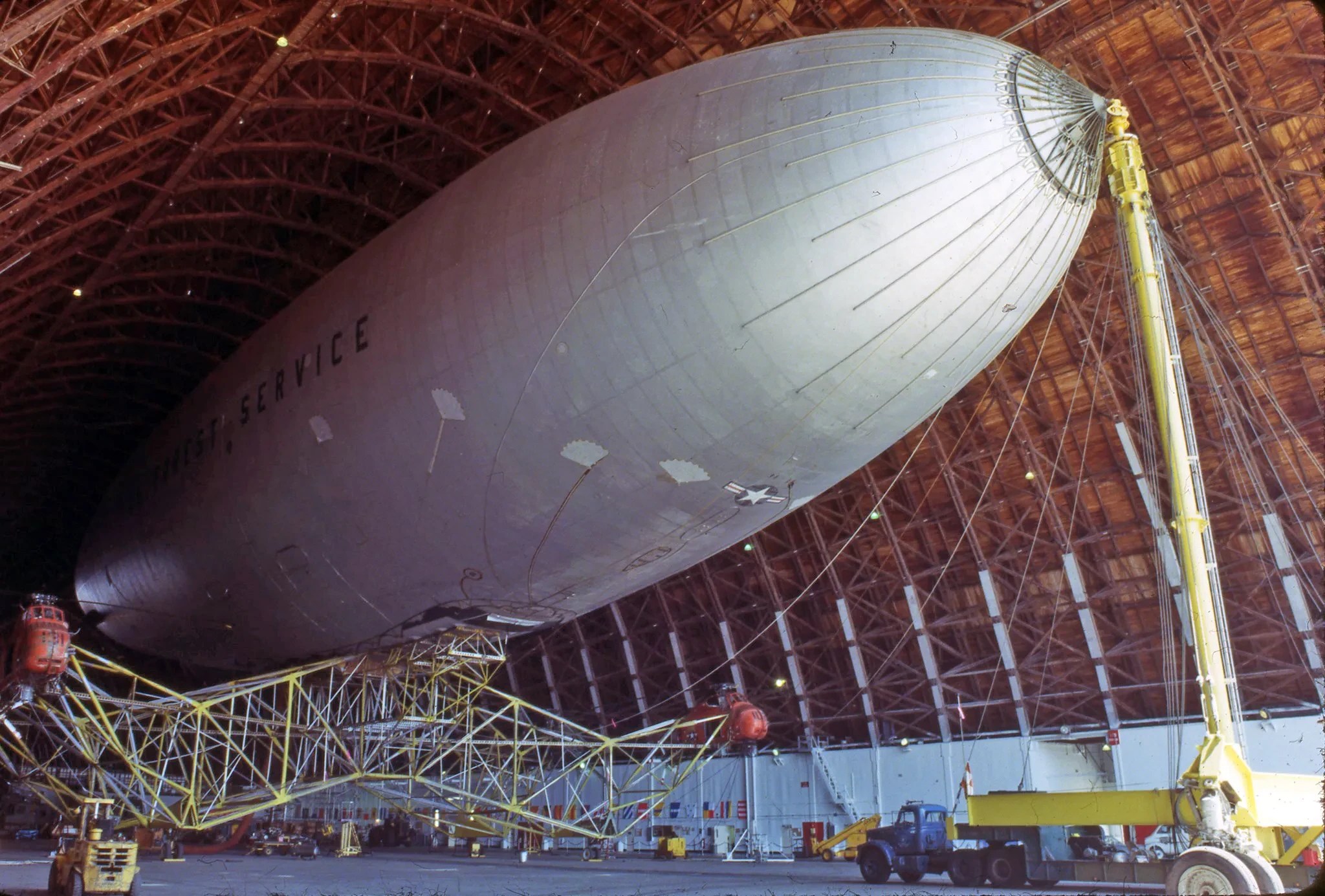
The light-coloured patches probably aren’t duct tape, but it would be on-theme at this point. That might be why the gas bag reads “Forest Service” — the US Navy was distancing itself from the project by the end.
The ZPG-2W gas bag that they found had a volume of 1,000,000 cu.ft (28,317 cu.m), providing up to 55,851 lb (25,334 kg) of aerostatic lift when inflated with helium. The remainder of the Helistat’s 107,051 lb (48,558 kg) gross weight was accounted for by the dynamic lift provided by the four Vietnam-era helicopters. Since the empty weight was less than the aerostatic lift– only 54,885 lb (24,895 kg), the helicopters would be responsible only for propulsion and vectored thrust until the helistat picked up its first load of logs. Alas, that never happened.
The Last Flight of the Helistat
Unlike many new designs, the PA-97 did not crash on its first flight, or even its second. Fifteen untethered flights demonstrated that the concept worked: even without modern fly-by-wire to link the helicopters, the craft was controllable. With a pilot and four flight engineers at the controls, the Helistat could take off, it could hover, it could fly, and it could land.
So what happened? What it couldn’t do was withstand its own vibrations. On what was to be the last test flight on the first of July, 1986, a gust of wind started a shimmy in one of the four free-wheeling casters that the craft used as landing gear. Think of a shopping cart with a shaking wheel. Just like the shopping cart, there was nothing to dampen the wheel shimmy, so it progressed. The pilot took off, but by that point the vibrations had already started into the airframe, triggering some kind of resonance mode that the helicopter engine or rotor contributed to. It’s also possible that the shaking of the airframe triggered “ground resonance”, a destructive shaking of the helicopter rotor. In any case, the Helistat literally shook itself apart, as one helicopter decoupled from the airframe, followed quickly by the other three.
Like most accidents of this nature, it’s easy to diagnose the faults in hindsight. A proper vibrational analysis should have been performed on the airframe– that would be fairly trivial today, but Piasecki Helicopters hadn’t yet computerized in the early 1980s. Vibrational analysis of that nature is far from trivial to do by hand. Contemporary critics decried the “slide-rule engineering” at work in the project even before the accident, and it’s likely it contributed to the disaster. Even just fitting a damper to the casters, on general principles, could perhaps have avoided the crash.
There were two casualties that day: test pilot Gary Oleshfski, and the very concept of the Helistat. The program, which was already far over budget, was immediately cancelled. As the meme goes: if I had a nickel for every type of aircraft whose entire class was discredited by a single example crashing at Lakehurst, NJ due to an avoidable design fault, I’d have two nickels. Which isn’t a lot but it’s weird it happened twice.
No Second Chances
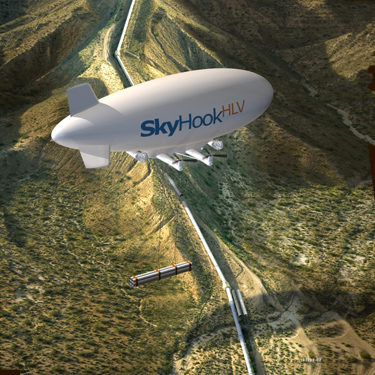
The SkyHook might have flown by 2014, if it wasn’t for the credit crunch.
Image: Boeing.
Piasecki Aircraft Corporation sought to find another patron to finish the design after the crash. They had been shopping it around to the construction, oil, and shipping industries along with the military before things went pear shaped. Their patent expired in 2003, and a Canadian company called SkyHook attempted to revive the Helistat concept, but a combination of the history of the crash and the sheer weirdness of the concept kept investors at bay, in spite of a partnership with Boeing. The SkyHook was perhaps also a victim of remarkably bad timing, as they were ready to start construction in 2008, a year not known for easy credit.
Still, we recently saw [rctestflight] demonstrate what you can do with collective control on a quadcopter– all you’d need to do would be strap a balloon to it, and you’d be most of the way to reviving the Helistat. If anyone tries that, please send a tip, and we can argue which is more of a hack: that hypothetical project, or the time a guy bolted four helicopters to a busted old blimp.