
Much like Apple’s once vaunted super-slim butterfly keyboard, today’s range of portable devices featuring flexible OLED displays – which can fold said display into a much smaller form factor – are a marvel of engineering.
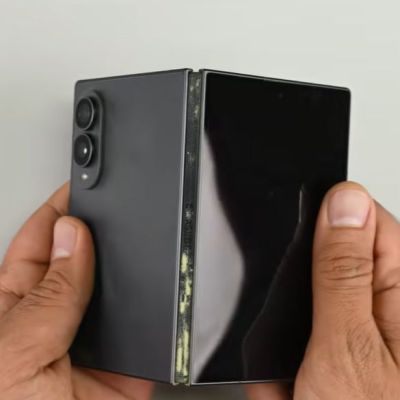
The foldable phone after a dusty encounter. (Credit: iFixit, YouTube)
Unfortunately engineering can only do so much against fundamental flaws. In the case of both these flexible OLEDs and butterfly keyboards the main issue is that of dust intrusion, with a recent teardown by [iFixit] going over the reasons for this.
As test subject we got a Galaxy Z Fold 8, as an example of a modern-day foldable smartphone-tablet hybrid. This phone has an IP48 rating, meaning that it’s water-resistant, but not dust-resistant for particles smaller than 1 mm. To test this, [iFixit] used UV-reactive dust particles, making sure that they got literally everywhere inside the phone’s hinge mechanism.
After this treatment, trying to fold the phone caused the hinge mechanism to make absolutely horrific crunching noises, confirming that it’s reached dust-under-butterfly-keycap levels of unusable. During the subsequent teardown a quick pass with the UV lamp showed that not much of the dust had penetrated into the two halves of the device at least, but the hinge mechanism wasn’t as lucky.
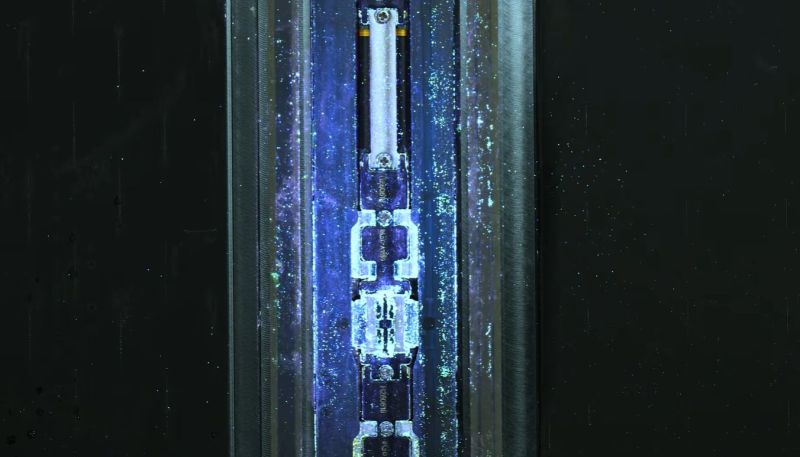
Getting to the hinge is sadly rather destructive, as it involves removing the flexible OLED. Once the hinge was exposed and subjected to UV light the spectacle was something to marvel at, as can be seen in the above screenshot. With the dust caking literally every part of the mechanism, it was little wonder that the hinge had ceased to work.
Although this was obviously an extreme case of dust exposure, and the average flexible OLED screen’s hinge won’t see nearly as much dust, one can’t help but feel slightly disconcerted at that crunching noise, knowing that it’s just one big dust exposure away.