
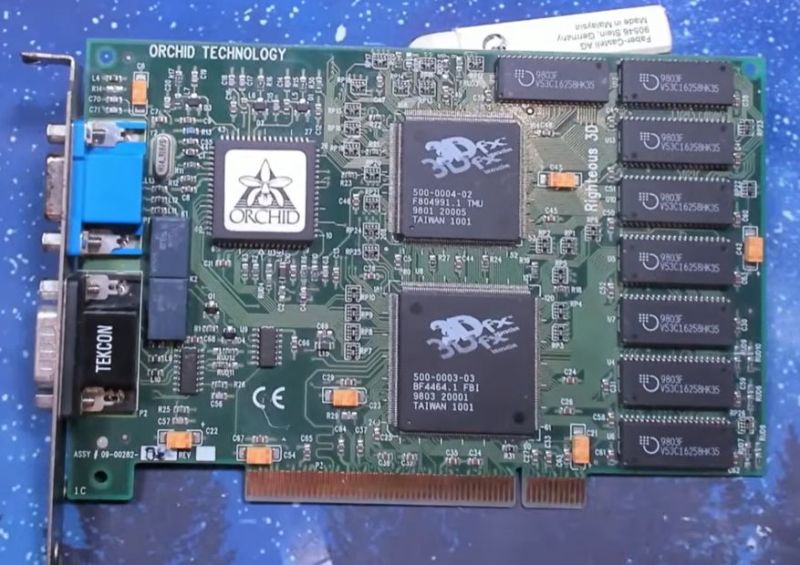
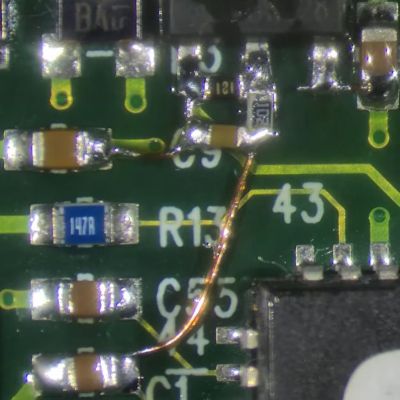
The basic idea here is to use the external voltage reference (Vref) pin for this ICS5342 RAMDAC and supply it with a constant 1.235V. If unused – as on this Orchid-branded Voodoo card – it is connected via an 0.1 microFarad capacitor to ground. This fortunately means that the pin is routed to easily accessible pads that make this modification relatively straightforward.
Basically this is where the AMS1117-ADJ chip comes into the picture, as a widely available adjustable LDO option, even if the 0.8A current rating is very much overkill for this application. With the supplied voltage the lowest voltage this LDO can output is around 1.25V, which is within the 1.10 – 1.35 V range of the datasheet.
Of course, with the PCB never having had a provision for this part, much of the rest of the video is about planning out where to place and route the components. After that tedious work and testing that nothing explodes, the new voltage is used for the RAMDAC’s Vref pin, fixing the brightness issue.
While one could argue that this RAMDAC is likely simply defective and already beginning to break down inside, this should at least give it a bit longer on what seems to be a little used card anyway.