
Syria's counterattack on an alleged Israeli strike will send Israel into a coma, an Iranian commander threatened, PressTV reported on Sunday.
“In the new era, the criminals should know that behind their every blow lies a massive retaliatory blow, whose time, level and magnitude will be determined by the resolve of the free and anti-hegemonic nations,” Deputy Chairman of Iranian Armed Forces’ Chief of Staff Masoud Jazayeri said.
Related:
On Sunday morning, Iranian Parliament Speaker Ali Larijani also warned Israel of the consequences of its alleged strike in Syria.
"The world is witnessing a vengeance carried out by the West, particularly the US, and some backward elements in the region against resistance," he accused.
Larijani called on countries in the region to distance themselves from Israel and said he believed "the Islamic awakening movement in the region would give a proper response to the Zionist regime."
Defense Minister Ehud Barak, who is taking part in an international defense conference in Munich, told a local television station that Israel is closely following “the issue of chemical weapons” in Syria, though he refused to address Wednesday’s events.
“We are examining the possibility of advanced weapons transfers to Hezbollah when the collapse of Assad’s regime is complete,” he said, adding that the Syrian president “will not survive.”
On Sunday, The Sunday Times cited sources close to military planners as saying that Israel is considering creating a buffer zone reaching up to 10 miles inside Syria.
A security fence is currently being erected from Mount Avital south to the point where the Israeli, Syrian and Jordanian borders meet on the southern Golan Heights, but, according to the military source, a buffer zone is necessary to prevent daily mortar and rocket attacks.
On Saturday, Syrian television aired images of wreckage at at military research center in Jamarya north-west of Damascus, where Syrian claims Israel has struck.
Details of Wednesday's strike remain sketchy and, in parts, contradictory. Syria said Israeli warplanes, flying low to avoid detection by radar, crossed into its airspace from Lebanon and struck the Jamraya military site.
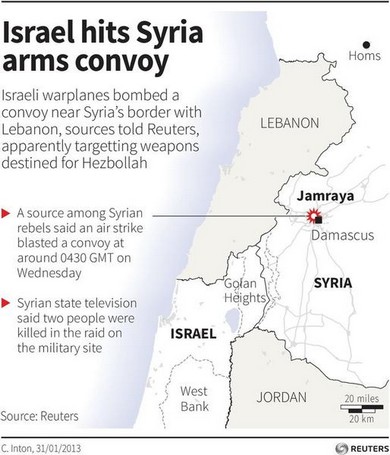 But diplomats, Syrian rebels and regional security sources said the Israeli planes hit a weapons convoy heading from Syria to Lebanon, apparently destined for President Bashar Assad's ally Hezbollah, and the rebels said they - not Israel - hit Jamraya with mortars.
Yaakov Lappin, Reuters and JPost.com staff contributed to this report.

“In the new era, the criminals should know that behind their every blow lies a massive retaliatory blow, whose time, level and magnitude will be determined by the resolve of the free and anti-hegemonic nations,” Deputy Chairman of Iranian Armed Forces’ Chief of Staff Masoud Jazayeri said.
Related:
- Khamenei aide: Attack on Syria is an attack on Iran
- Report: Israeli strikes in Syria hit multiple sites
On Sunday morning, Iranian Parliament Speaker Ali Larijani also warned Israel of the consequences of its alleged strike in Syria.
"The world is witnessing a vengeance carried out by the West, particularly the US, and some backward elements in the region against resistance," he accused.
Larijani called on countries in the region to distance themselves from Israel and said he believed "the Islamic awakening movement in the region would give a proper response to the Zionist regime."
Defense Minister Ehud Barak, who is taking part in an international defense conference in Munich, told a local television station that Israel is closely following “the issue of chemical weapons” in Syria, though he refused to address Wednesday’s events.
“We are examining the possibility of advanced weapons transfers to Hezbollah when the collapse of Assad’s regime is complete,” he said, adding that the Syrian president “will not survive.”
On Sunday, The Sunday Times cited sources close to military planners as saying that Israel is considering creating a buffer zone reaching up to 10 miles inside Syria.
A security fence is currently being erected from Mount Avital south to the point where the Israeli, Syrian and Jordanian borders meet on the southern Golan Heights, but, according to the military source, a buffer zone is necessary to prevent daily mortar and rocket attacks.
On Saturday, Syrian television aired images of wreckage at at military research center in Jamarya north-west of Damascus, where Syrian claims Israel has struck.
Details of Wednesday's strike remain sketchy and, in parts, contradictory. Syria said Israeli warplanes, flying low to avoid detection by radar, crossed into its airspace from Lebanon and struck the Jamraya military site.
Yaakov Lappin, Reuters and JPost.com staff contributed to this report.