
- Opposition: The Damascus area and Homs come under more fire Tuesday
- Rebels use seized army tanks to attack a military base, a commander says
- Syria's top diplomat in London has left his post, British foreign ministry says
- "Get the hell out now," the U.S. defense secretary advises al-Assad
Are you in Syria? Share your stories, videos and photos with the world on CNN iReport.
Northern Syria (CNN) -- Though Syrian rebels appeared to be securing their grip near the crucial city of Aleppo, this country's raging violence was far from over Tuesday as reports of renewed violence sprang up from across the country.
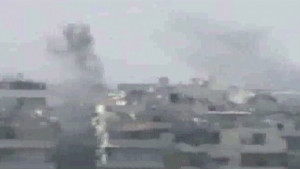
Heavy shelling fell in and around Damascus as the city of Homs -- already devastated by weeks of incessant attacks earlier this year -- endured rocket attacks, the opposition Local Coordination Committees of Syria said.
And fierce clashes broke out again between regime and rebel forces in Aleppo, the hotly contested city that is the commercial and cultural center of Syria, opposition activists said.
The rebels scored a notable victory Monday when they captured an army outpost near Aleppo, amassing tanks and crates of ammunition in the process.
The outpost was a restaurant outside the town of Anadan, about 10 kilometers (6 miles) north of Aleppo. It had been commandeered by government troops and surrounded by earthworks.
Rebels put the captured armor to work Monday by shelling an air base outside Azaz, about 40 kilometers (25 miles) farther north, said Ahmed Afesh, a commander with the rebel Free Syrian Army.
Afesh showed off two Soviet-era T-55 tanks captured by his men Monday, as well as an armored personnel carrier and the smoldering wreckage of another destroyed during the fighting. Rebel fighters and civilians greeted him with handshakes and kisses.


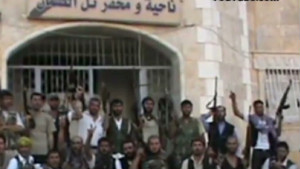
The rebels also have been able to establish growing enclaves in northern Syria and attempted to seize a number of key border crossings last week. They already control much of the main western highway from Aleppo to the Turkish border.
But on Tuesday, Syrian forces clashed with "armed terrorist groups" on the outskirts of Aleppo and destroyed nine armored vehicles "with all terrorists inside," state-run TV reported.
About 200,000 people in and around Aleppo have fled shelling and heavy weapons fire since Friday, U.N. humanitarian official Valerie Amos said Sunday.
In several neighborhoods, those who remained were left without phone, Internet or electricity service as tanks shelled the city, according to Deama, an activist in the city. CNN isn't using her full name because disclosing it could put her in danger.
"We're afraid they are going to do something worse. Usually, they will cut off connections and isolate these neighborhoods more when they are about to make something worse," Deama said Monday.
Protests against Syrian President Bashar al-Assad, whose family has ruled the country for more than 40 years, began in March 2011. Security forces launched a violent crackdown on peaceful protests that has been met by increasingly stiff resistance, with large numbers of government troops joining the opposition.
The conflict has claimed almost 17,000 lives, U.N. Secretary-General Ban Ki-moon said last week. Opposition activists put the toll at more than 20,000.
While there is no end to the violence in sight, al-Assad's regime has suffered a series of defections in recent weeks.
In London, the top diplomat at the Syrian Embassy resigned his post, the British Foreign & Commonwealth Office said Monday. Charge d'Affaires Khaled al-Ayoubi told British officials that he was "no longer willing to represent a regime that has committed such violent and oppressive acts against its own people," the office said in a statement.
And in Tunisia, his first stop on a visit to the Middle East, U.S. Defense Secretary Leon Panetta told CNN that al-Assad "knows he's in trouble, and it's just matter of time before he has to go."
Asked what he'd say to the embattled Syrian leader, Panetta said, "I would say if you want to be able to protect yourself and your family, you better get the hell out now." On Sunday, Panetta predicted that the crackdown in Aleppo will prove "a nail in Assad's coffin" by turning even more people against the government.
The United States is providing nonlethal aid to the rebels, including communications gear. Other countries are providing more direct military aid, Panetta said, "so there is no question that one way or another, they are getting the support they need in order to continue this fight."
CNN's Salma Abdelaziz, Barbara Starr and Yesim Comert contributed to this report.
