

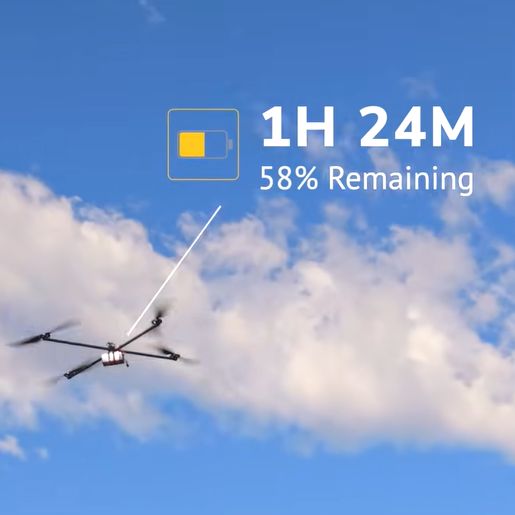
Keeping an eye on remaining battery charge. (credit: Luke Maximo Bell, YouTube)
Although not a typical focus of people who fly quadcopter drones for a hobby or living, endurance flying has a certain appeal to it for the challenge it offers. Thus, as part of his efforts to collect all the world records pertaining to quadcopter drones, [Luke Maximo Bell] has been working on a design that would allow him to beat the record set by SiFly Aviation at 3 hours and 11 minutes.
By using knowledge gained from his PV solar-powered quadcopter, [Luke] set about to take it all a few steps further. The goal was to get as much performance out of a single Watt, which requires careful balancing of weight, power output and many other parameters.
Crucial is that power usage goes up drastically when you increase the RPM of the propellers, ergo massive 40″ propellers were picked to minimize the required RPM to achieve sufficient lift, necessitating a very large, but lightweight frame.
The battery packs are another major factor since they make up so much of the weight. By picking high-density Tattu batteries and stripping these down even more this was optimized for as well, before even the wire gauge of the power wires running to the motors were investigated to not waste a single Watt or gram.
All of this seems to have paid off, as a first serious test flight resulted in a 3 hour, 31 minutes result, making it quite feasible that [Luke] will succeed with his upcoming attempt at the world’s longest flying electric multirotor record. Another ace up his sleeve here is that of forward movement as well as wind provides effectively free lift, massively reducing power usage and possibly putting the 4 hour endurance score within easy reach.