
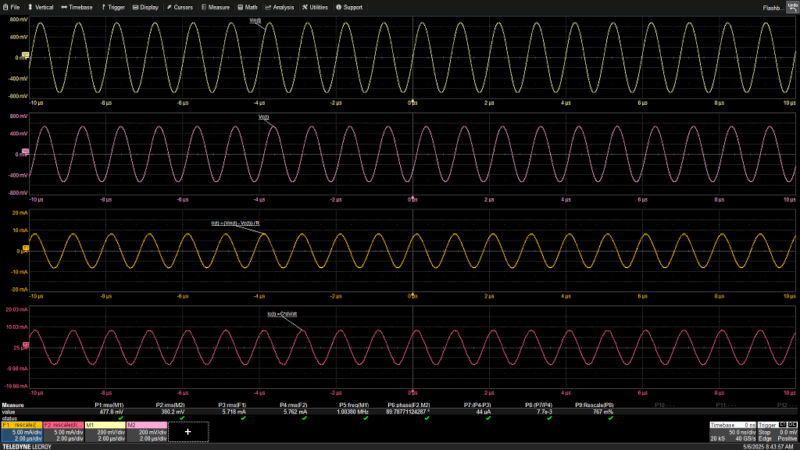
Even entry-level oscilloscopes today have simple math functions such as adding or subtracting two channels. But as [Arthur Pini] notes, more advanced scopes can now even do integration and differentiation. He writes about using these tools to make measurements on capacitors and inductors. The post in EDN is worth a read, even if your scope doesn’t offer this sort of math yet.
It makes sense that capacitors and inductors would benefit from this feature. After all, the current through a capacitor, for example, is proportional to the rate of change in the voltage across it. That’s a derivative. Since the scope can measure voltages, it can also differentiate to find the current.
The same idea applies to inductors, where the current through an inductor is related to the integral of the voltage across it. It is a simple matter to measure the voltages and perform an integration to determine the current.
All of this, of course, relates to differential equations and calculus. While calculus has a reputation for being hard, it actually makes sense if you want to work with quantities that change over time. Once you realize that a sine wave is just a fixed spot on a rotating wheel, everything comes together nicely. You could, of course, grab discrete samples from any scope and use numerical methods to get the same results. But it is much easier if your scope can do it for you.