
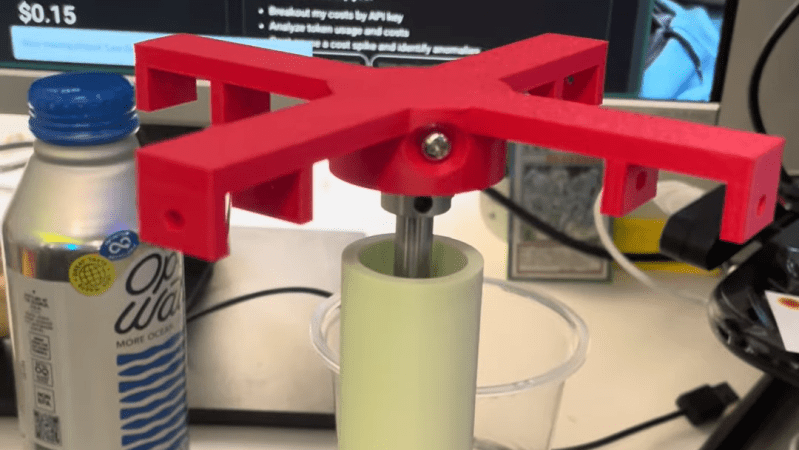
If you want to do certain types of lab work with blood, you’ll need a centrifuge. It’s often possible to find serviceable units on the used market, but they may not meet your requirements if you’re doing something quite specific. For that reason, [Thomas Nguyen] decided to build his own centrifuge from scratch.
His goal was to separate T cells from blood for further lab analysis, and he needed to be able to work with blood in 15 mL conical tubes. Capable centrifuges weren’t affordable, but he figured he could build his own quite easily. To that end, he enlisted a Raspberry Pi Pico, a 3D printer, and an A2212 brushless motor with a 30 amp electronic speed controller.
Soon enough, he had a design for a fixed-angle centrifuge design that could spin up blood products to the required speed for separation. It has useful safety features, like an MPU-6050 for vibration detection to shut down in case of dangerous imbalance, and an IR sensor for monitoring and controlling rotational speed. For now, the project is still in development, with the first version built and spinning. [Thomas] aims to check that the build operates safely and can separate fluids like dyed water and glycerol successfully before running it with real blood products.
We’ve seen other successful DIY centrifuge builds before, too. Sometimes, the lab hardware you need is the lab hardware you build yourself. If it works and does the job safely, it can be all that you need to get your science goals coming to fruition.