
- NEW: A blast outside the ANP office in Karachi kills six people
- Pakistan's struggling economy is beset by high unemployment, poverty
- Security is also a problem, especially given threats from Islamic extremists
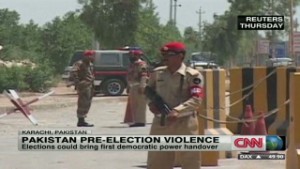
- Officials deploy 600,000 security personnel and 75,000 troops for elections
(CNN) -- Pakistanis headed to the polls Saturday in an election that will mark the first transition between civilian governments in the nation's 66-year history.
The election is a rarity for the young nation.
In its short existence, it has experienced three military coups, been ruled by generals for half its life and remains mired in political turmoil.




In March, the democratically-elected government finished serving a full five-year term, paving the way for the elections.
Despite pre-election attacks, voters lined up at dawn at polling stations nationwide, eager to send off the caretaker government put in place in March.
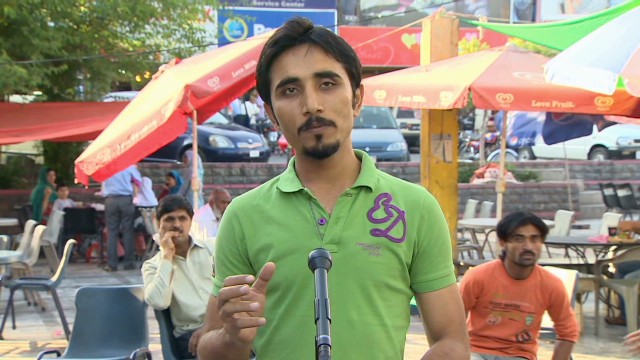
"This is the first time I am voting and I am 60, I want change," said Shaheen Khan, who was at a polling station in the largest city of Karachi. "There were thousands of people when I came ... the queue was so long. People in wheelchairs and crutches all waiting to vote."
Pakistanis hope the polls will usher reform in a country battling various issues, including corruption, a fledgling economy and security woes.
In some cities, the insecurity was evident.
A blast outside the Awami National Party office killed six people and wounded 30, CNN affiliate Geo TV reported. It also said seven people were injured when a bomb exploded at a polling station in Peshawar.
Record numbers
Of the 86 million voters registered to cast ballots, there will be 36 million new voters, according to the Election Commission of Pakistan.
More than double the number of candidates will be women, with 161 running compared with the 64 who contested the 2008 poll, according to the United Nations
As the nation makes the transition after years of mostly military rulers, the economic, political and security situation remains unstable.
Beyond high inflation and poverty rates, Pakistan has also seen spurts of violence, in some cases engineered by Islamic extremists.
Taliban threats
Since April, the Taliban in Pakistan have killed dozens in attacks on the three main political parties. Many urban voters and parties regard resurgent fundamentalism as one of the biggest threats to Pakistan.
More than 600,000 security personnel have been deployed nationwide leading up to the election, Information Minister Arif Nizami said Friday.
Pakistan's army, which helped deliver 650 tons of ballots to polling stations, will have 75,000 troops out around the country, a military spokesman said.
The governing Pakistan People's Party is led by Bilawal Bhutto Zardari, the son of assassinated former prime minister and party leader Benazir Bhutto. But in an indication of the danger facing politicians, Bhutto Zardari won't be out for Saturday's vote because of security threats, according to Pakistan's Dawn newspaper.
While his party became the first civilian government to complete a full five-year term -- the three governments after the death in 1988 of military strongman Zia ul-Haq were all brought down by the army -- its legacy is a deeply fractured country with a faltering economy.
The ruling party's main opposition comes from the Pakistan Muslim League-N, led by one of the country's leading industrialists and richest men, Nawaz Sharif. He's been prime minister twice before and was overthrown in a coup when Gen. Pervez Musharraf seized power in 1999.
Viewed as a religious conservative, his party -- Pakistan's second largest -- believes it would have won elections in 2008 had the assassination of Bhutto not given a massive boost to the ruling party.
Another contender is Imran Khan, the former star cricketer and heartthrob who leads the Tehreek-e-Insaf (Movement for Justice) party.
Not in contention is Musharraf, who returned in March from four years of self-imposed exile to take part in the elections. But he's been banned by a court from taking part in politics and his party, the All Pakistan Muslim League, has announced a boycott.
Musharraf and his allies weren't the only ones upset with Pakistan's leadership ahead of the election. The New York Times "strongly protested" the expulsion of its Islamabad bureau chief -- an order that Declan Walsh received at 12:30 a.m. locally, at his home.
The Committee to Protect Journalists joined the Times in slamming the move, with its Asia program coordinator Bob Dietz writing that the move suggests "a need to intimidate foreign and local journalists."
"The expulsion of Declan Walsh shows just how much the authorities fear independent media coverage," said Dietz.
CNN's Shaan Khan and Greg Botelho contributed to this report.
