
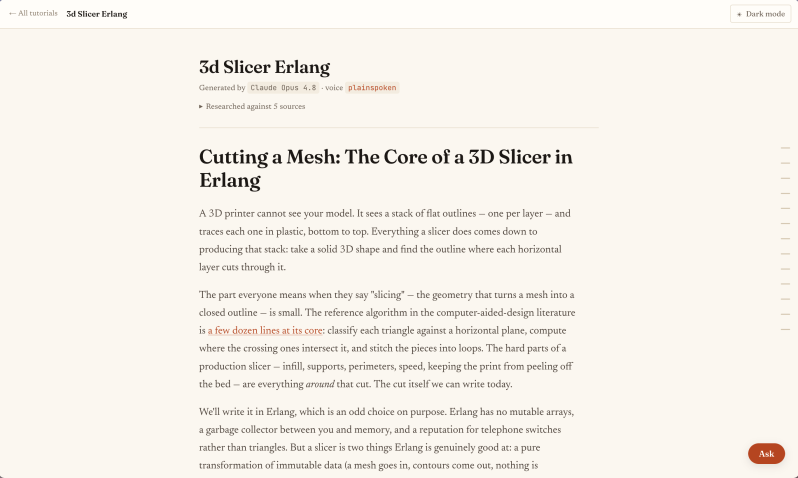
Quick question: how did you learn to code? It probably wasn’t bribing someone a year or two ahead of you in CS to finish all your homework, but that’s exactly what ‘vibe coders’ are doing — even in class. Odds are, you learned by working through exercises, following tutorials, and doing it yourself. Finding good tutorials isn’t getting any easier in the age of LLMs, and that’s where [Deven Jarvis]’s Lathe comes in: it’s a project to get an LLM to make the tutorial for you. Instead of doing the work for you, it gets the clanker to show you how to do it yourself.
Everyone’s different, so this may not apply to you, but it’s a journey/destination sort of problem. Some people just want a piece of software, and they can vibe code until the oceans dry up and will have no interest in this project. Other people take great joy in learning how to do things; [Deven] is one of those. A good tutorial is a great way to learn, since it artificially softens the learning curve compared to just jumping into a project with a man page or a datasheet.
Of course you’re still faced with the hallucination problem, something [Deven] admits in his excellent write-up. As he points out, the advantage is that you can call whatever model you plug into Lathe on its BS, and try and get a correct answer. Try that on Reddit, or most other places online. Sure, the tutorials aren’t going to match the best human-generated content, and [Deven] admits that. He’s using it for topics (like slicer design) that don’t have easy tutorials online — and sadly, his prediction that nobody is going to bother making good learning resources like they used to when they’ll just be scraped by LLMs is very likely true. It’s not that your options are vibe code or vibe-generated tutorial, but if that’s the direction the world is going, we’ll take the tutorial, thanks.
Getting the LLM to hold your hand through a tutorial might not appeal to the most Butlerian among us, but it’s a big step from that to the full cognitive surrender some people worry about.