
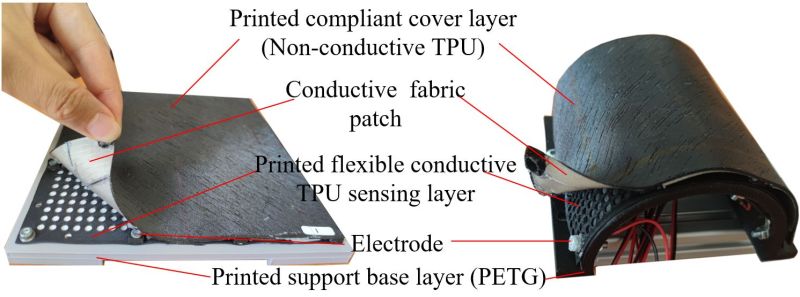
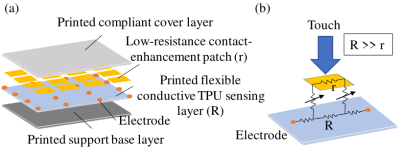
Schematic diagram of the touch-sensitive skin. (Credit: Haofeng Chen et al., ArXiv, 2026)
Hypoesthesia, more commonly referred to as numbness, is one of the more distressing ailments that can affect us humans, primarily because it reminds us of just how much we rely on our sensation of touch in daily life. From experiencing the world around us, handling objects, noticing when you just bumped into that side table again and the comforting hug of a fellow human being, touch is perhaps the most important of our senses.
In that regard the recently published research by [Haofeng Chen] et al. on giving robots a skin that can experience touch seems rather important as it would give especially humanoid robots a more natural way to interact with their environment, using feedback from touch.
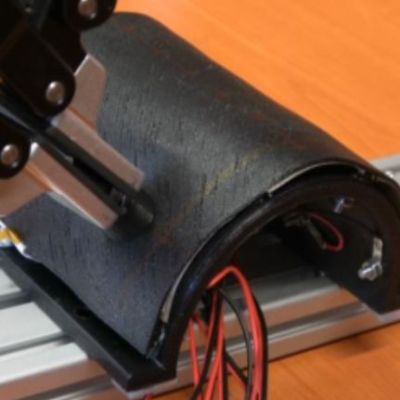
Poking the artificial skin. (Credit: Chen et al., arXiv, 2026)
One of the essential parts of biological skin is that it is teeming with sensors, at a density level that provides excellent resolution as required, down to sensing e.g. small surface imperfections with one’s finger tips. Replicating this with an artificial skin for robotics has always been a problem, due to the wiring and/or reliability nightmare this poses with typical approaches. Instead of focusing on many individual sensors, [Chen] et al. focused on effectively creating the equivalent of a resistive touch screen in skin format.
The basic principle underlying the demonstrated artificial skin is electrical impedance tomography (EIT), which uses surface electrodes to form a tomographic image based on measures electrical resistivity. Core here is the flexible TPU layer with electrodes and the conductive fabric patches attached to the top TPU cover layer. The electrodes continuously measure the resistivity, with disturbances from those patches due to touch events on the cover layer altering these values. From this EIT can be used to reconstruct the location and strength of the touch event.
The results from the created prototypes were promising, with only 16 electrodes sufficing to create a fairly accurate pressure map. Hardware-wise this makes it thus quite uncomplicated, with the characterization of the TPU porosity and such along with the EIT algorithm (provided in the paper) probably being the biggest hurdles for hobbyist recreations.