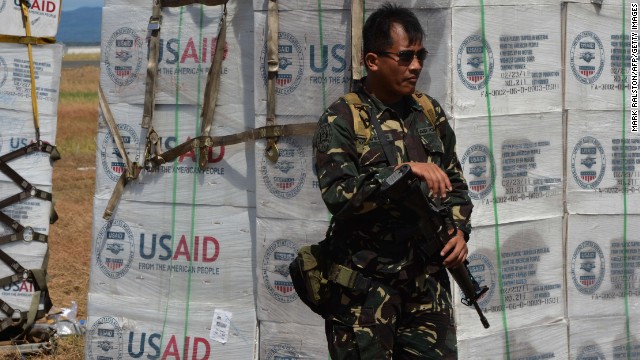
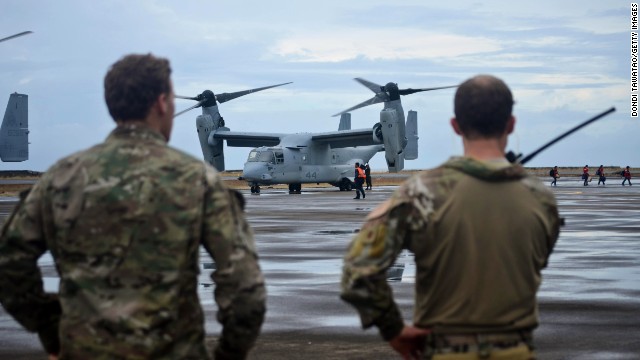
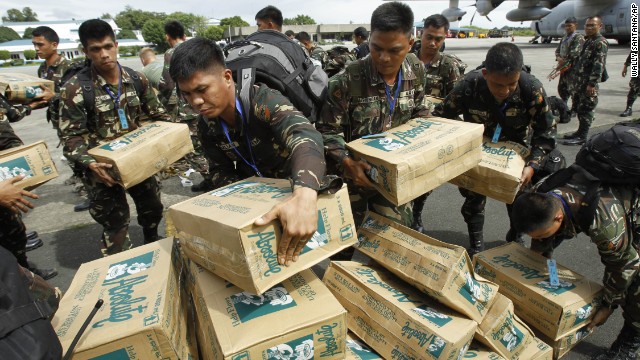
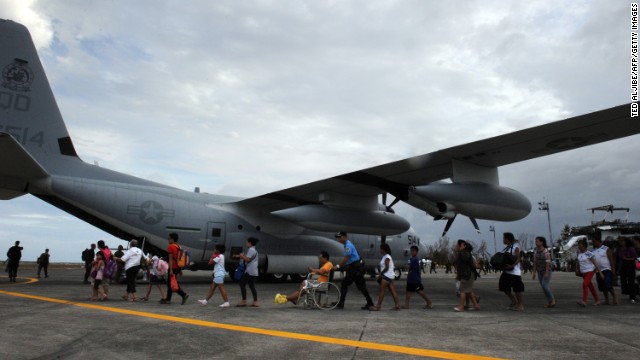
See how you can help." border="0" height="360" id="articleGalleryPhoto001" width="640"/>A Philippine soldier guards U.S. aid in the aftermath of the typhoon at Tacloban airport on Friday, November 15. Troops and aid organizations have been confronted with blocked roads and devastating damage in the aftermath of Super Typhoon Haiyan, one of the strongest storms in history.
See how you can help.
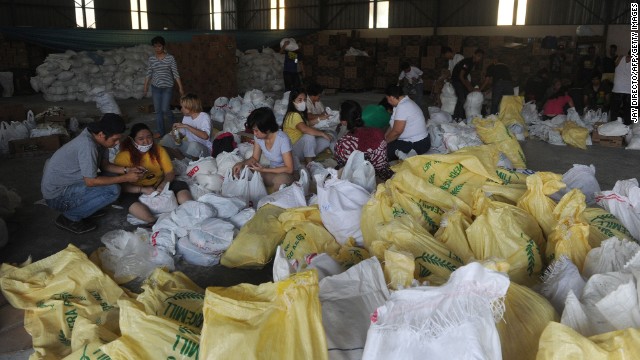
Volunteers prepare relief goods for victims of Super Typhoon Haiyan in Manila on Thursday, November 14.
Stranded passengers board a plane at a damaged airport in Tacloban, Philippines, on Wednesday, November 13.
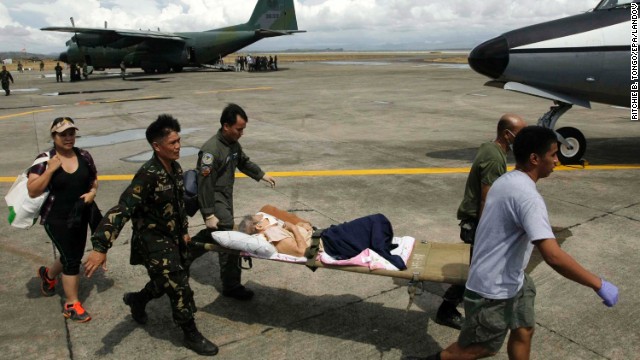
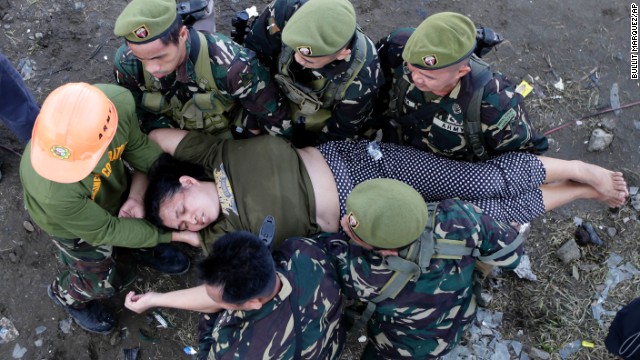
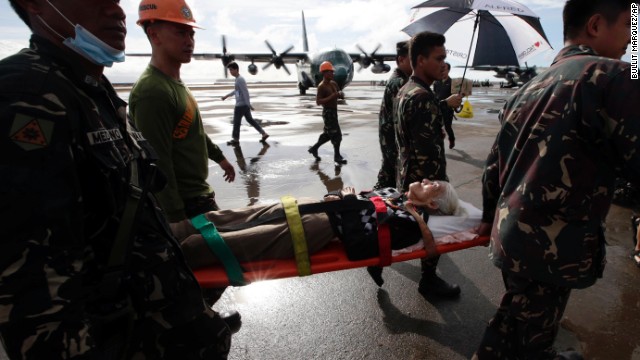
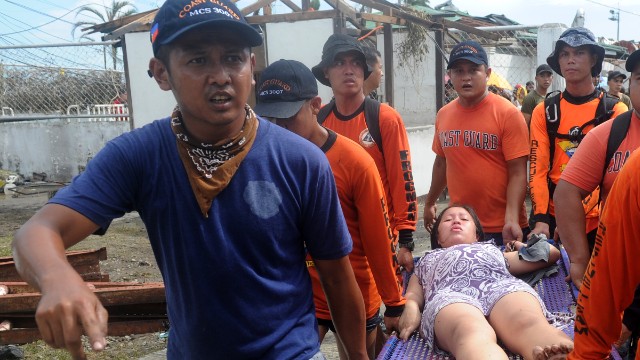
Soldiers evacuate a sick survivor at an airport in Tacloban on November 13.
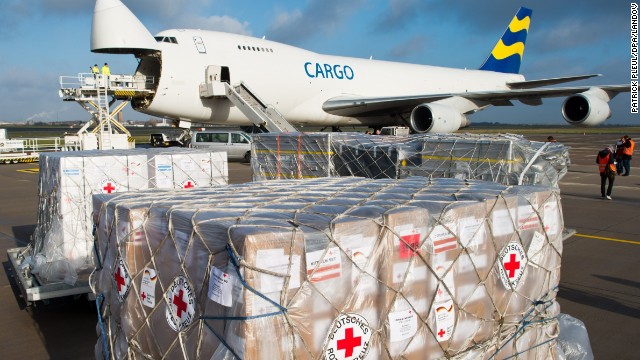
Relief supplies for the victims in the Philippines are loaded into an aircraft in Germany on November 13.
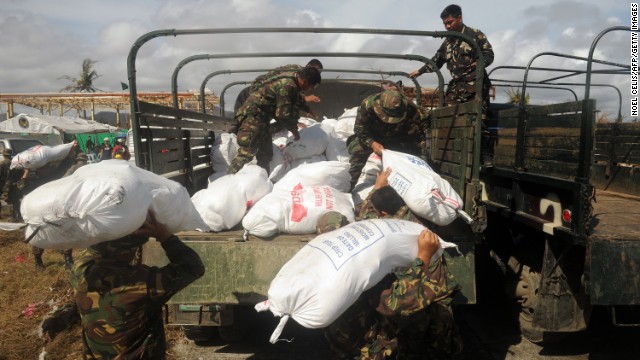
Soldiers load relief goods onto a truck in Tacloban on November 13.
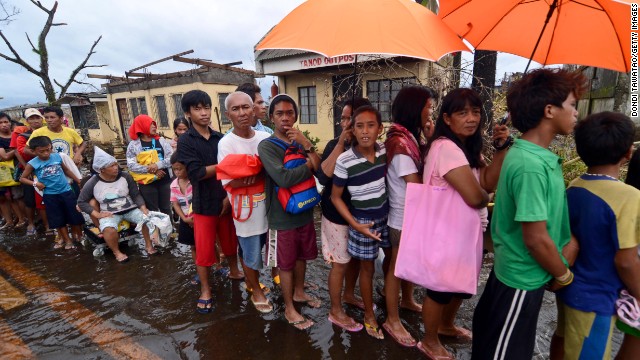
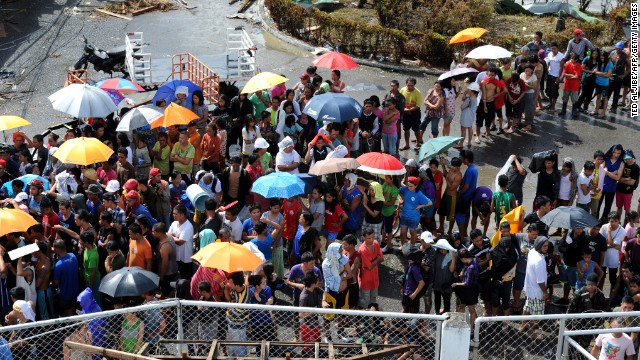
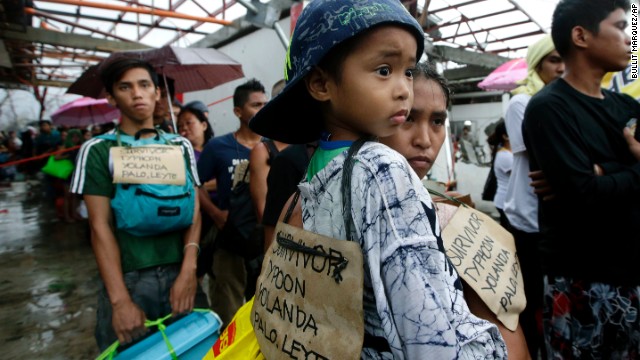
People wait in line to receive relief goods in Leyte on Tuesday, November 12.
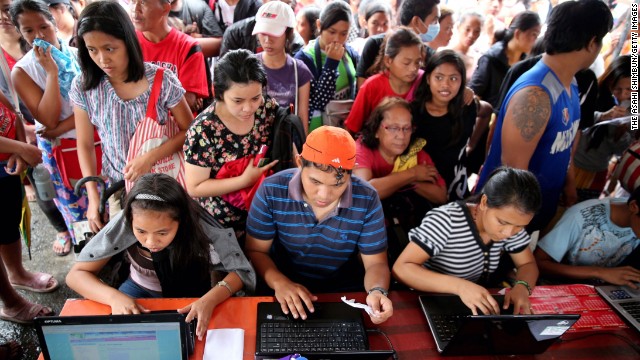
Evacuees send e-mails to their family members and relatives at a free Internet cafe set up by the Philippines government on November 12 in Tacloban.
Aid workers arrive in Leyte to assist survivors on November 12.
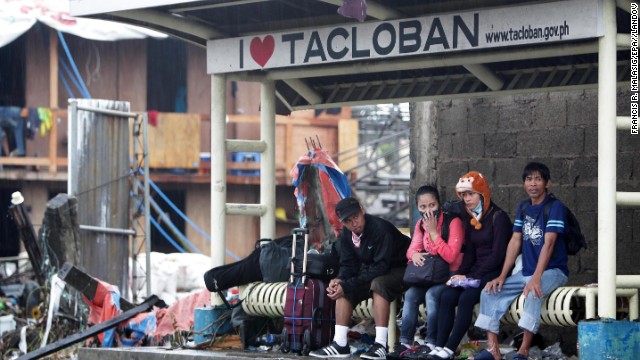
People wait at a bus stop November 12 in Tacloban, Philippines.
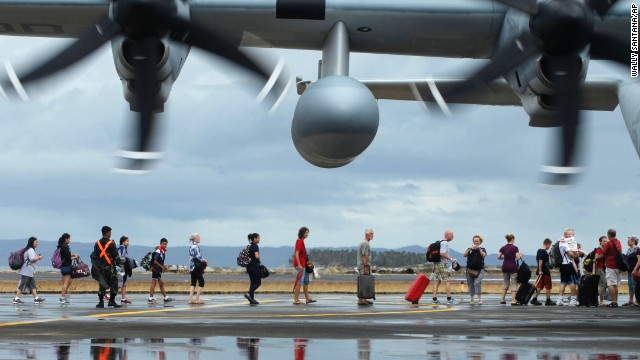
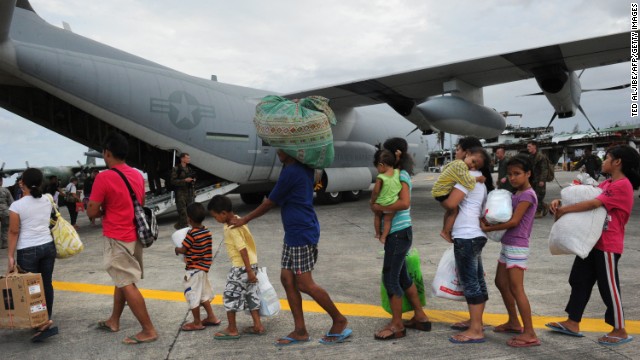
People board a U.S. military plane to evacuate Tacloban on November 12.
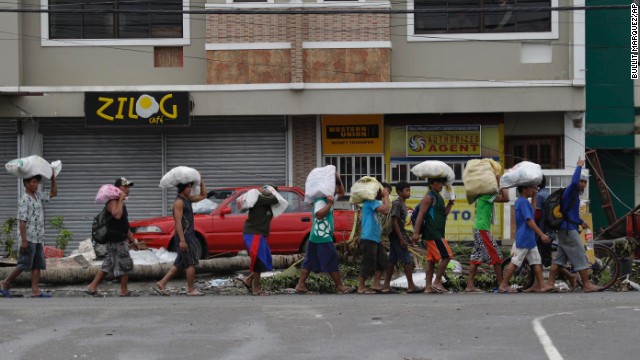
People carry sacks of goods November 12 in Tacloban.
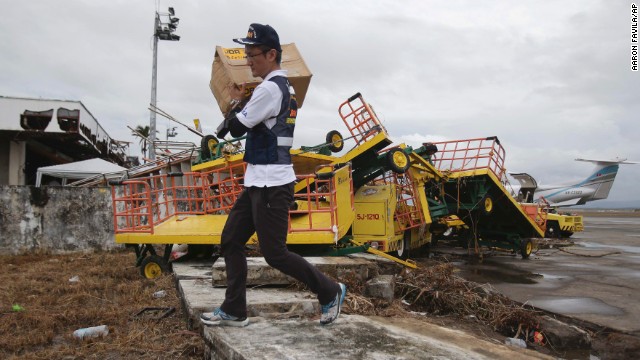
A member of the Japanese Disaster Relief Team carries goods in Tacloban on November 12.
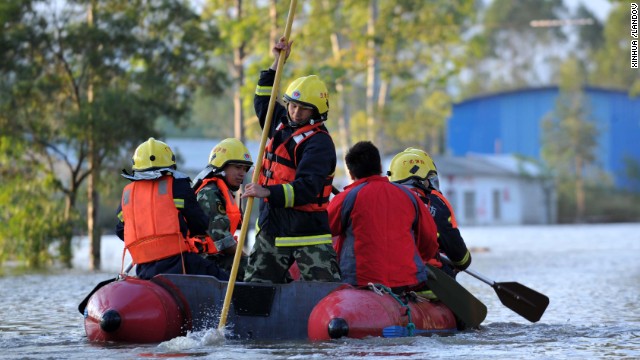
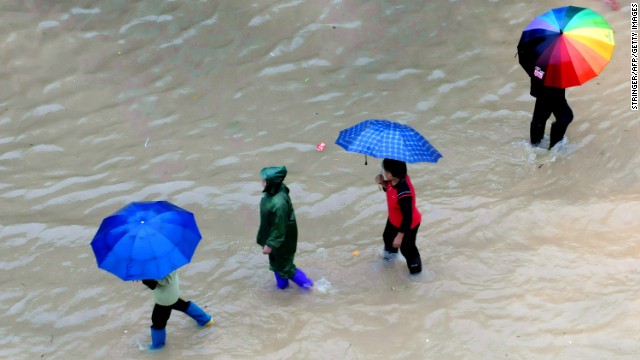
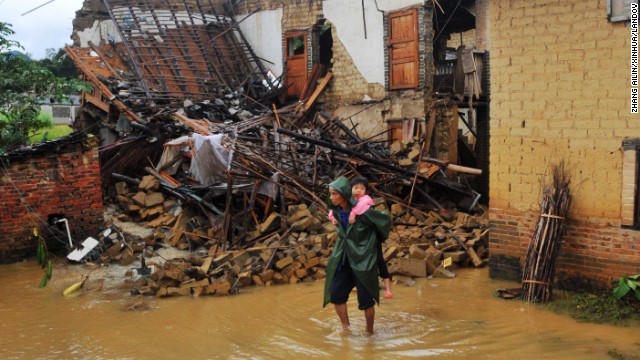
Rescuers in Guigang City, China, search a flooded road by boat on November 12. China and Vietnam were also hit hard by the typhoon.
Residents line up to receive treatment and supplies at the Tacloban airport on Monday, November 11.
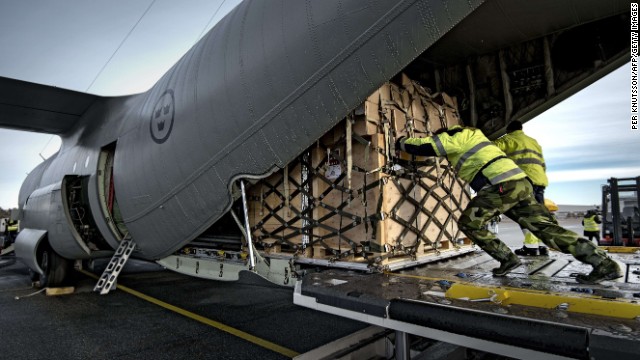
Staff load a Hercules airplane with equipment November 11 at the Orebro airport in central Sweden. The Swedish Civil Contingencies Agency, together with its humanitarian partners, sent equipment to support the United Nations' relief work in the Philippines.
Philippine troops load boxes of water at Villamor Air Force Base in Manila, Philippines, on November 11.
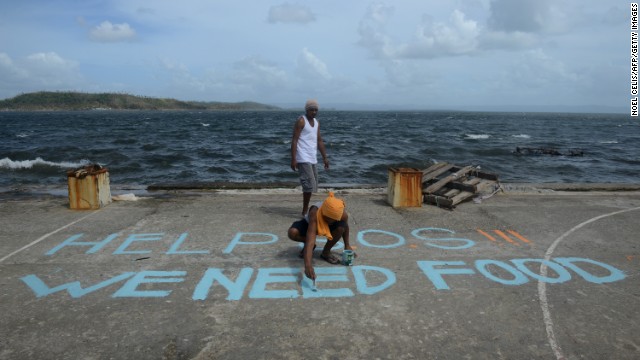
A man seeking aid paints a message on a basketball court November 11 in Anibong, Philippines.
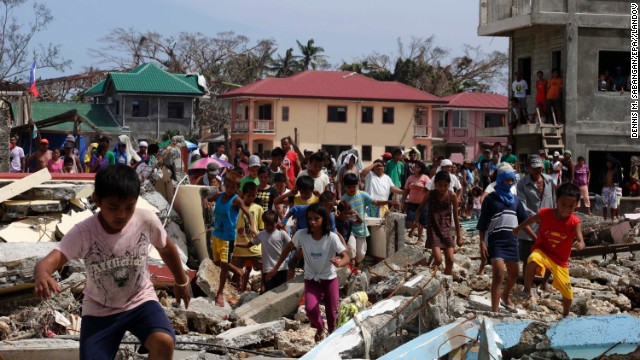
Villagers in Hernani, Philippines, run toward government officials hoping for food November 11.
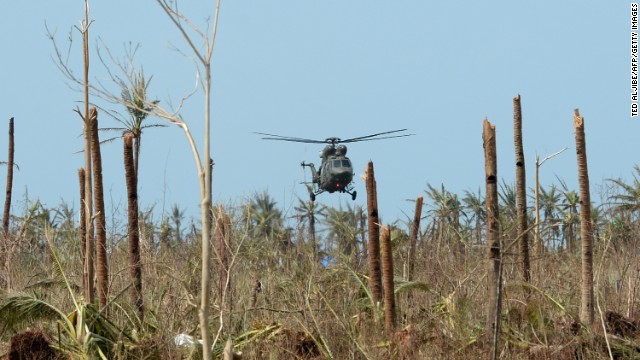
A military helicopter delivering food prepares to land at the airport in Guiuan, Philippines, on November 11.
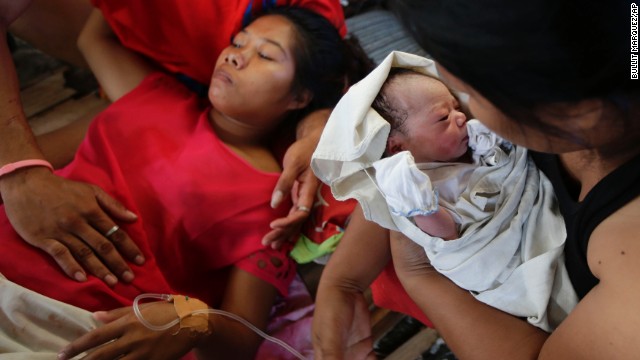
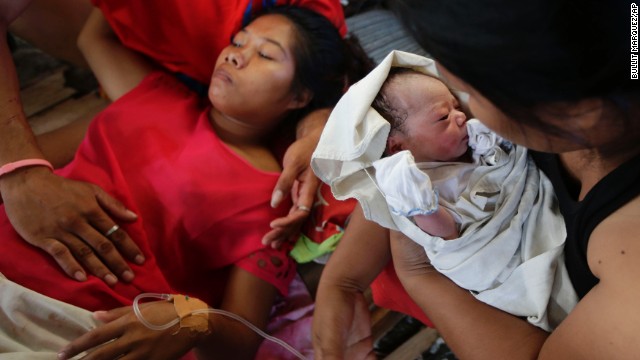
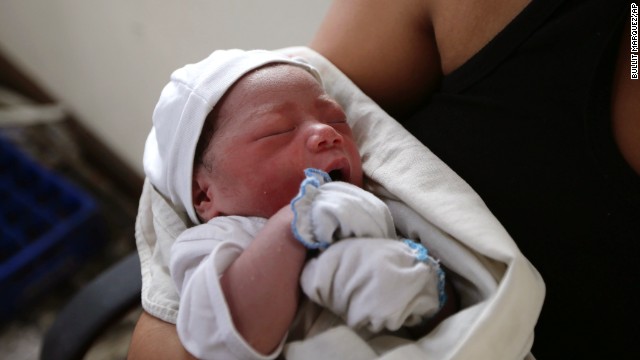
Emily Ortega rests on November 11 after giving birth to Bea Joy at an improvised clinic at the Tacloban airport.
Typhoon survivors line up at the Tacloban airport on November 11 to board a U.S. military plane bound for Manila.
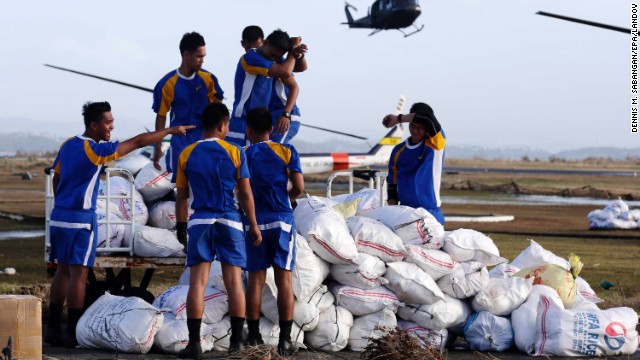
Philippine Air Force personnel prepare to load relief supplies at the Tacloban airport on November 11.
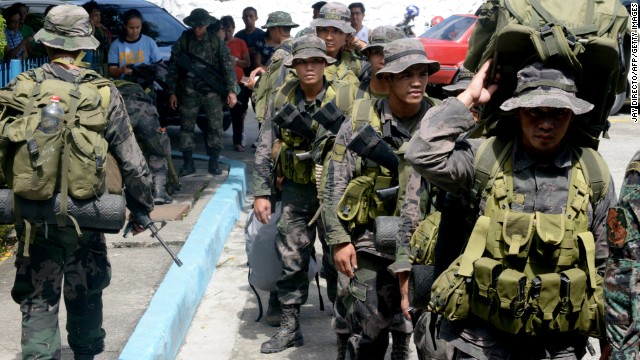
Philippine police commandos prepare to board a military plane in Manila on Sunday, November 10.
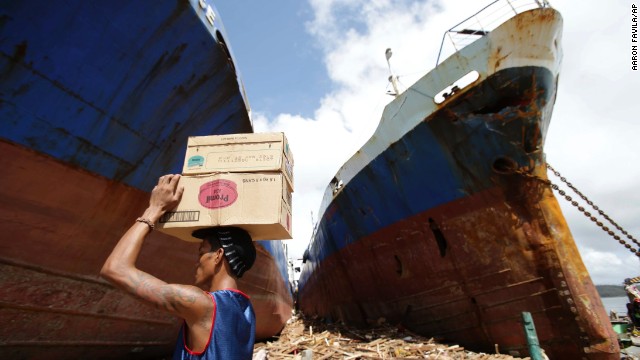
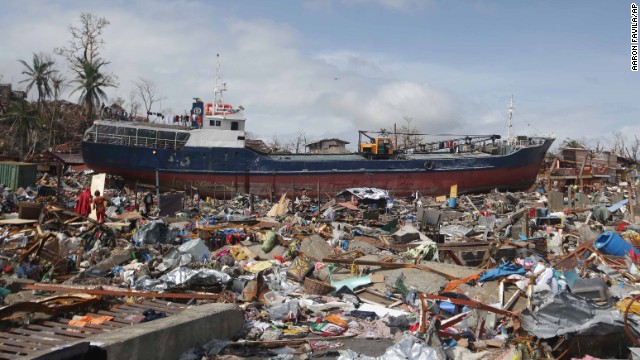
A Tacloban resident carries boxes of milk November 10 as he passes by ships washed ashore by the powerful storm.
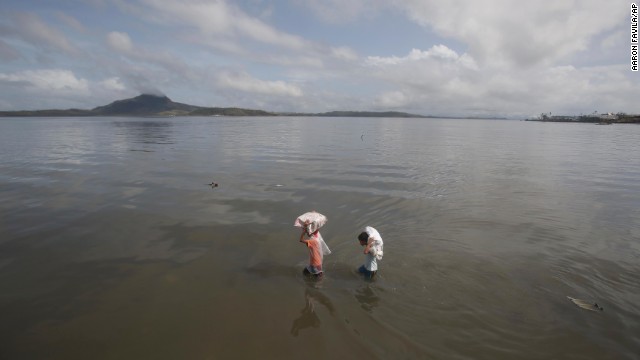
Residents carry relief goods along the bay in Tacloban on November 10.
1
2
3
4
5
6
7
8
9
10
11
12
13
14
15
16
17
18
19
20
21
22
23
24
25
26
- NEW: Official death toll climbs to 3,633 dead, disaster officials say
- Women flee with children while some men remain to rebuild
- "My children are decomposing," one woman says
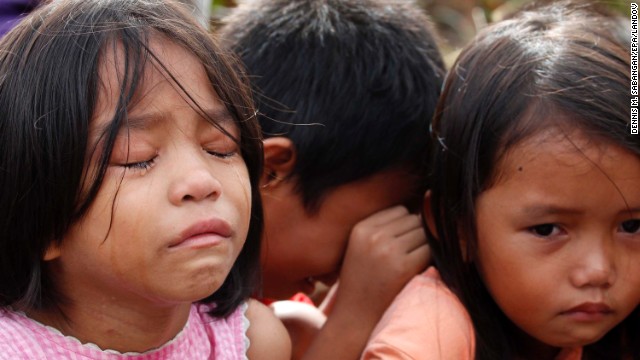
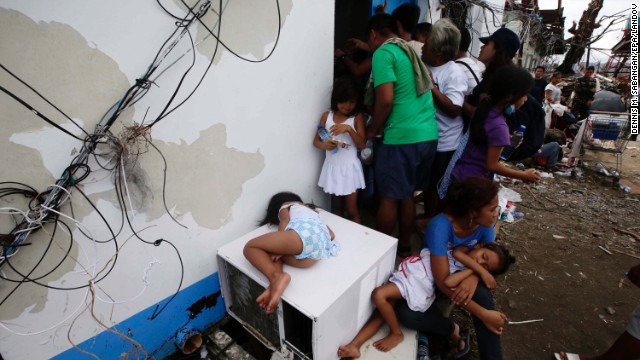
- Children wander the streets of Tacloban unattended
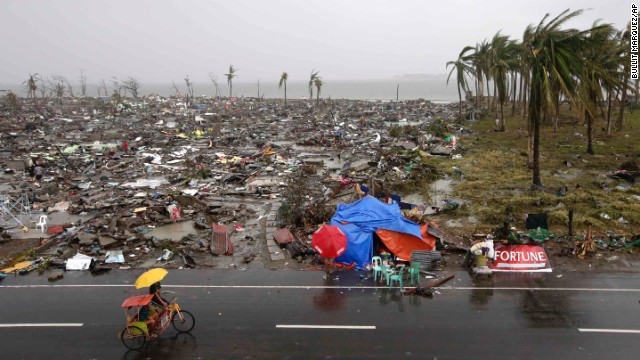
Tacloban, Philippines (CNN) -- More than a week after Typhoon Haiyan laid waste to much of the central Philippines, the toll is overwhelming: entire communities flattened, thousands dead and nearly 2 million people displaced.
The arrival in recent days of hundreds of aid workers and military troops has seen a flood gate of humanitarian aid -- food, water and medical supplies -- open, albeit sporadically, in the hard hit provinces.
Crews continued Saturday to collect bodies from streets, with the death toll raised to 3,633, according to the national disaster agency's official death count.
The number of injured stood at 12,487, the National Disaster Risk Reduction and Management Council reported. At least 1,179 were missing.
For some who survived the monster storm, the aid came too late.
Richard Pulga, 27, died Friday, seven days after surviving the massive storm surge and fierce winds that flattened large portions of Tacloban City, a city of more than 200,000 people.
Pulga initially suffered an "open fracture of his shin bones," according to doctors working at a damaged clinic. He then contracted a "terrible infection" that left him in need of a blood transfusion.
But with the clinic out of blood and antibiotics, he eventually died, the doctors said.
The death toll could still climb higher, with an additional 1,000 cadaver bags sent to provinces, the disaster council announced as search-and-rescue operations continued in Tacloban City.
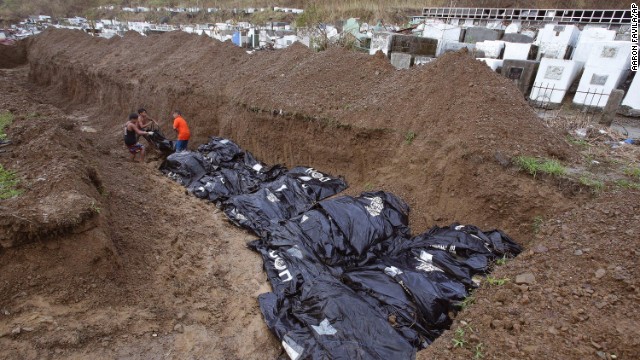
The national disaster council's executive director, Eduardo Del Rosario, said the bags would be placed on stand-by, given that most of the bodies had already been buried in mass graves or claimed by relatives.
Used cadaver bags are cleaned before being reused, he said.
The nation's disaster agency said more than 9 million people were affected in 44 provinces, 536 municipalities and 55 cities. Nearly 2 million were displaced, with about 400,000 of them finding shelter inside evacuation centers.
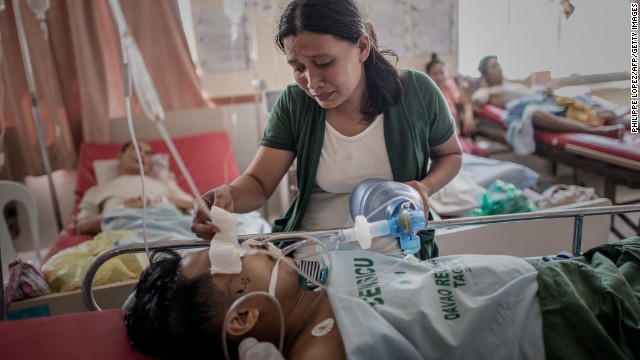
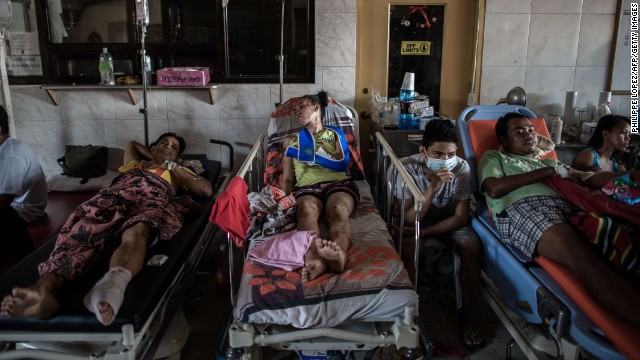
A typhoon survivor keeps her husband alive by manually pumping air into his lungs following an infection after his leg was amputated at the Divine Word Hospital on Friday, November 15, in Tacloban, Leyte province, Philippines. The hospital has been operating without power since Typhoon Haiyan laid waste to much of the central Philippines a week ago.
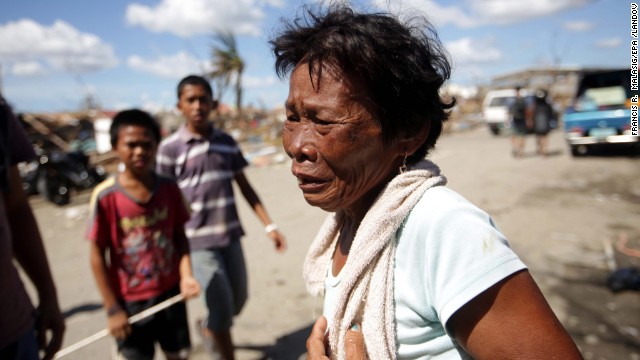
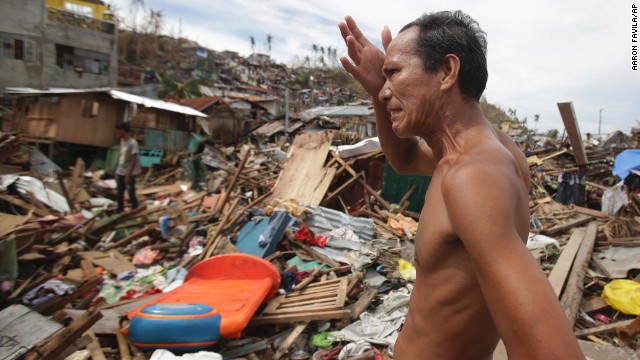
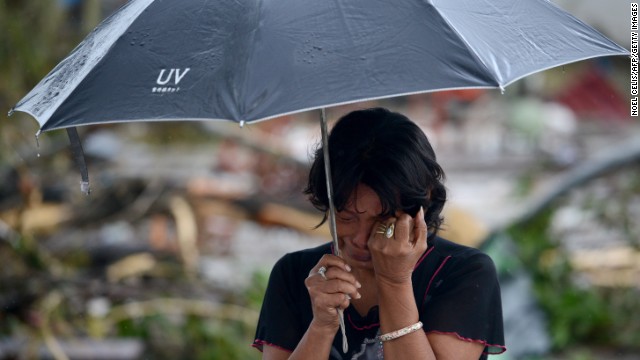
A survivor reacts to the damage at a residential area in Tacloban on November 15.
Typhoon victims are treated in the lobby of the Divine Word Hospital on November 15.
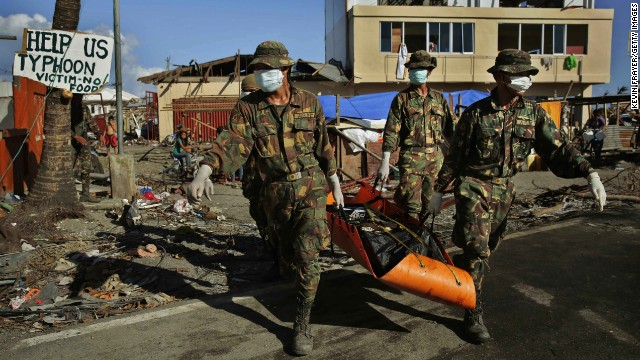
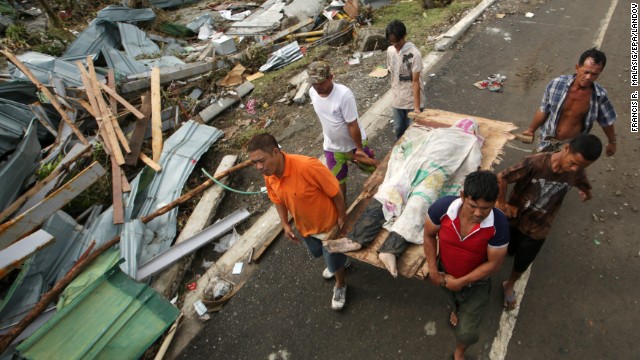
Philippines Army soldiers carry the body of a civilian collected from the rubble in the devastated town of Tanuan, south of Tacloban, on November 15.
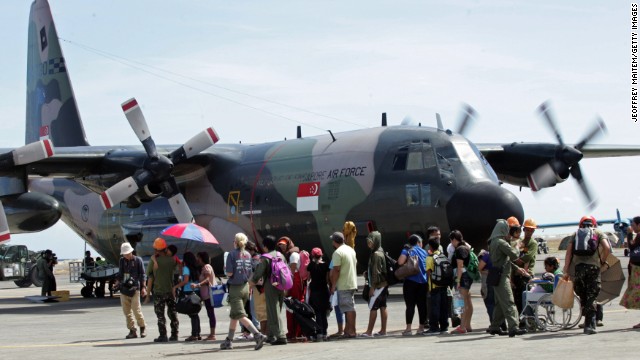
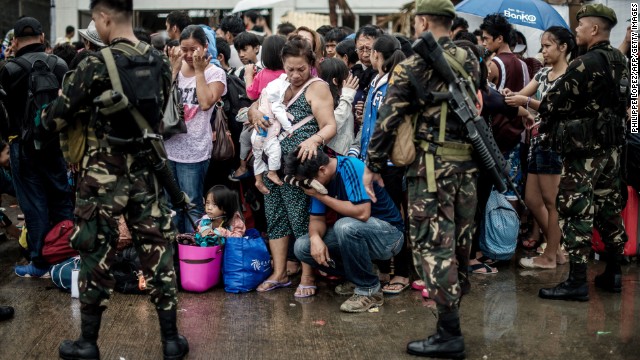
Residents wait to board a Singaporean cargo plane at the Tacloban airport on November 15. Many survivors have converged on the city's airport to wait for flights.
Search and retrieval teams carry a body bag in Tacloban on November 15.
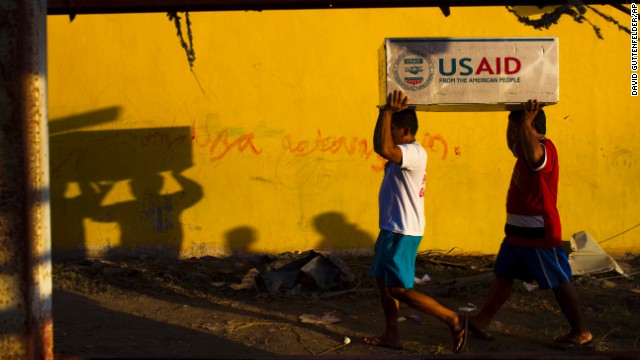
Survivors of Typhoon Haiyan carry food that a U.S. military helicopter dropped off in Guiuan, Philippines, on Thursday, November 14. The U.S. Agency for International Development donated the food to help with international relief efforts.
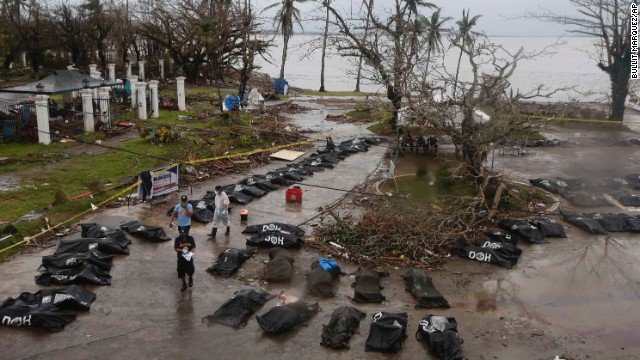
Dozens of bodies are placed near Tacloban City Hall on November 14 as workers prepare a mass grave on the outskirts of the hard-hit city.
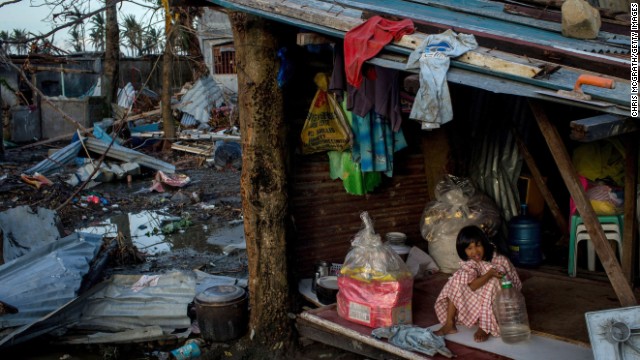
A girl plays inside her house amid the devastation in Tacloban on November 14.
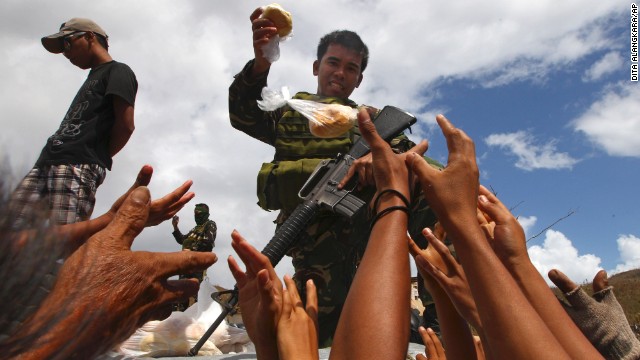
A Filipino soldier hands out bread to survivors in Maraboth on November 14.
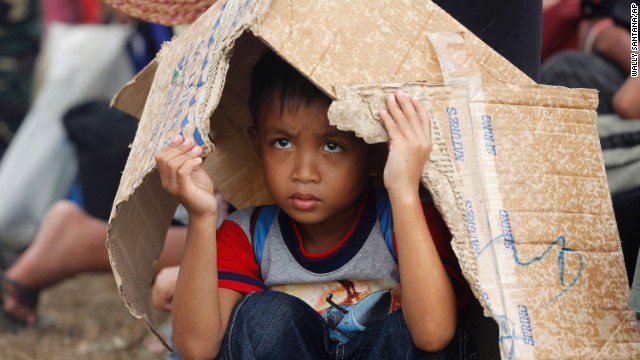
A boy takes cover from rain while waiting for an evacuation flight from Tacloban's airport November 14.
Workers arrange bodies at a mass burial site at a Tacloban cemetery November 14.
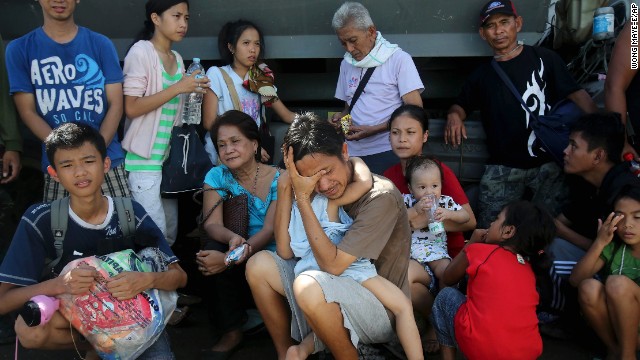
The weary wait for evacuation from Tacloban on November 14.
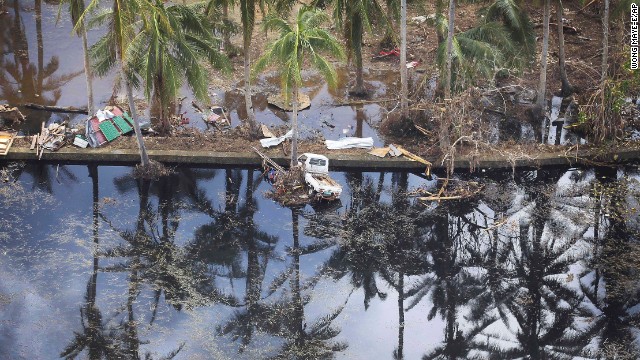
A truck lies in the water in Hernani on November 14.
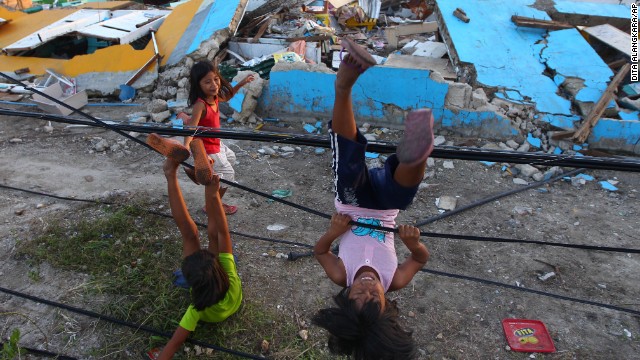
Children play with fallen power lines near a damaged school in Guiuan on November 14.
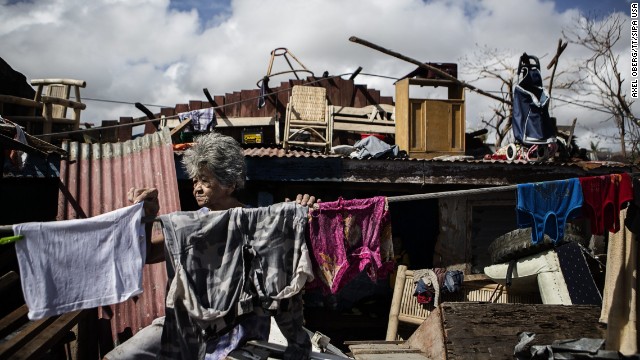
Teresa Mazeda hangs laundry in the ruins of her home in Tacloban on Wednesday, November 13.
Nina Duran searches for belongings at her family's destroyed house in Tacloban on November 13.
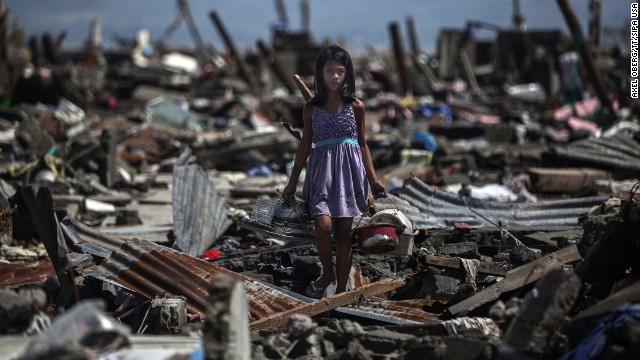
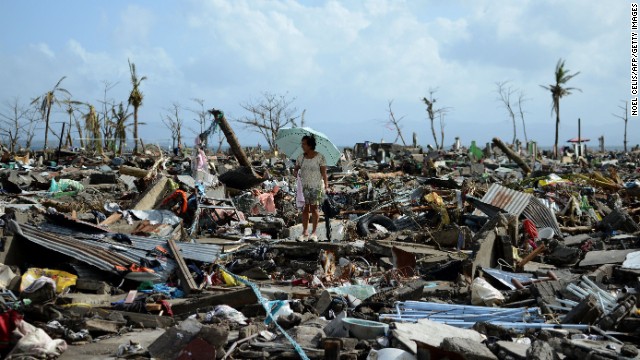
Survivors walk through the ruins of their neighborhood outside Tacloban on November 13.
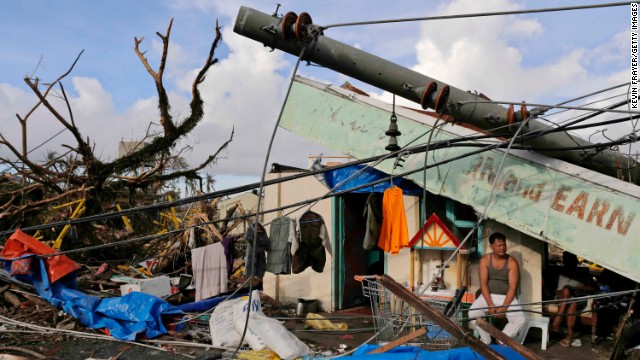
A man sits in front of his destroyed business on November 13 in Tacloban.
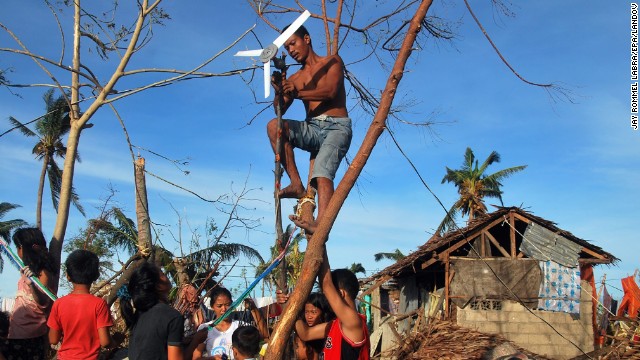
On November 13, a family tries to use a ceiling fan to generate electricity, desperate to charge mobile phones to search for family and friends in the wake of Typhoon Haiyan in Cebu province.
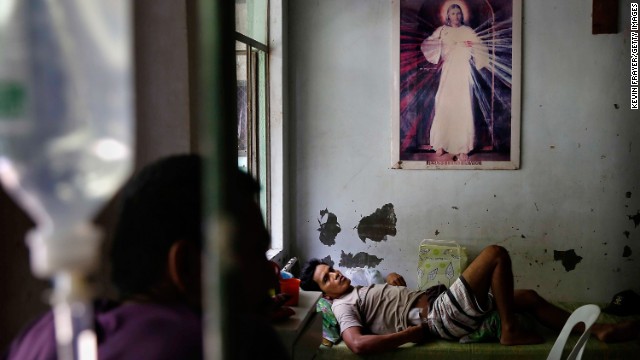
An injured man rests beneath a picture of Jesus Christ in Tacloban on November 13.
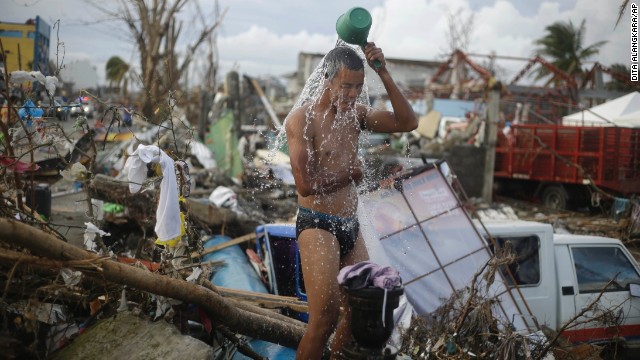
A man takes a shower amid rubble in Tacloban on November 13.
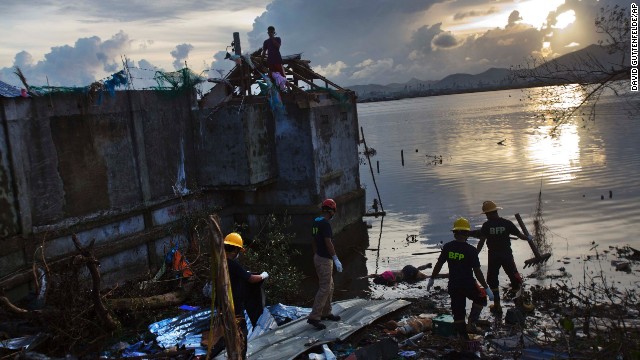
A rescue team wades into floodwater to retrieve a body in Tacloban on November 13.
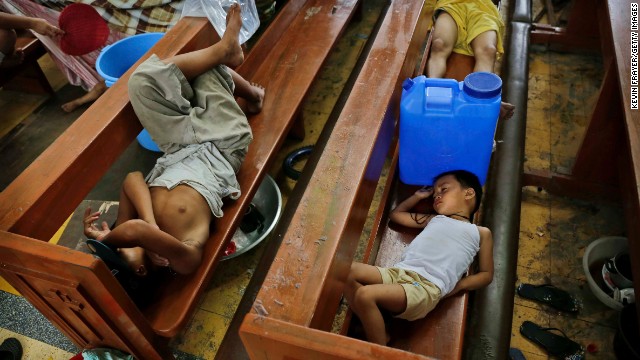
Residents take shelter in a Tacloban church on November 13 in the aftermath of Typhoon Haiyan.
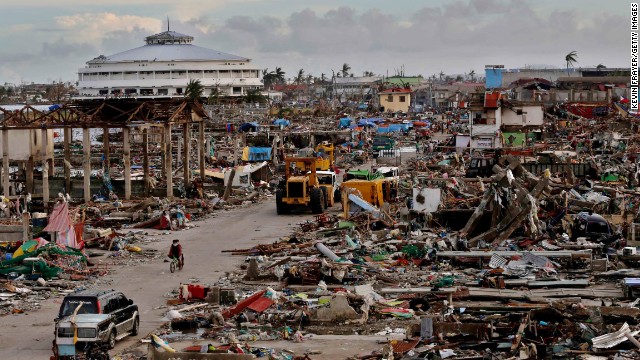
Residents make their way through a destroyed neighborhood in Tacloban on November 13.
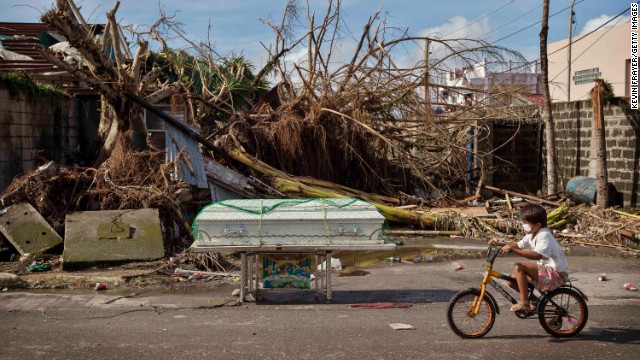
A boy cycles past a coffin left on a street in Tacloban on November 13.
A man looks at his home destroyed by Typhoon Hayian in Tacloban on November 13.
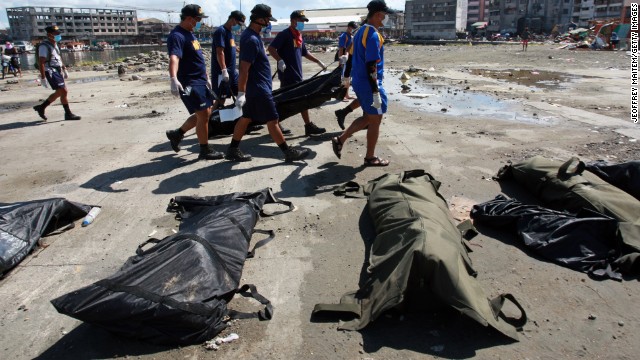
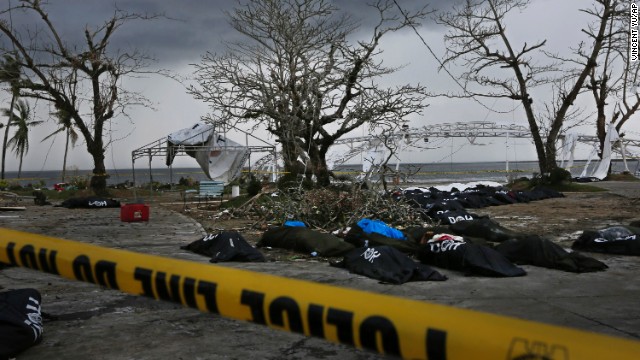
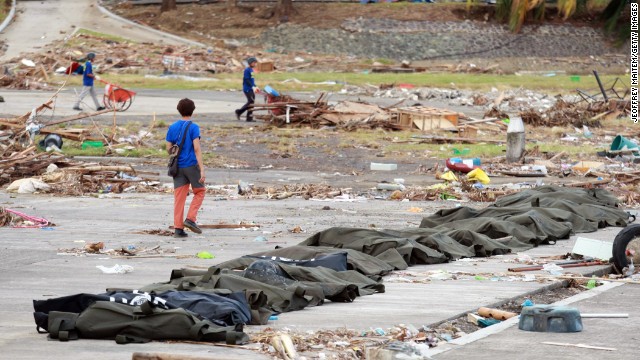
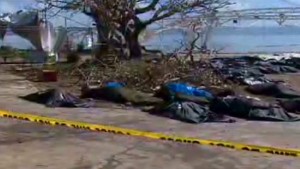
Body bags are lined up in the typhoon's aftermath in Tacloban, one of the hardest-hit cities, on November 13.
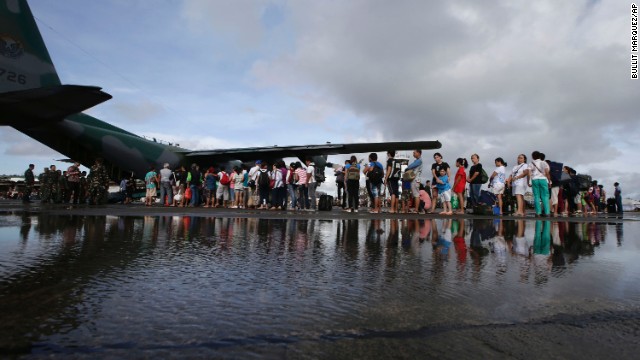
Survivors prepare to board a military plane November 13 at the airport in Tacloban.
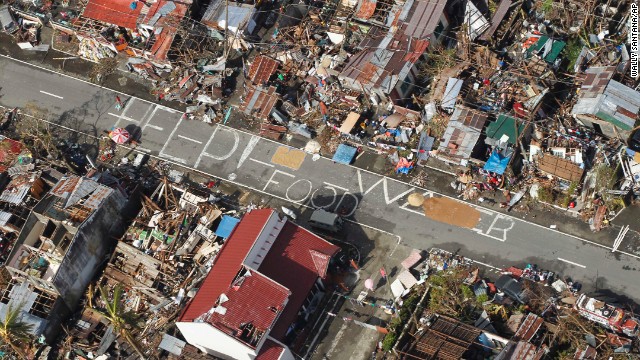
An aerial view shows signs pleading for help and food scrawled on a road in the coastal town of Tanauan on November 13.
Soldiers help a woman after she collapsed while waiting in line to board a military plane at Tacloban's airport November 13.
Survivors wait to be evacuated from Tacloban on November 13.
An injured survivor gets carried on a stretcher before being airlifted from Tacloban's airport November 13.
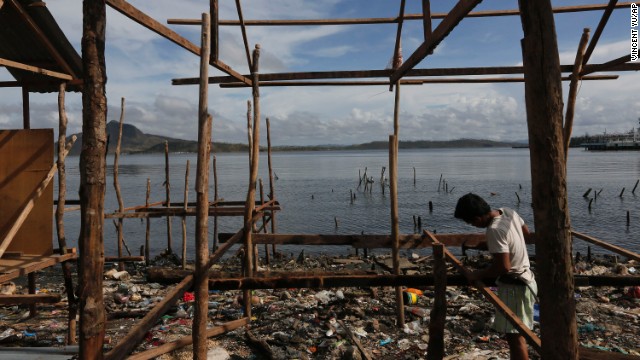
A survivor begins to rebuild his house in Tacloban on November 13.
Evacuees wait to board a military aircraft in Leyte on Tuesday, November 12.
People walk through damage in Tacloban on November 12.
A young man waits at the airport November 12 in hopes of being evacuated from Tacloban.
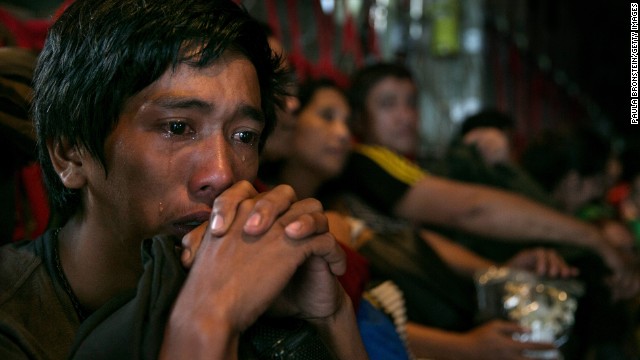
A woman comforts a crying relative as a plane leaves the Tacloban airport November 12.
A man sits crying on a packed aircraft in Tacloban on November 12.
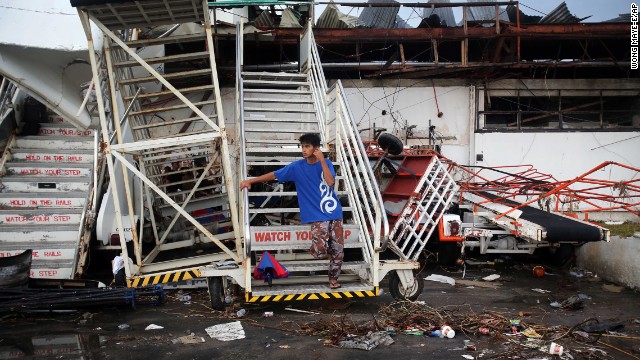
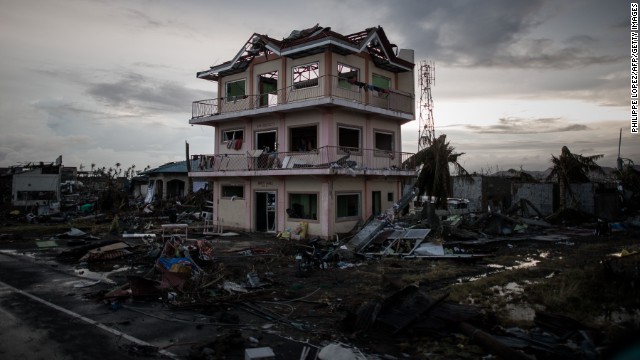
Debris lays scattered around a damaged home near the Tacloban airport on November 12.
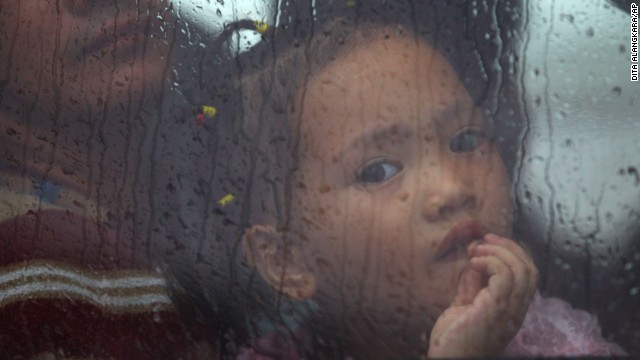
A girl sits inside a bus as she waits for a ferry in Matnog, Philippines, on November 12.
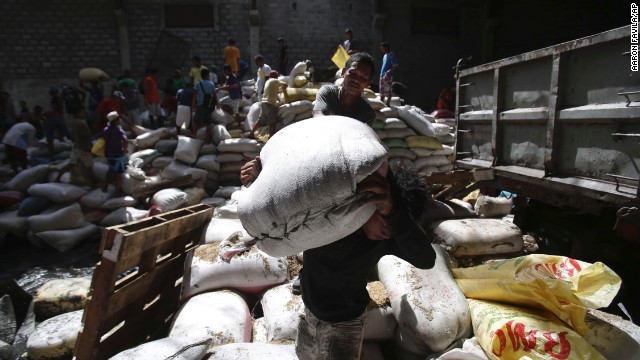
Residents carry bags of rice from a Tacloban warehouse that they stormed November 11 because of a food shortage.
Survivors in Tacloban board a military plane bound for the Philippine capital of Manila on November 11.
Police line up bodies for processing in Tacloban on November 12.
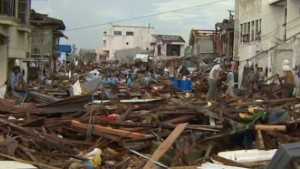
People in Tacloban pass debris on November 11.
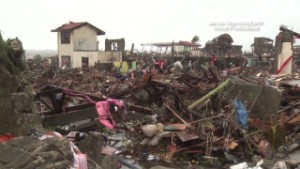
A woman in Tacloban walks amid the debris of destroyed houses on November 11.
People make their way across a flooded street in Shangsi, China, on November 11. Haiyan moved toward Vietnam and south China after devastating the Philippines.
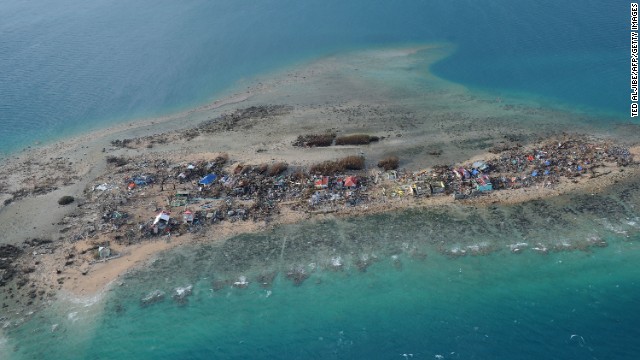
Buildings lie in ruins on Eastern Samar's Victory Island.
Emily Ortega rests on November 11 after giving birth to Bea Joy at an improvised clinic at the Tacloban airport.
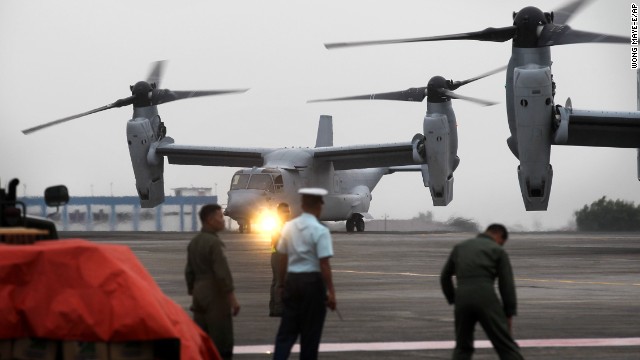
U.S. Marine Corps Osprey aircraft arrive at Manila's Villamor Airbase to deliver humanitarian aid on November 11.
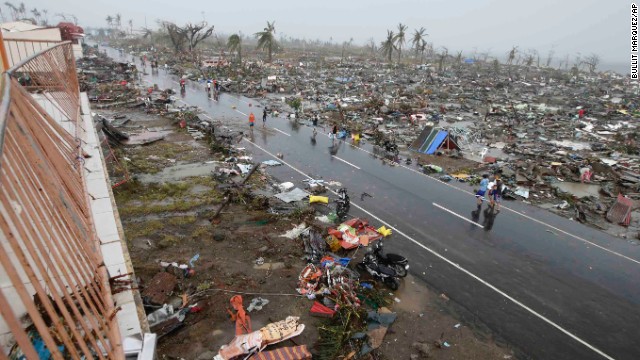
People ride past destruction in Tacloban on Sunday, November 10.
A body lies amid the Tacloban devastation on November 10.
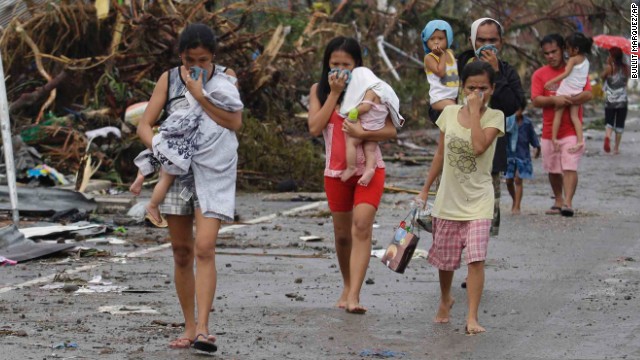
People cover their noses to block the smell of bodies in Tacloban on November 10.
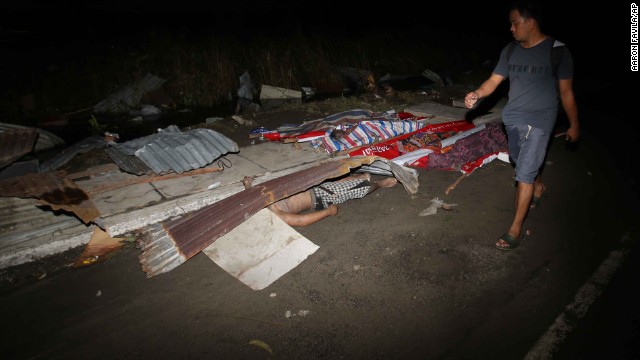
Bodies of victims lie along a Tacloban road on November 10.
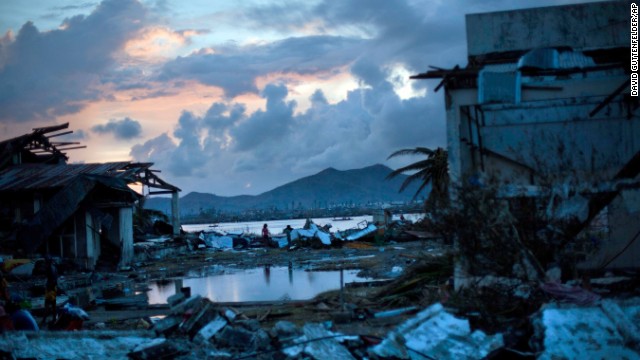
A large boat sits aground, surrounded by debris in Tacloban on November 10.
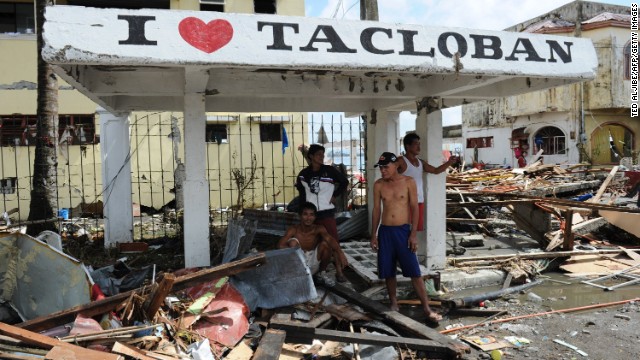
People walk past the Tacloban devastation on November 10.
People stand under a shelter in Tacloban.
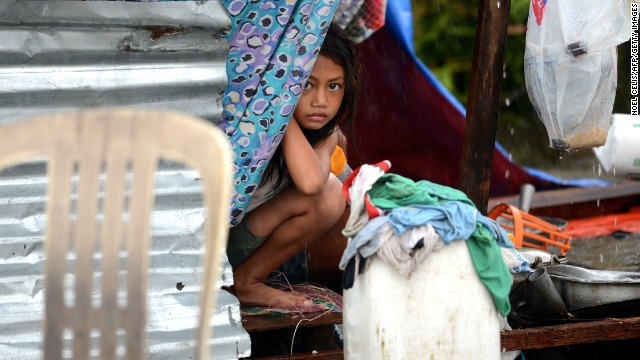
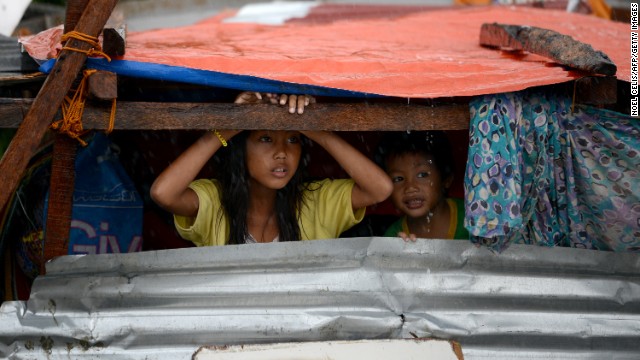
A girl peeks out from a makeshift shelter in Tacloban.
Typhoon survivors wait to receive relief goods at the Tacloban airport on November 10.
A woman mourns in front of her husband's dead body November 10 in Tacloban.
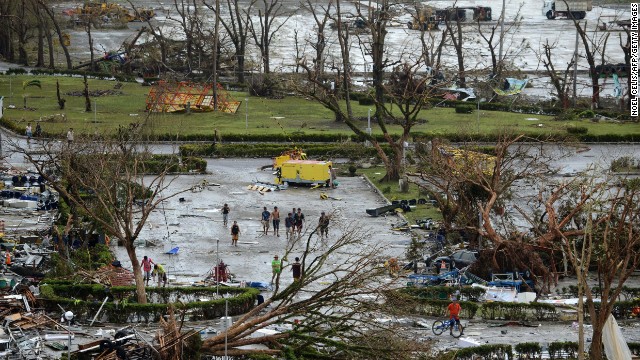
Fallen trees litter the ground at the Tacloban airport on Saturday, November 9.
A resident passes victims' bodies on a Tacloban street November 9.
People in Tacloban carry a victim of the typhoon November 9.
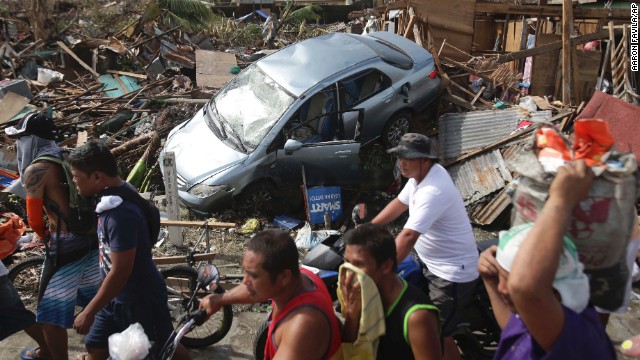
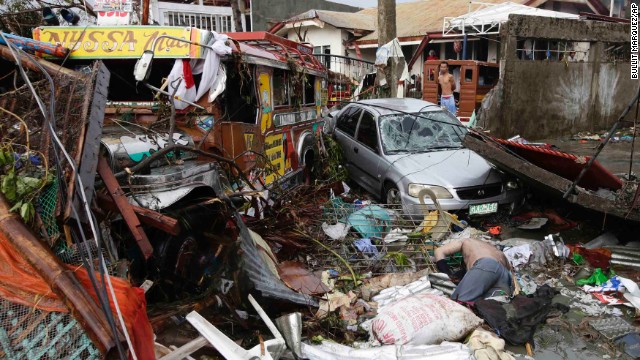
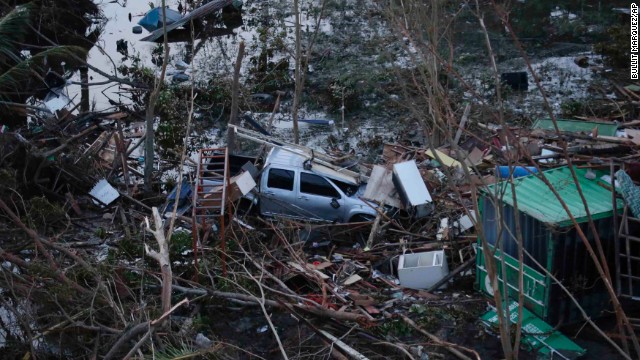
A vehicle lies amid Tacloban debris on November 9.
People walk past a victim left on the side of a road in Tacloban.
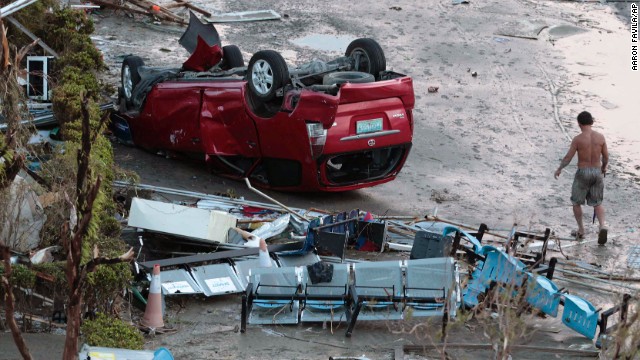
A resident passes an overturned car in Tacloban on November 9.
Rescue workers carry a woman about to give birth November 9 at a makeshift medical center at the Tacloban airport.
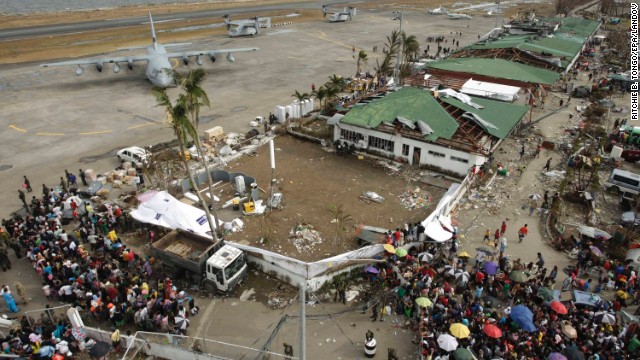
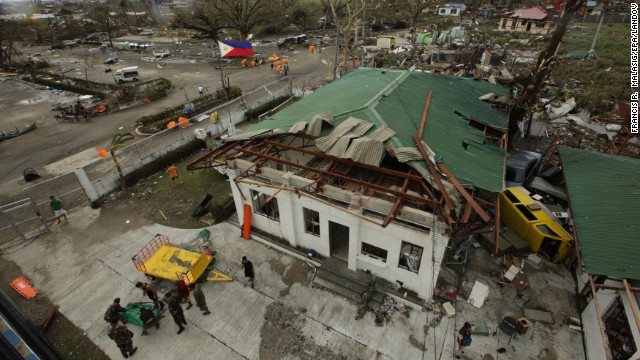
An airport lies in ruins in Tacloban.
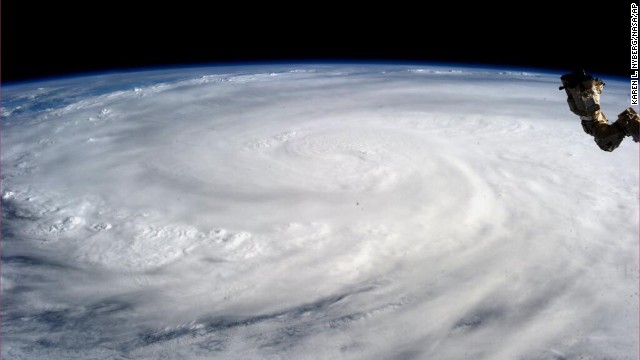
Astronaut Karen L. Nyberg took a picture of the typhoon from the International Space Station on November 9.
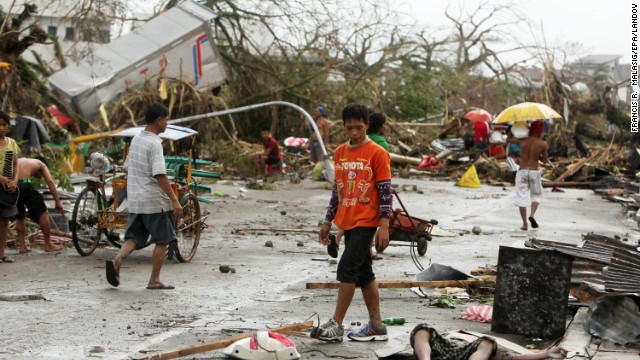
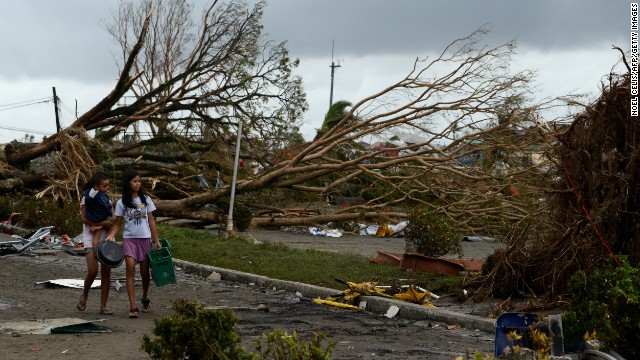
Women walk past fallen trees and destroyed houses in Tacloban on November 9. Residents scoured supermarkets for water and food as they slowly emerged on streets littered with debris.
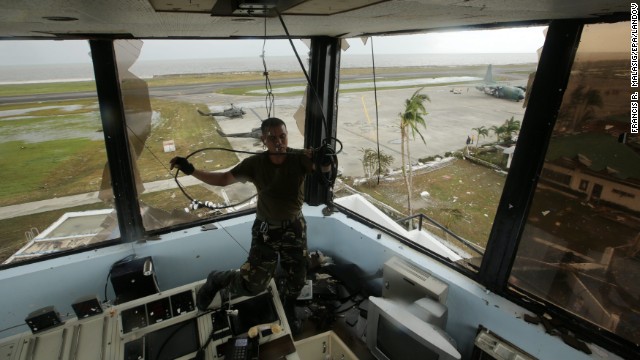
A soldier pulls a cable inside the devastated airport tower in Tacloban.
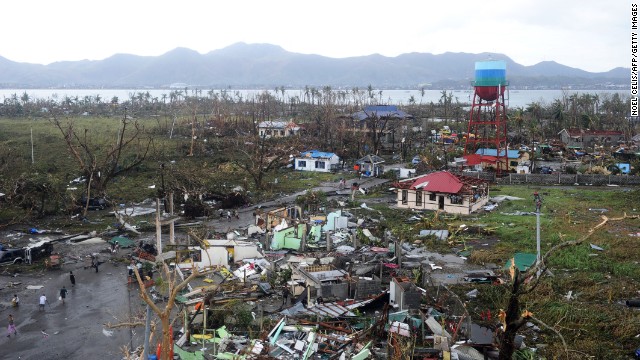
Tacloban houses are destroyed by the strong winds caused by the typhoon.
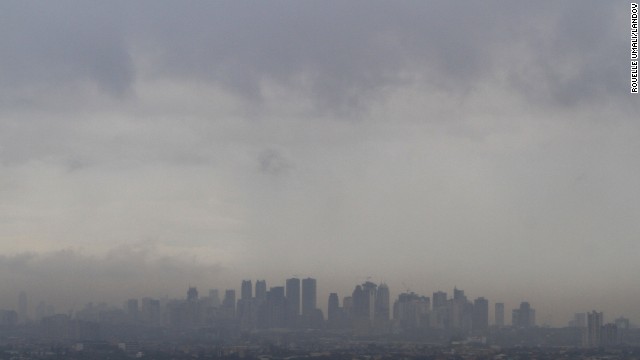
Dark clouds brought by Haiyan loom over Manila skyscrapers on November 8.
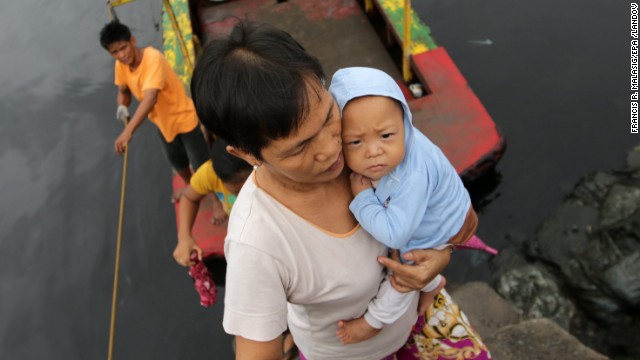
A woman carries a baby across a river November 8 at a coastal village in Las Pinas, Philippines.
A resident walks along a fishing village in Bacoor, Philippines, on November 8.
A house in Legazpi, Philippines, is engulfed by storm surge November 8.
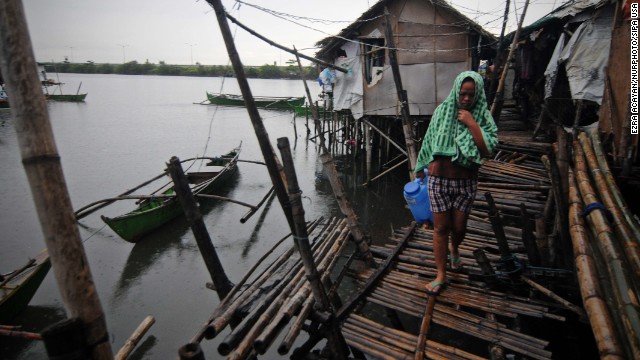
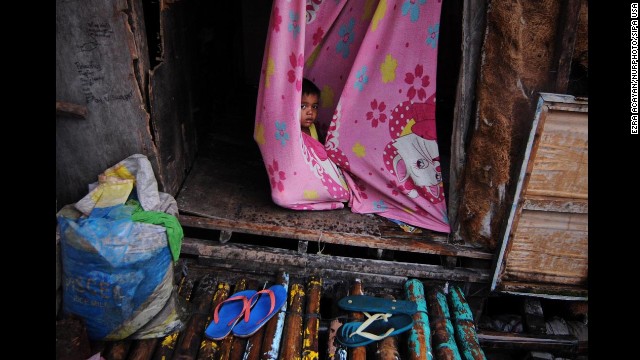
A child wraps himself in a blanket inside a makeshift house along a Bacoor fishing village.
A woman and her children head for an evacuation center November 8 amid strong winds in Cebu City, Philippines.
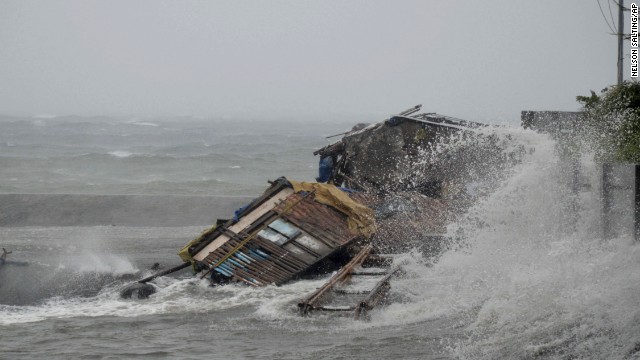
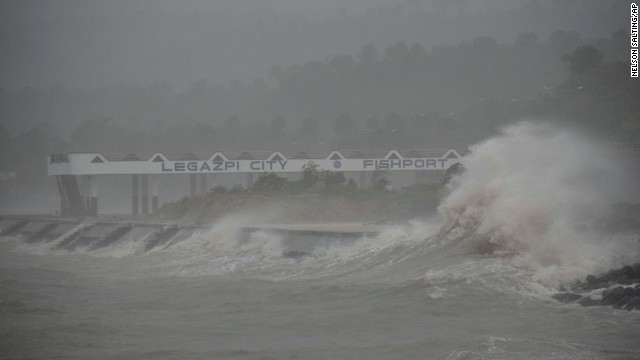
Huge waves from Haiyan hit the shoreline in Legazpi on November 8.
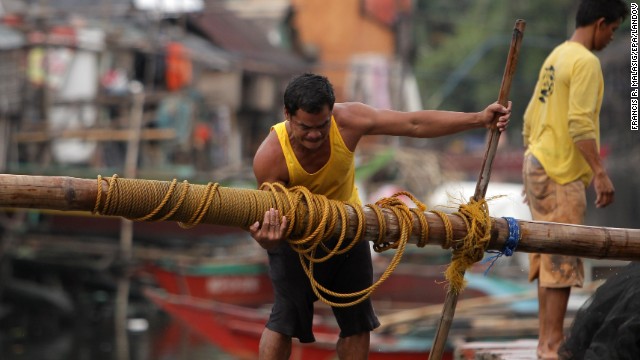
A fisherman lifts a post to reinforce his home at a coastal village in Las Pinas on November 8.
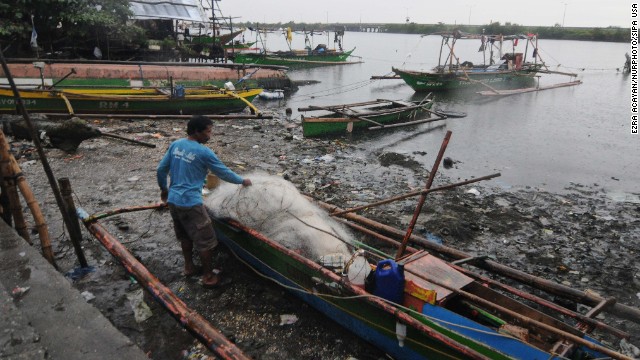
A resident unloads nets off a fishing boat in Bacoor on November 8.
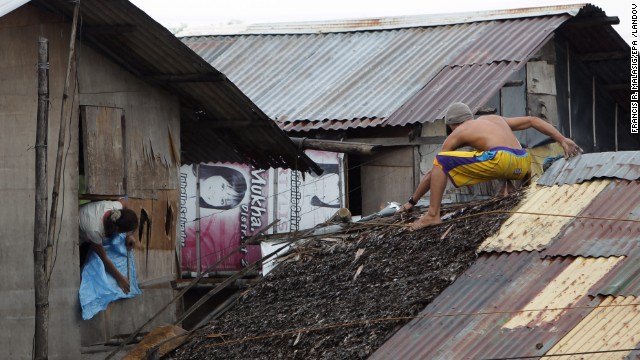
Residents reinforce their homes in Las Pinas on November 8.
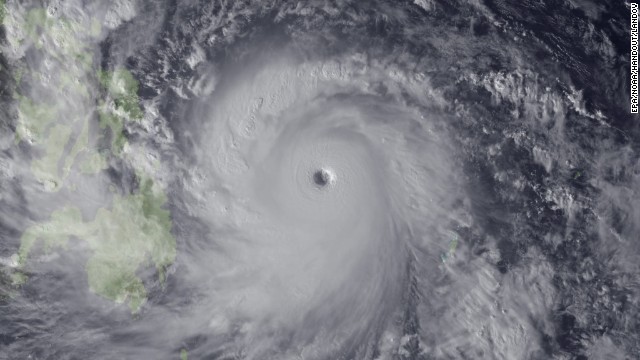
The storm approaches the Philippines in this satellite image taken Thursday, November 7, by the National Oceanic and Atmospheric Administration.
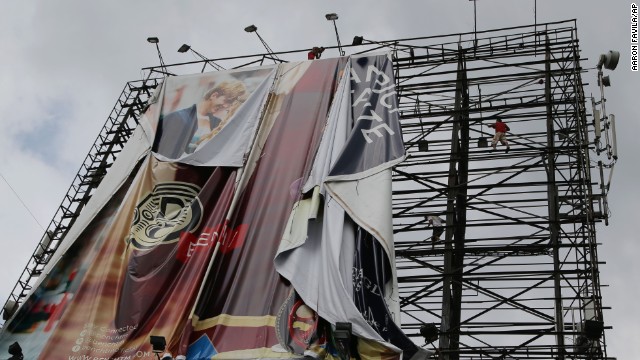
Workers bring down a billboard in Makati, Philippines, on November 7 before Haiyan makes landfall.
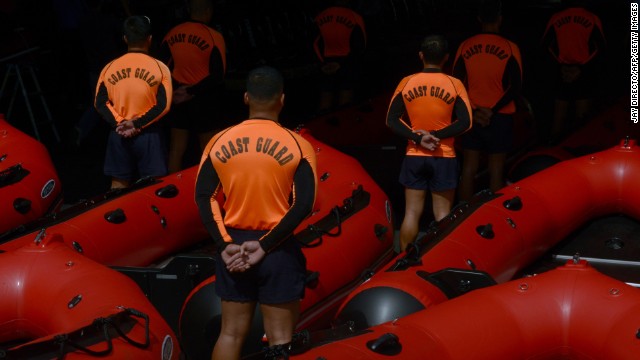
Philippine Coast Guard personnel stand in formation beside newly acquired rubber boats after a blessing ceremony in Manila on Wednesday, November 6. The boats were to be deployed to the central Philippines in preparation for Haiyan.
1
2
3
4
5
6
7
8
9
10
11
12
13
14
15
16
17
18
19
20
21
22
23
24
25
26
27
28
29
30
31
32
33
34
35
36
37
38
39
40
41
42
43
44
45
46
47
48
49
50
51
52
53
54
55
56
57
58
59
60
61
62
63
64
65
66
67
68
69
70
71
72
73
74
75
76
77
78
79
80
81
82
83
84
85
86
Photos: Typhoon Haiyan
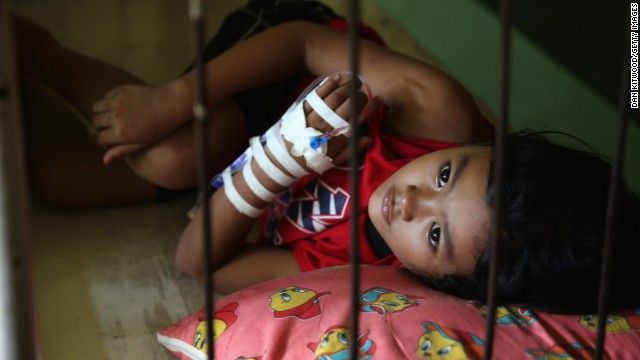
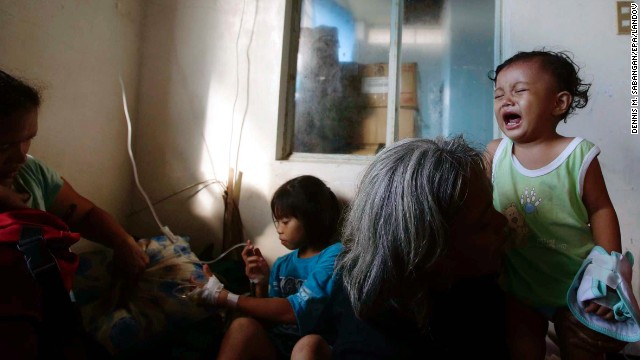
A young girl lays in bed awaiting treatment in a Tacloban hospital on Friday, November 15, in Leyte, Philippines. Typhoon Haiyan, one of the strongest storms in recorded history, has devastated parts of the Philippines and killed at least 3,621 people.
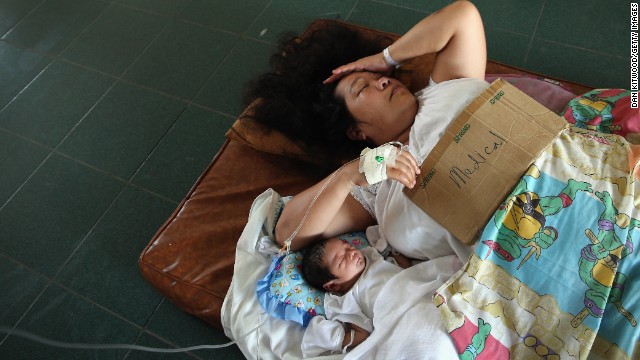
A woman and her newborn baby lay on the floor in a Tacloban hospital on November 15.
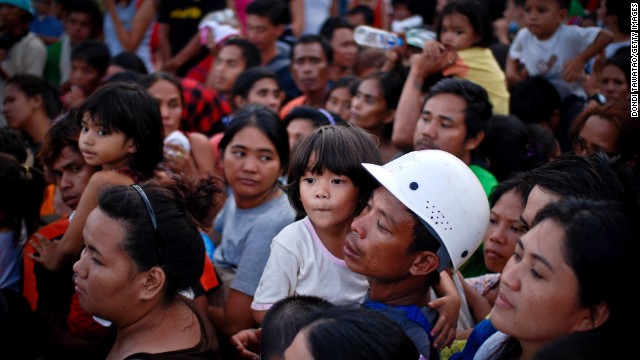
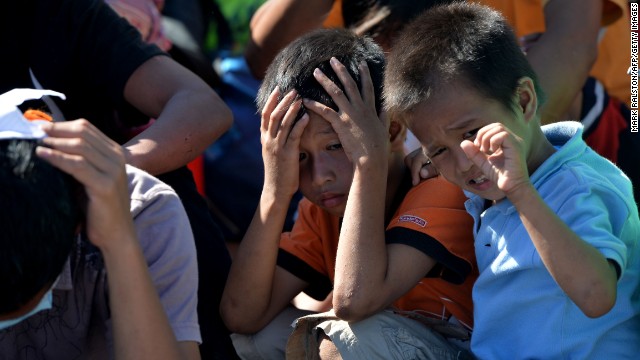
Children gather at the Tacloban airport on November 15. Many survivors have converged on the city's airport to wait for flights out.
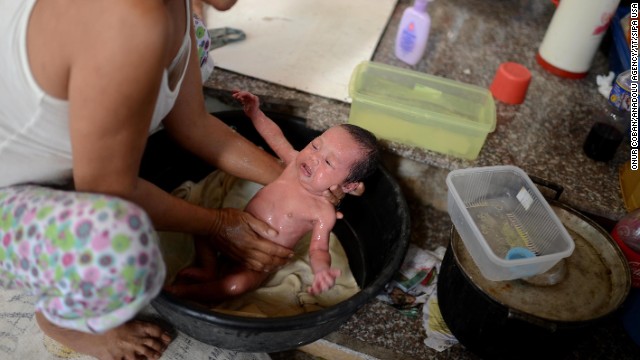
A woman bathes a baby at a church building where a number of survivors are taking shelter in Tacloban on Thursday, November 14.
A boy rides his bike past a coffin and other scenes of destruction in Tacloban on Wednesday, November 13.
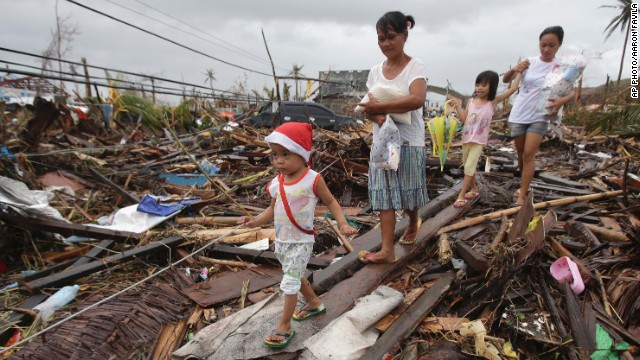
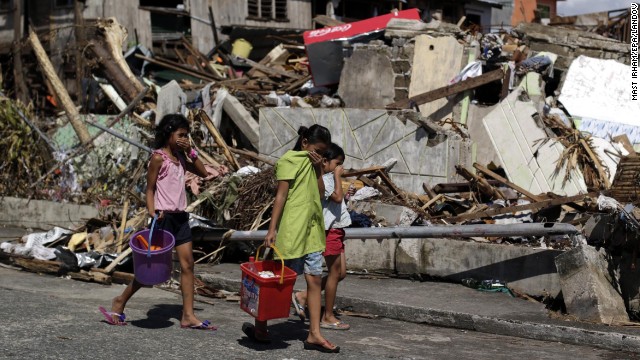
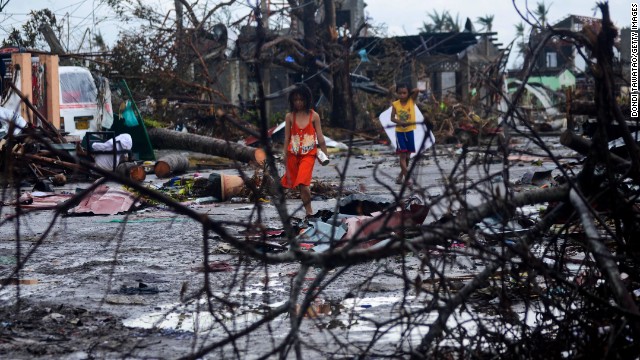
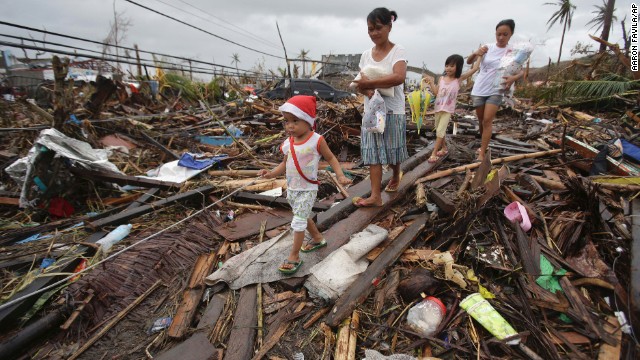
Children carry relief goods as they pass by damaged houses in Tacloban on November 13.
Survivor children, who escaped after their village was attacked by allegedly armed men, wait for social workers in Tacloban on November 13.
Residents ask for water while waiting to get a free pass to board a US C-130 plane in Tacloban on Tuesday, November 12.
Survivors seek medical attention inside a makeshift hospital inside an airport compound on November 13 in Tacloban.
Residents take shelter in a church November 13 in Tacloban, one of the hardest-hit cities. The Philippine government estimates the storm has left more than 582,000 homeless.
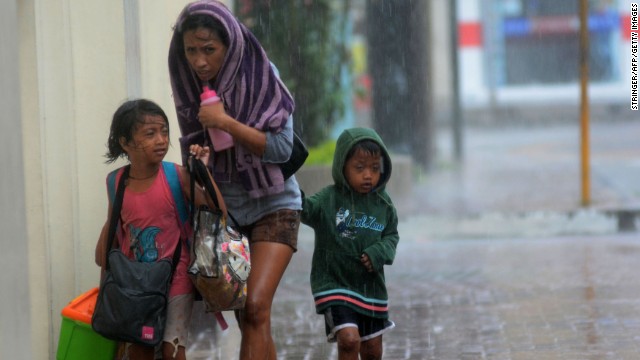
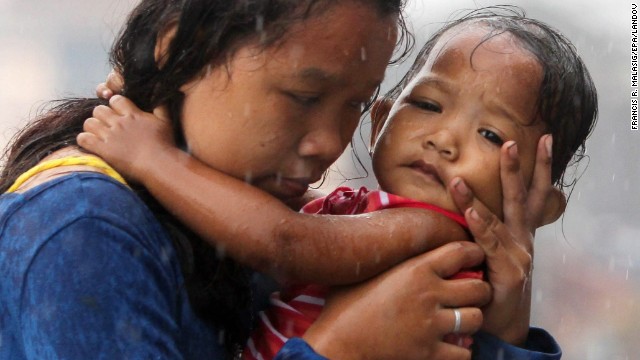
A woman holding a baby runs during a downpour Tuesday, November 12, in Tacloban.
A boy and a girl salvage materials November 12 in Leyte, Philippines. Many in the region have nothing left.
Typhoon survivors line up November 12 in hopes of boarding a military transport plane out of Tacloban.
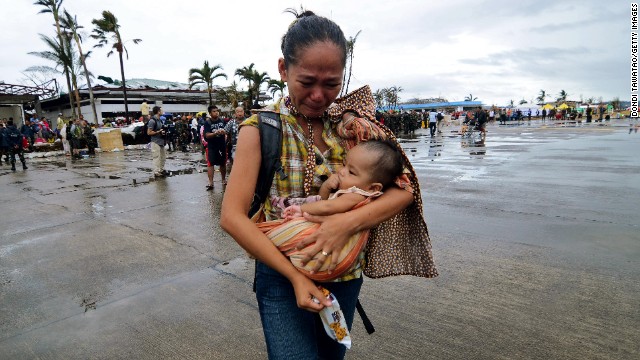
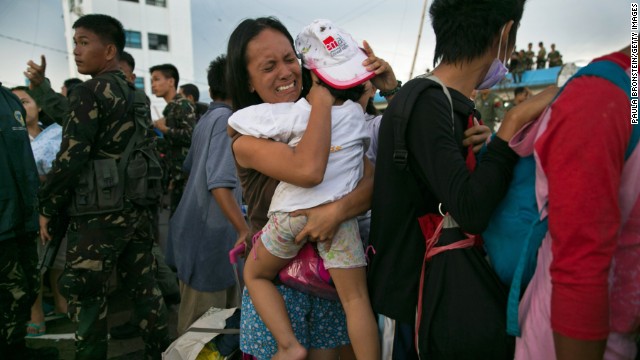
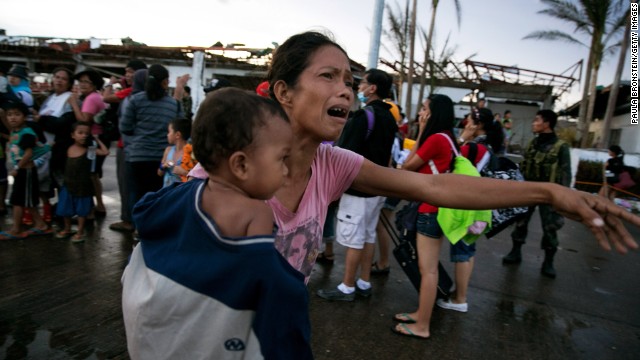
A woman weeps as she carries a child to a military aircraft in Leyte on November 12.
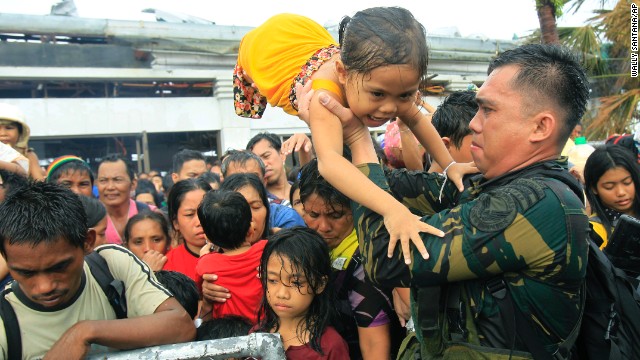
Philippine military personnel try to prioritize children and women first as people wait for evacuation flights November 12 in Tacloban.
A woman carrying a child cries November 12 as survivors wait to board an aircraft in Tacloban.
Survivors walk in Tacloban on November 12.
A woman cries November 12 as other survivors wait to evacuate Tacloban.
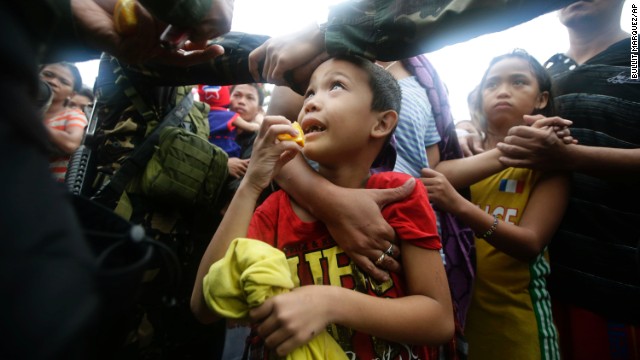
A Philippine air force officer hands out orange slices to typhoon survivors as they line up to board a military transport plane November 12 in Tacloban.
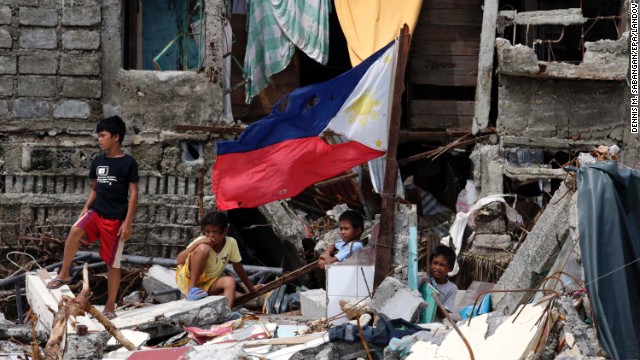
Children stand on rubble in the storm-ravaged town of Hernani, Philippines, on Monday, November 11.
Newborn Bea Joy rests November 11 after her mother gave birth to her at the airport in Tacloban.
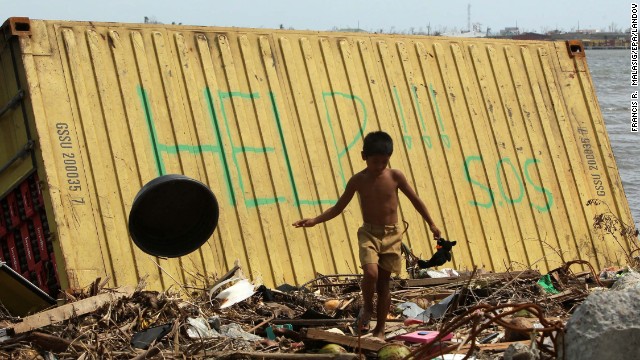
A boy in Tacloban walks near a container appealing for help.
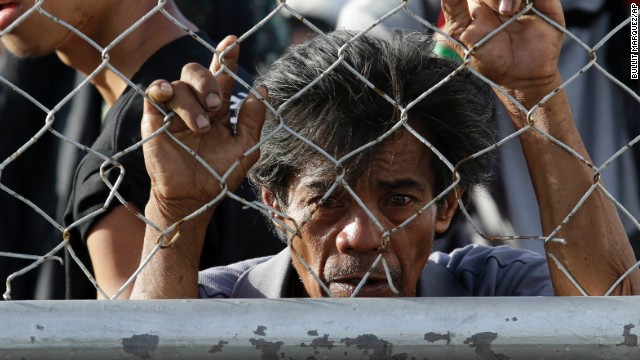
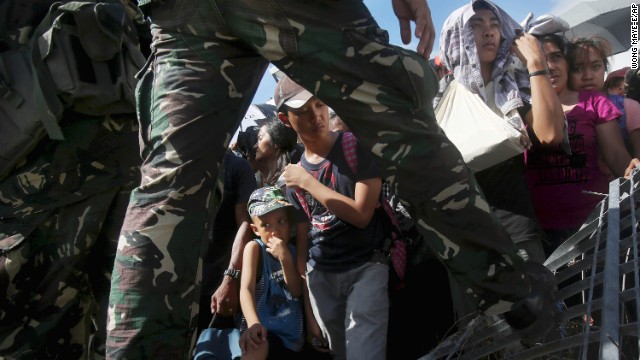
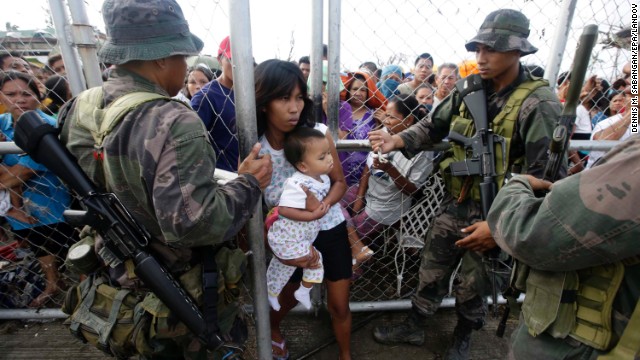
Soldiers let a woman and her child through a fence to get food November 11 outside the Tacloban airport.
A woman carries a child through a flooded street in Yong'an, China, on November 11. China and Vietnam were also hit hard by the storm.
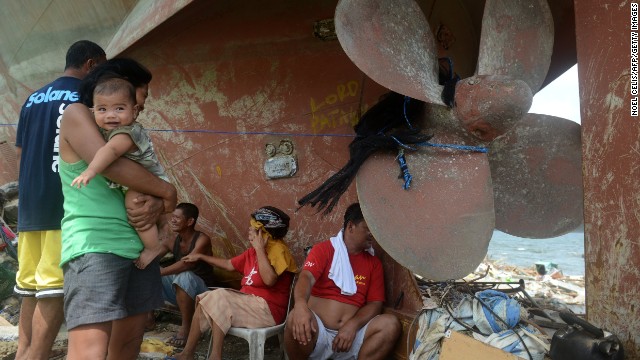
Residents of Anibong, Philippines, rest November 11 near a ship propeller that washed ashore during the storm.
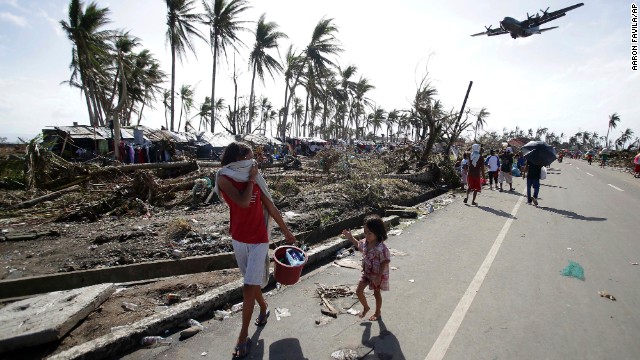
Survivors walk through the streets of Tacloban as a military plane flies overhead on November 11.
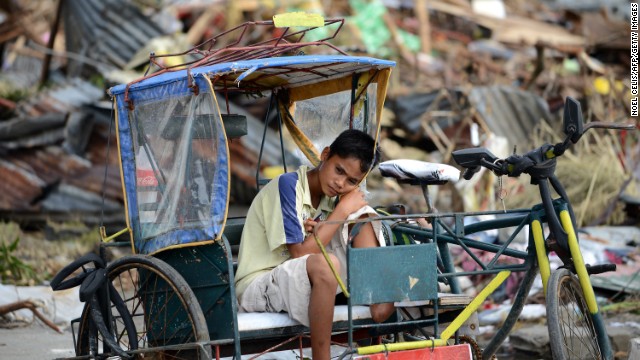
A young survivor rests on a pedicab November 11 in Tacloban.
Children peek out from their makeshift shelter in Tacloban on Sunday, November 10.
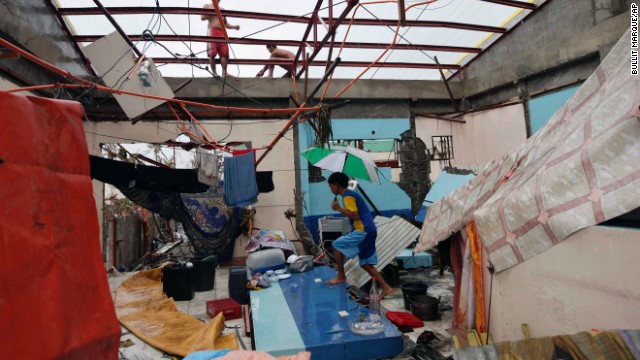
A young Tacloban resident walks inside a damaged home on November 10.
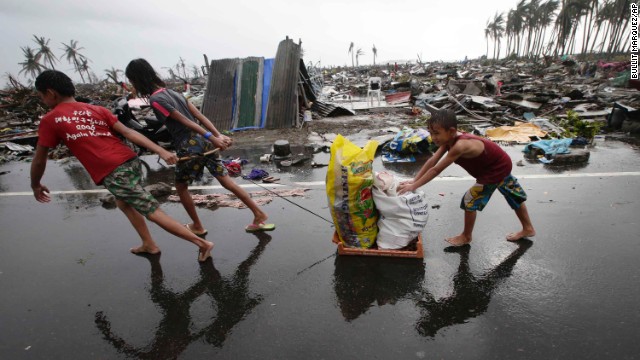
Children carry relief goods past damaged homes in Tacloban on November 10.
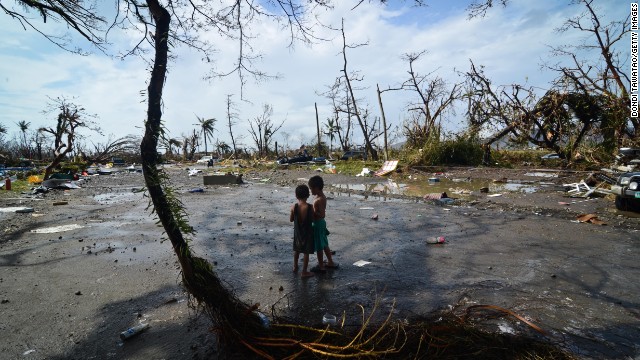
Two young boys look at the devastation in Tacloban on November 10.
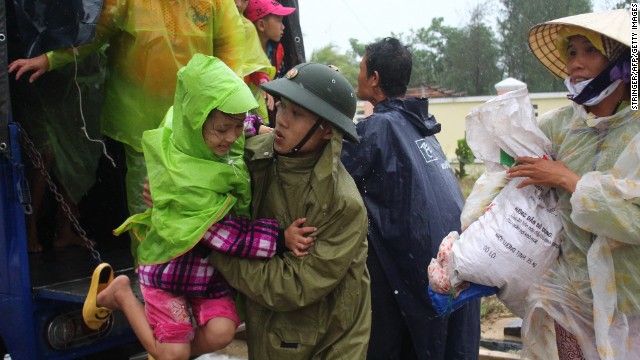
A Vietnamese soldier assists a girl Saturday, November 9, as villagers are moved in the central province of Quang Nam.
Children among Typhoon Haiyan victims
Children among Typhoon Haiyan victims
Children among Typhoon Haiyan victims
Children among Typhoon Haiyan victims
Children among Typhoon Haiyan victims
Children among Typhoon Haiyan victims
Children among Typhoon Haiyan victims
Children among Typhoon Haiyan victims
Children among Typhoon Haiyan victims
Children among Typhoon Haiyan victims
Children among Typhoon Haiyan victims
Children among Typhoon Haiyan victims
Children among Typhoon Haiyan victims
Children among Typhoon Haiyan victims
Children among Typhoon Haiyan victims
Children among Typhoon Haiyan victims
Children among Typhoon Haiyan victims
Children among Typhoon Haiyan victims
Children among Typhoon Haiyan victims
Children among Typhoon Haiyan victims
Children among Typhoon Haiyan victims
Children among Typhoon Haiyan victims
Children among Typhoon Haiyan victims
Children among Typhoon Haiyan victims
Children among Typhoon Haiyan victims
Children among Typhoon Haiyan victims
Children among Typhoon Haiyan victims
Children among Typhoon Haiyan victims
Children among Typhoon Haiyan victims
Children among Typhoon Haiyan victims
Children among Typhoon Haiyan victims
Children among Typhoon Haiyan victims
1
2
3
4
5
6
7
8
9
10
11
12
13
14
15
16
17
18
19
20
21
22
23
24
25
26
27
28
29
30
31
32
Photos: Children among typhoon victims
Typhoon Haiyan: A week of devastation
In Tacloban City, sickness, hunger and thirst have settled in with the sticky, humid heat and the stench of rancid flesh hanging over the apocalyptic scene.
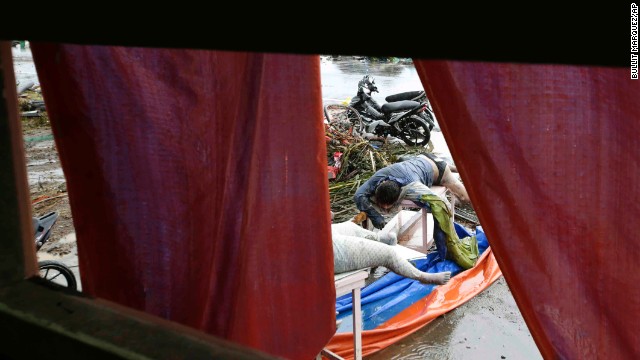
Survivors in improvised shelters have kept watch over the bodies of their dead relatives.
Typhoon Haiyan: Faces of the storm
Cadaver collectors in debris-removal crews uncover some of the dead, while heaving away wreckage from the roads.
But the bodies that initially seemed ubiquitous are becoming a rarer sight, as collections continue.
PNA reported Friday that five-person teams that include a forensic expert and photographer would begin Saturday using a "quick system" for the bodies.
"Under the system, the public will not be allowed to view the identification process but relatives will be asked to participate in the final identification of corpses at an appointed time," it reported, citing the Department of Health.
Tweets from @cnni/typhoon-updates
Each team will be required to handle 40 corpses per day, it said.
Health Secretary Enrique Ona said that photos will be taken, identifying marks will be documented, and belongings and tissue samples for possible use in DNA testing will be collected, when practical.
Officially, 801 bodies were counted in Tacloban City by Friday, but thousands are feared dead in the capital city of Leyte province where entire neighborhoods were swept out to sea.
Turning a corner?
Children at risk in the Philippines
Children at risk in the Philippines
Confusion over typhoon death toll
Anderson defends CNN's typhoon coverage
By Friday, crews had cleared the major streets of Tacloban
Many survivors have converged on the city's airport, where they were waiting in line for seats on flights out.
Others took to the sea. As naval ships pushed up on beaches like gray whales and dropped their loading bay gates, people laden with possessions entered the bellies of the arks en route to new lives elsewhere.
At the convention center, many stood for hours in long lines under the sun awaiting the next load of food and bottled water to arrive in bulk pallets from donors around the world.
Some were there because they had nowhere else to go.
"We really don't know what we're going to do next," said 30-year-old May May Gula, who was among nine families sharing a room on the convention center's ground floor.
Reaching and helping the survivors -- more than 2 million of whom need food, according to the government -- are priorities.
Recovery efforts were helped on Thursday, when the USS George Washington, an aircraft carrier with 5,500 crew, sailed into Philippine waters.
PHILIPPINES AID (IN U.S. $)Australia: 30 million
U.N.: 25 million
UK: 24 million
U.S.: 20 million
Japan: 10 million
Denmark: 6.9 million
European Union: 4.1 million
Sweden: 3.6 million
UAE: 10 million
South Korea: 5 million
Canada: 4.8 million
Norway: 3.4 million
Switzerland: 3.4 million
Indonesia: 2 million
Spain: 1.8 million
New Zealand: 1.75 million
China: 1.6 million
Ireland: 1.4 million
Italy: 1.3 million
Mexico: 1 million
Austria: 690,000
Belgium: 690,000
Czech Republic: 214,000
Singapore:160,000
Vatican: 150,000
Vietnam: 100,000
Source: U.N. OCHA, government officials, reports
It was accompanied by eight more ships that, together, carry 80 aircraft, including 21 helicopters that can deliver supplies to villages, where many roads have been obliterated, and identify people still cut off from help.
By Saturday, the U.S. miltiary had delivered 623,000 pounded of relief supplies, the Department of Defense said.
How to help Typhoon Haiyan survivors
Irony -- those who help survivors struggled to survive
Some who would typically have provided aid found themselves needing help.
Ryan Cardenas, with the Philippine Navy, had helped with recovery efforts in each of the past two years after cyclones that left hundreds dead.
But when Haiyan slammed into the Tacloban naval station where he's based, he and other sailors were in no position to help others immediately -- they stayed alive by clinging to rafters in their barracks.
Their commanding officer, who was in a building badly damaged by the storm, clutched a palm tree's trunk for survival.
Afterward, the sailors helped retrieve bodies, according to Cardenas. One found his mother sitting dead against a wall.
Later, they sorted through the wreckage of the naval station and awaited orders.
"This is the worst," Cardenas said, taking a break from fixing a piece of damaged furniture. "We're both victims and rescuers."
Typhoon victim: This is worse than hell
CNN's Jethro Mullen reported from Tacloban; Ben Brumfield and Chelsea J. Carter wrote and reported from Atlanta. CNN's Anna Coren contributed from Cebu; Karen Smith and Tom Watkins contributed from Atlanta.