
Everything on the electromagnetic spectrum has some properties of both waves and particles, but it’s difficult to imagine a radio wave, for example, behaving like a particle. The main evidence for a particle-like nature is quantization, the bundling of electromagnetic energy into discrete packets. One way around this is to theorize that quantization is due to the specific interaction between the electromagnetic field and matter, not intrinsic to the field itself. To investigate this theory, [Huygens Optics] conducted several experiments with gamma rays, including Compton scattering.
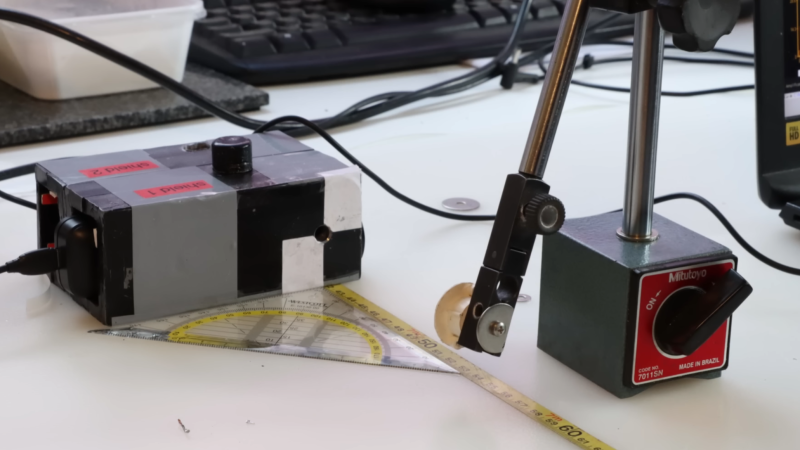
For these experiments, he used a Radiacode 110 X-ray and gamma ray detector, which uses a photodetector to detect radiation’s passage through a scintillation crystal. By summing the energy contained in the light emitted by one ray, it can measure the ray’s energy and, over time, create an energy spectrum. [Huygens Optics] used the americium capsule from an old smoke detector as a radiation source, and cast a lead enclosure to shield the Radiacode from most background radiation, with a small opening for measurements.
First, he tested whether the inverse-square law held true for gamma radiation by measuring radiation at varying distances from the source, which it did. The second experiment was more complicated and measured the temporal correlation between ray detections. For this, he used a second-order correlation function to correlate observations from two Radiacodes. Since there was no included software for time detections, he opened the devices and found a test pad which produced a pulse when a detection was made, then used an Arduino to time these. There was no correlation between rays emitted by the americium source, but interestingly, there was a strong correlation in background radiation due to cosmic ray-induced radiation showers.
For a final experiment, [Huygens Optics] demonstrated Compton scattering, the scattering caused by a ray knocking outer electrons away from atoms. The energy of the emitted radiation depends on the angle of incidence. As the angle between the radiation source and a block of graphite increased, the radiation observed behind the graphite shifted to lower energies, as expected.
None of these experiments was absolutely conclusive, but the Compton scattering in particular was strong evidence that quantization is innate to the electromagnetic field. If you’re interested in more, we’ve covered similar questions before.