
- Police and their vehicles are attacked in a 5th night of violence in East Belfast
- The Belfast City Council meets for the first time since its controversial ruling
- In December, the council voted to fly the Union Jack only on certain days
- Authorities accuse a loyalist extremist group of ''orchestrating violence''
Belfast, Northern Ireland (CNN) -- Police and their vehicles were attacked with petrol bombs, hatchets and sledgehammers in East Belfast as rioting broke out in Northern Ireland for a fifth consecutive night, police said Tuesday.
Monday evening's violence came as authorities accused pro-British extremists of exploiting protests over a decision by Belfast City Council to stop a century-old tradition of flying the Union Jack year-round.
About 400 people gathered at Belfast City Hall on Monday as the City Council met for the first time since it voted in December to fly the British flag only on certain days, police said. The protest, which was mostly peaceful, was organized via social media, authorities said.
Protesters called for the council to reverse its ruling over the flag.
In East Belfast, where the disorder was focused, about 250 protesters gathered and missiles such as petrol and paint bombs, fireworks and heavy masonry were thrown at police.

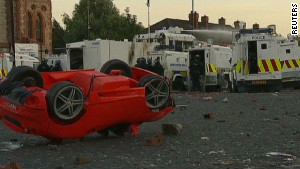
Officers responded with plastic bullets and water cannon before calm was restored.
Three police officers were injured in the disorder, the Police Service of Northern Ireland said Tuesday, and eight arrests were made.
Six of those arrests -- four men and two women -- were made in East Belfast, where the worst of the violence broke out.
Police also received a reports of attempted vehicle hijackings in the area.
Clashes also erupted between pro-British and pro-Irish groups at a point where predominantly Protestant and Catholic communities meet.
Authorities say more than 50 officers have been wounded in total in the protests.
Read more: Fresh protests break out in Northern Ireland after night of violence
The chief constable for the Police Service of Northern Island put the blame for the violence on members of the loyalist Ulster Volunteer Force, who were "orchestrating violence for their own selfish motives."
The British flag, the Union Jack, has long been a flashpoint between British loyalists -- primarily Protestants -- who want to remain part of the United Kingdom and Irish nationalists calling for Northern Ireland to join Ireland.
Northern Ireland's political leaders have called for an end to the pro-British protests, and politicians, clergy and community met Sunday to discuss possible ways to bring about an end to the unrest.
Read more: Policewoman targeted as Northern Ireland tensions rise
"Everyone involved needs to step back. The lack of control is very worrying," Chief Constable Matt Baggott told CNN. "The only answer is a political solution."
A large number of police officers have been pulled away from their normal duties to deal with the demonstrations, Baggott said.
If this continues, "it will eat into our ability to deal with drugs, into our ability to deal with alcohol issues, and deal with what is a very severe dissident threat."
Read more: Police: Loyalist paramilitaries behind Northern Ireland violence
The vote on the flag followed a summer of heightened tensions between Northern Ireland's Catholic and Protestant communities. Riots in September left dozens of police officers injured.
The majority of the island gained independence in 1921, following two years of conflict. But six of the nine counties of the province of Ulster chose to stay in the United Kingdom, eventually becoming the country of Northern Ireland.
In the late 1960s, the conflict between mainly Protestant loyalists, who want Northern Ireland to remain part of the United Kingdom, and largely Roman Catholic nationalists, who want it to be reunited with the rest of Ireland, exploded into a political and sectarian war, known as "the Troubles."
The three decades of ensuing violence between loyalists and the IRA claimed more than 3,000 lives, most of them north of the border. While the Good Friday Agreement of 1998, also known as the Belfast Agreement, effectively ended the conflict, distrust remains between Catholics and Protestants.
Under the terms of the accord, groups on both sides dumped their weapons, and members of Sinn Fein, the political affiliate of the IRA, now work with pro-British politicians in Northern Ireland's power-sharing government.
Read more: Clinton urges calm amid tensions in Northern Ireland
CNN's Laura Smith-Spark and Chelsea J. Carter contributed to this report.

