
Six months ago, few Israelis had heard of him. Today, the media calls the former high tech tycoon a “superstar,” and everyone knows about Naftali Bennett, leader of the Bayit Yehudi (“Israel Home”) Party.” As Prime Minister Benjamin Netanyahu faces criticism from left and right, Bennett’s popularity is rising by the day. The latest polls suggest that if an election were held this week, Bayit Yehudi would triple its seats in the Knesset to become Israel’s third largest party. In fact, Bennett is gaining supporters who don’t even agree with his ultra-religious/nationalist platform, a fact that is greatly troubling Netanyahu’s Likud.
Election basics
Under Israel’s parliamentary system, citizens cast their ballots for a party, not a candidate. The 120 Knesset seats are assigned according to the percentage of the total national votes each party wins. In order to win a seat in the Knesset, a party must win a minimum of 1.5 percent of the total votes.
Usually, the leader of the party with the most seats is named prime minister and tasked with forming a new government consisting of 61 seats. Because no party has ever won enough seats to form a government by itself, parties form coalitions to meet the 61-seat majority. New elections can be called if the prime minister cannot form a government, if a coalition collapses or it is not able to pass its budget.
Last October, Netanyahu called for early elections, saying his coalition would not be able to pass a “responsible” austerity budget. Soon afterward, he announced that Likud would merge with the hardline Yisrael Beitenu Party headed by Avigdor Lieberman. Some believed Netanyahu was looking to gain support for a military strike on Iran’s suspected nuclear facilities. Others believe he wanted to strengthen the party in light of speculation that former Prime Minister Ehud Olmert would run for office and put together a rival coalition.
Either way, Netanyahu’s plans seem to have failed. The latest Haaretz polls show the Likud Party losing as many as a dozen of its present 42 seats in government.
Barak Ravid is a diplomatic correspondent for Israel’s Haaretz newspaper who explains the trend.
“First, a very big part of the Israeli society does not know who they want to vote for,” Ravid said. “This is one trend. The other trend is that you can see very clearly that even right wing voters do not want to vote for Benjamin Netanyahu. They would rather vote for Naftali Bennett’s party.”
Ravid describes Netanyahu’s last four years in office as “more or less” the status quo.
“Nothing really bad has happened, but on the other hand, nothing really good has happened either,” Ravid said. He cites the troubled economy as one factor in Netanyahu’s waning ratings. In addition, he says traditional Likud voters are troubled by the Likud-Beitenu partnership.
“The Likud Party used to be a right-winged but liberal party, and this unification with Lieberman’s semi-fascist party—it’s ultra-nationalistic, anti-rule of law, anti-democracy. This unification may have given Bibi (Netanyahu) the edge in putting together the next coalition, but in the longer term, it caused Likud a lot of damage,” Ravid said.
Finally, Ravid cites the “Pillar of Defense” military operation in Gaza last November. “It’s pretty obvious that Israel did not win this round of fighting,” he said.
New Kid on the Block
So, who is Naftali Bennett and why is he attracting so many voters? Jeremy Saltan manages Bennett’s English-language campaign and believes the attraction is obvious: The political newcomer fits the mold of what people, especially young voters, look up to.
“He is the son of American immigrants who moved to Israel from California,” Saltan said. “He went to national religious schools. He served in elite IDF (Israel Defense Forces) units, including the Sayeret Matkal [special operations force], which is considered by many to be the most elite of all units. Then he left the army and went off to start a high tech company with a bunch of other investors.”
After selling his company for a $145 million profit, Bennett was hired as Netanyahu’s chief of staff, but left after two years because of political differences. He went on to serve as CEO of the Yesha (“Settlers”) Council, where he led the opposition to Netanyahu’s freeze on settlements in occupied Palestinian territories.
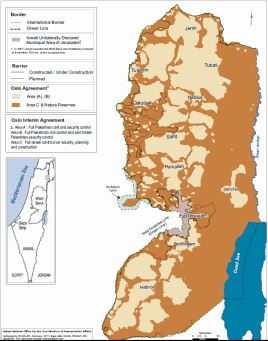 UN OCHR Map West Bank
x

UN OCHR Map West Bank
Election basics
Under Israel’s parliamentary system, citizens cast their ballots for a party, not a candidate. The 120 Knesset seats are assigned according to the percentage of the total national votes each party wins. In order to win a seat in the Knesset, a party must win a minimum of 1.5 percent of the total votes.
Usually, the leader of the party with the most seats is named prime minister and tasked with forming a new government consisting of 61 seats. Because no party has ever won enough seats to form a government by itself, parties form coalitions to meet the 61-seat majority. New elections can be called if the prime minister cannot form a government, if a coalition collapses or it is not able to pass its budget.
Last October, Netanyahu called for early elections, saying his coalition would not be able to pass a “responsible” austerity budget. Soon afterward, he announced that Likud would merge with the hardline Yisrael Beitenu Party headed by Avigdor Lieberman. Some believed Netanyahu was looking to gain support for a military strike on Iran’s suspected nuclear facilities. Others believe he wanted to strengthen the party in light of speculation that former Prime Minister Ehud Olmert would run for office and put together a rival coalition.
Either way, Netanyahu’s plans seem to have failed. The latest Haaretz polls show the Likud Party losing as many as a dozen of its present 42 seats in government.
Barak Ravid is a diplomatic correspondent for Israel’s Haaretz newspaper who explains the trend.
“First, a very big part of the Israeli society does not know who they want to vote for,” Ravid said. “This is one trend. The other trend is that you can see very clearly that even right wing voters do not want to vote for Benjamin Netanyahu. They would rather vote for Naftali Bennett’s party.”
Ravid describes Netanyahu’s last four years in office as “more or less” the status quo.
“Nothing really bad has happened, but on the other hand, nothing really good has happened either,” Ravid said. He cites the troubled economy as one factor in Netanyahu’s waning ratings. In addition, he says traditional Likud voters are troubled by the Likud-Beitenu partnership.
“The Likud Party used to be a right-winged but liberal party, and this unification with Lieberman’s semi-fascist party—it’s ultra-nationalistic, anti-rule of law, anti-democracy. This unification may have given Bibi (Netanyahu) the edge in putting together the next coalition, but in the longer term, it caused Likud a lot of damage,” Ravid said.
Finally, Ravid cites the “Pillar of Defense” military operation in Gaza last November. “It’s pretty obvious that Israel did not win this round of fighting,” he said.
New Kid on the Block
So, who is Naftali Bennett and why is he attracting so many voters? Jeremy Saltan manages Bennett’s English-language campaign and believes the attraction is obvious: The political newcomer fits the mold of what people, especially young voters, look up to.
“He is the son of American immigrants who moved to Israel from California,” Saltan said. “He went to national religious schools. He served in elite IDF (Israel Defense Forces) units, including the Sayeret Matkal [special operations force], which is considered by many to be the most elite of all units. Then he left the army and went off to start a high tech company with a bunch of other investors.”
After selling his company for a $145 million profit, Bennett was hired as Netanyahu’s chief of staff, but left after two years because of political differences. He went on to serve as CEO of the Yesha (“Settlers”) Council, where he led the opposition to Netanyahu’s freeze on settlements in occupied Palestinian territories.
x

UN OCHR Map West Bank