
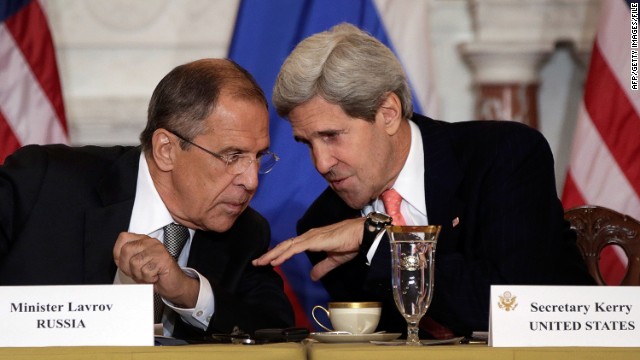
Russian Foreign Minister Sergey Lavrov (L) talks with Secretary of State John Kerry in August at the State Department.
- Secretary of State John Kerry to meet with Russian counterpart on Thursday
- Obama pauses push for military action to give diplomacy a chance
- Unclear how long window will remain open for plan for Syria to relinquish chemical arms
- U.N. Security Council to meet on Syria; U.S.-Russia communications exchanged
Washington (CNN) -- Secretary of State John Kerry heads to Geneva on Thursday for a high-stakes meeting with his Russian counterpart that could conceivably tip the balance on whether the United States strikes Syria militarily over alleged chemical weapons use.
Kerry will meet with Russian Foreign Minister Sergey Lavrov to discuss the specifics of Moscow's plan that would put Syria's chemical stockpiles under international control, described as a difficult but momentous step that would nullify the threat of weapons of mass destruction and diffuse the crisis.
In his address to the nation on Tuesday, President Barack Obama said he was willing to test the seriousness and feasibility of the proposal before resuming his push for a vote in Congress on whether to authorize force to punish the Syrian regime led by Bashar al-Assad over an alleged poison gas attack last month the United States says killed more than 1,400 people.

Key developments in Syria crisis
Kerry will take the lead in dealing with the Russians, Obama said.
"It's too early to tell whether this offer will succeed and any agreement must verify that the Assad regime keeps its commitments," Obama said in his prime-time speech to a war-weary public that is skeptical of another military venture in the Middle East.
"But this initiative has the potential to remove the threat of chemical weapons without the use of force, particularly because Russia is one of Assad's strongest allies," he added.
'Verifiable process' required
Kerry's goal over two days in Geneva is to "hear from the Russians" about their ideas and "to assess whether they will meet our requirements for the final disposition of Assad's chemical weapons," State Department spokeswoman Jen Psaki said.
Kerry and Lavrov spoke on Wednesday to discuss the matter, officials said. No details of their conversation were disclosed.
Russian officials have submitted a plan to the United States, Russia's Itar-Tass news agency reported Wednesday, citing a Russian diplomatic source.
White House spokesman Jay Carney said that conversations took place and papers exchanged with Russia, but that he was unaware of a full formal proposal.
"I think we're not at the stage of putting down public pieces of paper," he said.
Vladimir Chizhov, Russia's emissary to the European Union, explained that the plan calls for Syria's chemical weapons to be placed under international supervision -- inside that country initially, at least.
"The ultimate aim is to have these weapons destroyed," Chizhov told CNN's Christiane Amanpour.
He acknowledged the task of gaining control of the weapons and destroying them with civil war raging in Syria won't be easy, voicing worries about what rebel fighters might do.
Separately, the United States, France, and Britain discussed a U.N. Security Council draft resolution, according to a spokesman for British Prime Minister David Cameron.
The council -- comprised of permanent members the United States, China, France, Britain and Russia -- were scheduled to meet on Wednesday, a U.N. diplomat said.
Administration officials have not disclosed how long the window for a diplomatic solution will remain open.
How long window open?
But Sen. Dick Durbin said following Obama's meeting this week with Senate Democrats that the president asked asked lawmakers "for some time to work things out -- a matter of days into next week." Though another Senate Democrat said it could take weeks.
Carney said "it obviously will take some time" to assess if there is tangible progress.
Psaki offered more near-term detail.
"In this stage of the process, our goal here is to test the seriousness of this proposal, to talk about the specifics of how this would get done, what are the mechanics of identifying, verifying, securing, and ultimately destroying the chemical weapons," she said.
Members of Congress will watch Kerry's trip closely for a sense of Obama's next move following weeks of beating the drum for military action against Syria.
"If diplomacy fails, he's painted himself into a corner," Sen. Lindsey Graham told CNN after Obama's speech. "The leader of the free world can't say all these things at the end of the day and do nothing."
Senior State Department officials have cautioned that negotiations over the proposed deal may not conclude after the scheduled round of talks in Geneva. The plan would be to take any final deal to the United Nations Security Council to be formalized in a resolution.
Outcome far from certain
While Obama has asked Congress to hold off for the moment on considering a military strike, he did say that he had ordered the armed forces to maintain its posture in the region "to keep the pressure on Assad."
Obama has said the operation would be targeted, limited and not involve U.S. ground forces. The goal would be to degrade al-Assad's ability to use chemical weapons.
The path to any vote in the Security Council remains far from certain. Russian President Vladimir Putin has said that any action there with the looming threat of military action could result in a Russian veto.
CNN Poll: Part of Syria strike opposition is the messenger's fault
Analysts say Kerry has his work cut out for him.
"I think it's unlikely the Russian government is going to relent on this issue of whether or not it would support the use of force in a security council resolution," Nicholas Burns, a former senior State Department official now at Harvard University's Kennedy School of Government told CNN.
"They've been consistent since day one of the Syrian crisis that they did not want to see the United States or anyone else use force. I think that's one of the ambitions the Russians have going into this negotiation in Geneva," he added.
Obama makes case: opinion
Still Ryan Crocker, a former U.S. ambassador to Syria and other countries, told Amanpour that Syria's admission that it even possesses chemical weapons and its apparent willingness to give them up should be considered a success.
"But none of us should think that it will be decisive to the outcome of the war," Crocker said.
Elise Labott, Barbara Starr, Greg Bothello, John King and Dana Bash contributed to this report.
