
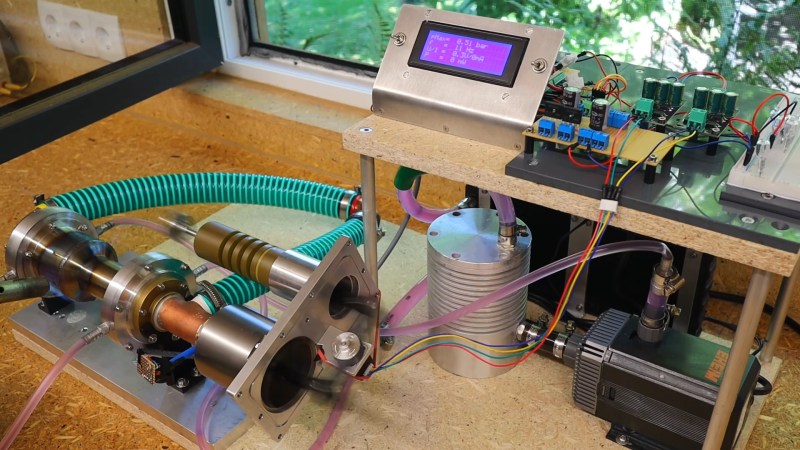
[My Engines] has been doing some sterling work on Stirling engines for some years now. Their thermoacoustic engine is now finally far enough along to open-source, so the magic of collaboration can speed technological advancement.
You’ve probably heard of Stirling Engines, but what’s this “thermoacoustic” business? Hot sound? Well, that’s the translation, and it’s not a bad starting point for understanding what’s going on: the engine converts heat into high-amplitude sound waves — that is, waves of pressure — which means the engine itself has no moving parts. Well, almost. Obviously moving parts are required to get power out. In [My Engines] case he’s using a piston and linear generator, but otherwise it makes for a very simple, very reliable engine that can be fueled by any available source of heat. Say like burning methane from [My Engines]’s home biogas plant.
[My Engines] promises more videos to help you understand the construction in a way his previous videos might not detail, and has put 3D models and drawings at a public Google Drive. There’s also a Discord you can join, because apparently that’s the only way to communicate about projects these days.
The whole build is very much within range of a home maker, though there’s a lot more to it than the toy Stirling engines you may have made out of tin cans back in the day. If you want to play with thermoacoustics but [My Engines]’s design seems like a little much to get started with, you can make a demonstrator with some steel wool and a test tube. Be careful, though: model engines can be an addictive hobby.