
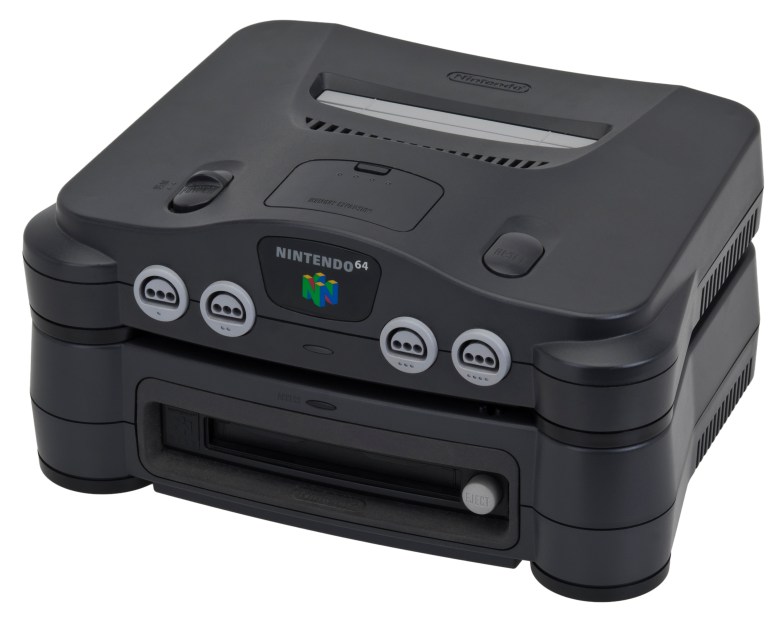
What if you took a Nintendo 64 cartridge-based game and allowed it to also use a large capacity magnetic disc format alongside it? This was the premise of the Nintendo 64DD peripheral, and the topic of a recent video by [Skawo] in which an archaeological code dig is performed to see what traces of the abandoned product may remain.
The 64DD slots into the bottom of the console where the peripheral connector is located, following which the console can read and write the magnetic discs of the 64DD. At 64 MB it matched the cartridge in storage capacity, while also being writable unlike cartridges or CDs. It followed on previous formats like the Famicom Disk System.
For 1998’s Game of the Year title The Legend of Zelda: Ocarina of Time such a 64DD-based expansion was worked on for a while before being cancelled along with the 64DD. With this Zelda game now decompiled, its source code has shown to be still full of 64DD-related code that [Skawo] takes us through in the video.

The Nintendo 64DD discs resembled ZIP discs. (Credit: Evan-Amos, Wikimedia)
As is typical for CD- and magnetic storage formats like these 64DD discs, their access times and transfer speeds are atrociously slow next to a cartridge’s mask ROM, which clearly left the developers scrambling to find some way to use the 64DD as an actual enhancement. Considering that the 64DD never was released outside of Japan and had a very short life, it would seem apparent that, barring PlayStation-level compromises, disc formats just weren’t a good match for the console.
The interface with the 64DD in the game’s code gives some idea of what the developers had in mind, which mostly consisted out of swapping on-cartridge resources like dungeon maps with different ones. Ultimately this content did make its way into a commercial release, in the form of the Master Quest option on the game’s re-release on the GameCube.
Although this doesn’t enable features once envisioned, such as tracking the player’s entire route and storing permanent map changes during gameplay, it at least gives us a glimpse of what the expansion game on the 64DD could have looked like.
Top image: N64 with stacked 64DD, credit: Evan-Amos