


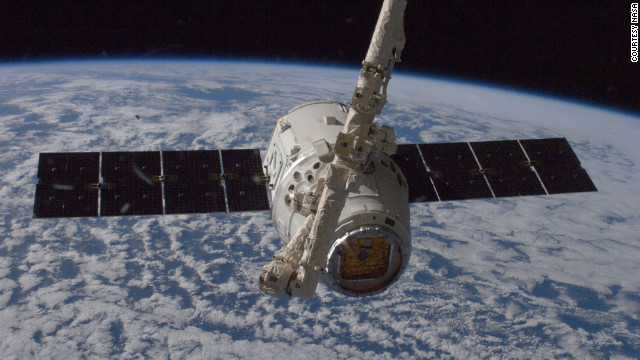
- "Big change in plans, spacewalk tomorrow," tweets space station commander
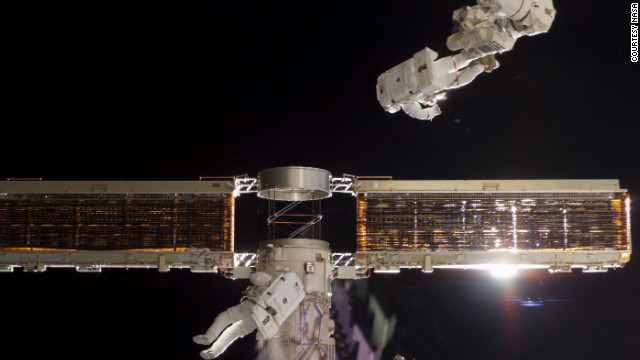
- The ammonia is leaking from a cooling loop on a solar array
- NASA says there is no danger to the space station crew
- Three crew members are scheduled to end their mission on Monday
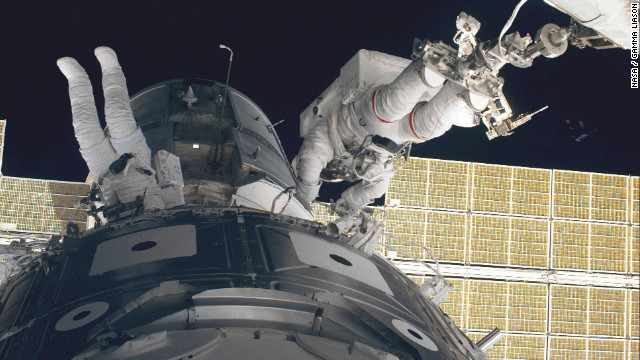
(CNN) -- The International Space Station crew is preparing for a spacewalk to address a leaking ammonia from a cooling system, the commander said Friday.
Cmdr. Chris Hadfield of Canada announced the plan to venture outside the space station via his Twitter account.
"Good Morning, Earth! Big change in plans, spacewalk tomorrow, Chris Cassidy and Tom Marshburn are getting suits and airlock ready. Cool!" he posted Friday.
Cassidy and Marshburn are NASA astronauts. Hadfield, who is with the Canadian Space Agency, is aboard the space station as its commander.
The six-man crew, which also includes three Russian cosmonauts, is not in danger from the leak, NASA said Thursday in a news release.
The leak was detected after space station crew reported seeing small white flakes floating away from the station, the space agency said.
NASA helped locate the leak with external cameras while the crew used hand-held cameras pointed out of windows.
The leak was in a cooling loop in a solar array that has leaked before. NASA said crew members tried to fix the leak in November. It's unclear whether this is the same leak or a new one.
The cooling system could shut down within 24 hours, NASA said. It is devising a plan to reroute other power sources so that all systems remain fully operational.

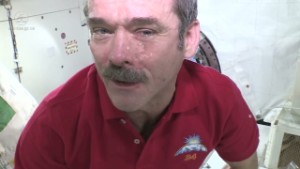
Ammonia is used to cool each of the solar arrays that provide electricity to station systems, NASA said.
"It is a serious situation, but between crew and experts on the ground, it appears to have been stabilized. Tomorrow we find out for certain," Hadfield tweeted Thursday.
Hadfield, Marshburn and Russian cosmonaut Roman Romanenko are scheduled to leave the station Monday at 7:08 p.m. ET.
Hadfield asked NASA on Thursday if the leak would affect the undocking.
Capsule Communicator Doug Wheelock said officials at the Mission Control Center in Houston saw nothing that they couldn't overcome technically, but that they would have more information in the morning.
Three crew members, Cassidy and Russian cosmonauts Alexander Misurkin and Pavel Vinogradov, will remain on the space station when the others leave.
They will be joined at the end of the month by three new crew members -- NASA astronaut Karen Nyberg, Russian cosmonaut Fiyodor Yurchikhin and European Space Agency astronaut Luca Parmitano, who are due to launch aboard a Russian Soyuz spacecraft on May 28.
The space station is operating normally aside from the leak, NASA said.
