
Mary Beth Marklein, USA TODAY 12:03 a.m. EDT September 10, 2013
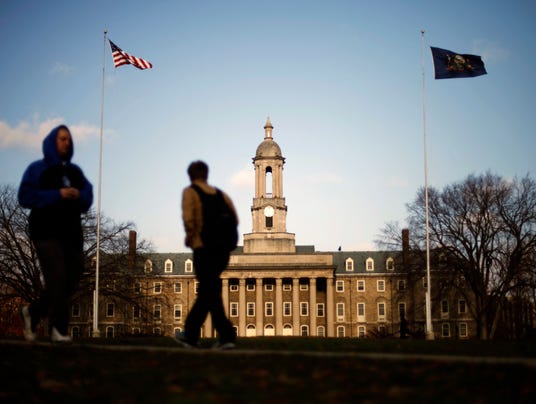
In this November 2011 file photo, students walk past the Old Main building on the Penn State campus in State College, Pa.(Photo: By Matt Rourke, AP)
[h=3]Story Highlights[/h]
Penn State University and a pair of small liberal arts colleges in California made some of the biggest gains this year in the U.S. News & World Report annual rankings.
None of them pushed perennially top-ranked schools such as Princeton or Williams out of their top perches, but they fared well under a revised formula that puts less emphasis on who gets admitted and more on whether students graduate.
The changes "take into account the latest data and trends in higher education," said Robert Morse, U.S. News director of data research. They have been in the works since early this summer, he added, weeks before President Obama announced plans for the Education Department to develop a "new rating system" that analyzes a school's success in graduating low-income students and preparing them for jobs.
Under the new U.S. News methodology, graduation-related data account for 30% of the rankings, making it the most-heavily weighted factor. Student selectivity, based on class rank and standardized test scores, accounts for 12.5% of the formula, down from 15% last year. Other key factors include a school's reputation among peers and faculty resources.
The formula had little impact on top-ranked colleges, but several schools saw considerable jumps, primarily because they posted strong retention and graduation rates, Morse said. A few highlights:
Penn State moved up nine spots, to 37, among national universities, defined as those that offer a full range of undergraduate majors, grant master's and doctoral degrees and emphasize faculty research. The University of Washington and University of Texas-Austin were among public national universities seeing drops.
College of the Holy Cross in Worcester, Mass., rose to 25th from 32nd among national liberal arts colleges, which focus almost exclusively on undergraduate education. Soka University of America in Aliso Viejo, Calif., shot up eight spots, to 41st. Pitzer College in Claremont, Calif., jumped eight spots to 35th.
Among private national universities, Boston University and Northeastern University in Boston each moved into the top 50. Boston University jumped from 51st to 41st, and Northeastern improved from 56th to 49th. Wake Forest University rose four spots from 27th to 23rd.
U.S. News, which began ranking colleges in 1983, has been joined in recent years by other publications, including Forbes and Washington Monthly. Forbes' rankings include factors such as student loan debt and salaries of new graduates. Washington Monthly this year developed a list of colleges its formula finds do "the best job of helping non-wealthy students attain marketable degrees at affordable prices."
Contributing: Abby Kloppenburg
Follow @mbmarklein on Twitter

In this November 2011 file photo, students walk past the Old Main building on the Penn State campus in State College, Pa.(Photo: By Matt Rourke, AP)
[h=3]Story Highlights[/h]
- Penn State gains in latest "U.S. News & World Report" rankings
- Small liberal arts schools in California also get a boost
- More weight given now to colleges' success in getting kids to graduate
Penn State University and a pair of small liberal arts colleges in California made some of the biggest gains this year in the U.S. News & World Report annual rankings.
None of them pushed perennially top-ranked schools such as Princeton or Williams out of their top perches, but they fared well under a revised formula that puts less emphasis on who gets admitted and more on whether students graduate.
The changes "take into account the latest data and trends in higher education," said Robert Morse, U.S. News director of data research. They have been in the works since early this summer, he added, weeks before President Obama announced plans for the Education Department to develop a "new rating system" that analyzes a school's success in graduating low-income students and preparing them for jobs.
Under the new U.S. News methodology, graduation-related data account for 30% of the rankings, making it the most-heavily weighted factor. Student selectivity, based on class rank and standardized test scores, accounts for 12.5% of the formula, down from 15% last year. Other key factors include a school's reputation among peers and faculty resources.
The formula had little impact on top-ranked colleges, but several schools saw considerable jumps, primarily because they posted strong retention and graduation rates, Morse said. A few highlights:
Penn State moved up nine spots, to 37, among national universities, defined as those that offer a full range of undergraduate majors, grant master's and doctoral degrees and emphasize faculty research. The University of Washington and University of Texas-Austin were among public national universities seeing drops.
College of the Holy Cross in Worcester, Mass., rose to 25th from 32nd among national liberal arts colleges, which focus almost exclusively on undergraduate education. Soka University of America in Aliso Viejo, Calif., shot up eight spots, to 41st. Pitzer College in Claremont, Calif., jumped eight spots to 35th.
Among private national universities, Boston University and Northeastern University in Boston each moved into the top 50. Boston University jumped from 51st to 41st, and Northeastern improved from 56th to 49th. Wake Forest University rose four spots from 27th to 23rd.
U.S. News, which began ranking colleges in 1983, has been joined in recent years by other publications, including Forbes and Washington Monthly. Forbes' rankings include factors such as student loan debt and salaries of new graduates. Washington Monthly this year developed a list of colleges its formula finds do "the best job of helping non-wealthy students attain marketable degrees at affordable prices."
Contributing: Abby Kloppenburg
Follow @mbmarklein on Twitter